From ledgers to APIs: Treasury management of tomorrow

Harrison Mann
,
Head of Growth
Treasury management is about knowing where your money is, where it’s going, and ensuring you have enough when you need it. For most of corporate history, this meant accountants with ledgers, tracking cash positions across banks while reconciling statements that arrived days after transactions occurred.
A simple question—“How much cash do we have globally?”—could take days to answer. Every labor-intensive step introduced possible errors. Decisions were made based on stale data, and processes relied on people with institutional knowledge that was difficult to transfer or scale.
After the 1990s, treasury management systems emerged, capable of centralizing data and automating basic workflows. Electronic banking replaced phone calls and fax machines. But you were still dealing with siloed platforms that required manual data entry, batch processing, and extensive reconciliation between systems unable to interoperate seamlessly.
What could the future of treasury management look like?
To answer that, we could look to securities trading. Just 25 years ago, the latter required calling a broker who manually entered orders into exchange systems. Today, algorithmic trading systems execute millions of trades per second via direct API connections to exchanges, analyzing market data and executing strategies for each trade.
What was once a high-touch, relationship-driven business is now programmatic, with people defining the big picture and algorithms executing tactics. The routine work of order execution disappeared, but the capacity to manage risk and interpret market dynamics, while tying that to quick action, became more valuable.
The X factor: Stablecoin
Covid-19 fundamentally changed how treasurers perceive risk. When the world economy essentially paused, carefully modeled cash flow forecasts became instantly obsolete.
The pandemic also revealed the brittleness of manual treasury processes. When treasury staff couldn’t access offices, companies with digitized, API-connected systems maintained operations seamlessly. Those dependent on paper-based approvals or manual payment processing faced operational paralysis. Digital transformation thus accelerated dramatically.
Enter stablecoins, primed to supercharge this shift. These blockchain-based digital currencies, pegged to fiat currencies like the US dollar, are qualitatively different from previous payment innovations.
Traditional cross-border payments are architecturally complex, routing through correspondent banking networks that operate on decades-old infrastructure. A payment from a US company to a supplier in Southeast Asia might traverse five or six intermediary banks, each adding fees and processing time.
Stablecoins offer an alternative architecture that skips the red tape and all those institutional gateways. A treasury department could hold a dollar-pegged stablecoin in a digital wallet and transfer it directly to a supplier's wallet anywhere in the world. The transaction settles in minutes, is cryptographically verified, and incurs minimal fees. Currency conversion, if needed, happens at the endpoints with transparent rates.
Imagine maintaining operating liquidity in stablecoins accessible 24/7, not subject to banking hours or holidays. International payments can be initiated and settled within the hour, dramatically improving forecasting accuracy by eliminating multi-day float.
Stablecoins have already begun disrupting financial exchanges. In 2024 they processed more transaction volume than Visa and Mastercard combined … and they facilitate what, in the financial world, are dubbed “low-value” transactions, such as peer-to-peer or small business transactions, and cross-border payments in “exotic” corridors. This specific market was worth $179 trillion in 2024. These transactions don’t lend themselves easily to existing banking infrastructure, which means banks mostly just leave that cash on the table for fintechs.
Traditional rails are designed for domestic payments in developed markets with efficient banking infrastructure. But for cross-border transactions, particularly to emerging (the aforementioned “exotic”) markets or for time-sensitive payments, stablecoins offer compelling advantages.
Just as treasurers learned to manage multiple currencies, multiple banks, and multiple payment rails, they'll need to incorporate stablecoins into their toolkits. OpenFX resolves this complexity, with infrastructure and an API that plugs stablecoins directly into treasury workflows.
APIs: The missing link
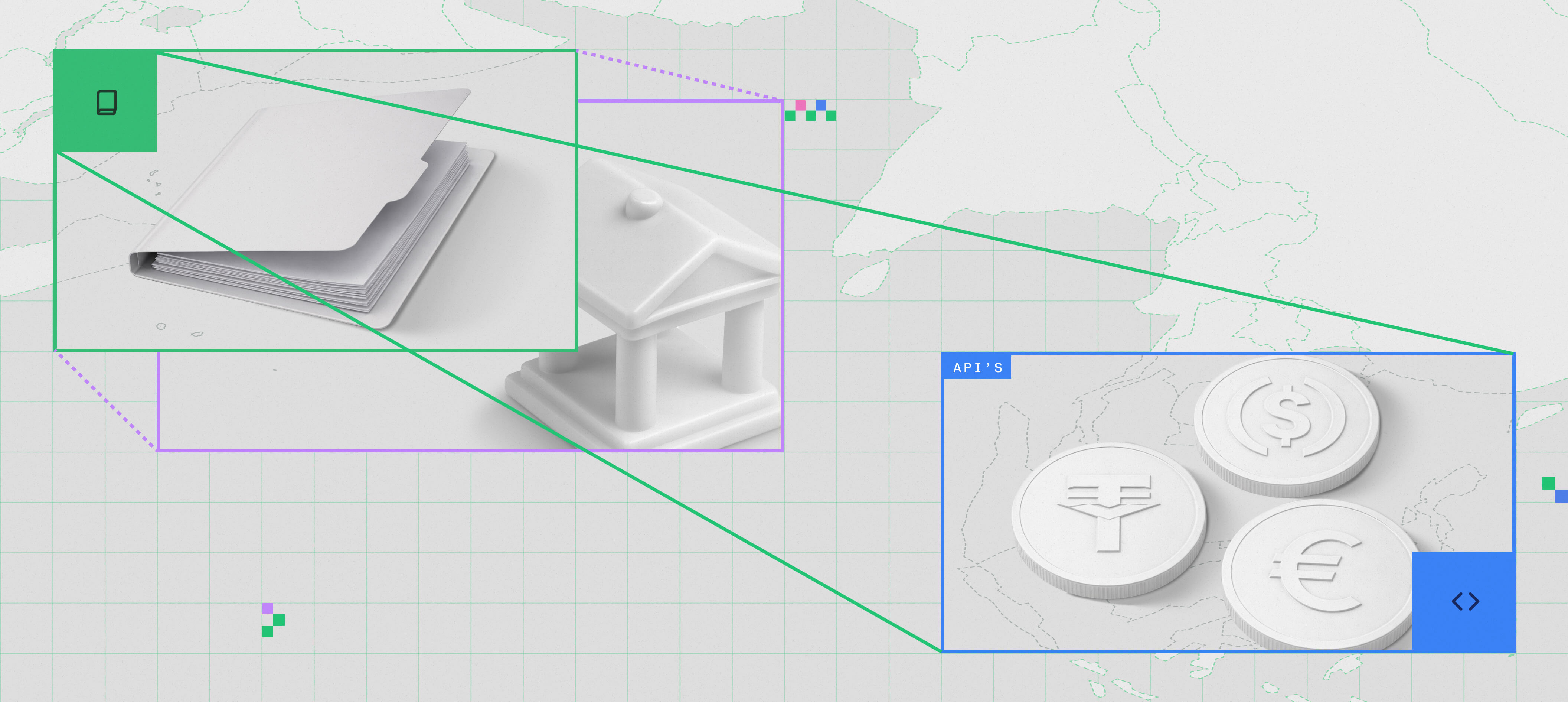
Rather than systems that merely digitize processes, APIs enable real-time, bidirectional communication between previously disconnected platforms. This is critical because treasury management isn’t just about transforming currencies; it’s about collating the information required to manage cashflow, then turning it into actionable insights. In short, APIs transform treasury infrastructure from a collection of digital filing cabinets into a living network.
Practically speaking, a treasury management system can query banking APIs every few minutes to retrieve real-time balance information across dozens of institutions and hundreds of accounts globally. When an invoice is approved, an API can automatically trigger payments through the appropriate bank, routed based on predefined rules. Foreign exchange rates can be retrieved in real-time from multiple sources, hedging strategies can be evaluated algorithmically, and trades can be executed automatically when conditions favor it.
Like blood pumping through the body, payments flow through APIs—from a company’s enterprise resource planning (ERP) system to the treasury platform, to the bank's payment gateway, through correspondent banking networks, accompanied by real-time status updates. What once took days and multiple handoffs now happens in seconds.
This connectivity extends beyond banking. Every API connection can transform data into actionable intelligence, monitoring everything from interest rates to commodity prices. They can integrate with procurement systems to forecast payment obligations, with sales systems to project receivables, with HR systems to anticipate payroll requirements, and so on.
The combination of APIs and stablecoins will take treasury management into a future where money finally moves like data, as opposed to gold bricks on a train.
The complexities of Agentic AI
An agentic AI with access to all treasury data through APIs could monitor cash positions continuously, generate sophisticated forecasts using machine learning, optimize investment decisions algorithmically, execute hedging strategies automatically, and flag anomalies for human review—24/7, without ever getting tired.
Sounds good! But don’t hit the go button yet; let’s consider some caveats.
Regulatory frameworks require human accountability for material financial decisions. This is because treasury management involves more than payroll; it involves managing shareholder assets and ensuring debts get paid. If something goes amiss, a CFO can’t credibly stand before her board and say, “Well, our AI decided that.”
By necessity, optimization in treasury management requires temperance. Imagine an AI suggests getting a loan because interest rates are favorable and forecasts reflect an imminent cash need. But the company is in acquisition negotiations, where demonstrating strong liquidity and minimal debt will strengthen its position. This kind of information is difficult to plug into an algorithm; it requires judgment off-paper, from someone aware of these relationships and the company’s strategic priorities.
Going back to the securities trading example, the presence of agentic AI doesn’t make the human commodity less valuable. Rather, it demands a collaborative perspective where powerful automated systems work alongside human oversight.
How treasury management could look tomorrow
Well, maybe not tomorrow. Let’s thought-experiment treasury management a decade on. The move from manual ledgers to stablecoin-enriched, API-connected operations is about more than “progress”; it’s about fundamentally reimagining how to manage financial risk and resources.
A treasurer starts the day reviewing a dashboard that updates continuously, thanks to APIs connected to banks worldwide, the ERP system, market data providers, and payment networks. Cash positions are accurate to the minute, not the previous day. An agentic AI has executed overnight sweeps to optimize positioning and flagged unusual transactions for review—one likely fraudulent (blocked automatically), two requiring judgment calls (presented for decision).
The forecasting model, trained on years of company data, reflects projected cash needs for the next 90 days with confidence intervals. It incorporates current sales pipeline data, adjusted for historical rates and payment patterns by customer segment; and factored in upcoming payroll, debt service, and seasonal patterns.
An urgent payment request comes in—a critical supplier needs payment today to ship components required for production tomorrow. This once triggered frantic calls to banks and speculations about whether that’s even possible. Now a stablecoin transfer settles it within the hour, and the funds appear in the supplier's wallet halfway around the world.
When month-end arrives, analysis that once consumed days happens automatically. APIs pull data from all sources, AI compiles figures for validation, and reports appear in the required formats for accounting, taxes, and regulatory filing.
APIs provide the connective infrastructure that makes this possible, transforming isolated systems into integrated networks where actions can be triggered programmatically, facilitated by data that simply flows, unimpeded but mindfully contained. Stablecoins and blockchain technologies offer new rails for moving value that complement traditional banking infrastructure, investing it with speed and transparency.
The ‘80s-style treasurer with a ledger, and the treasurer of tomorrow, are ultimately engaged in the same mission: ensuring their organization has the resources it needs when it needs them, while managing foreseeable risks. The key here is remembering that we’re still responsible for other people’s money. Instead of getting dazzled by the tools now at our disposal, it’s crucial to use them wisely and well.
Share article
Read other articles
Stay informed with our latest articles on currency launches, institutional FX trends, and global liquidity.