What It Takes To Win At Cross-Border Payments: The Story of our $94M Series A

OpenFX
In May 2025, we emerged from stealth at $8 billion in annualized payment volume. By February 2026, we'd crossed $45 billion.
Revenue grew 10x.
Our customers trust us. On average, activated clients move 3x their initial transaction volume within 90 days of onboarding.
By month six, it's 7x.
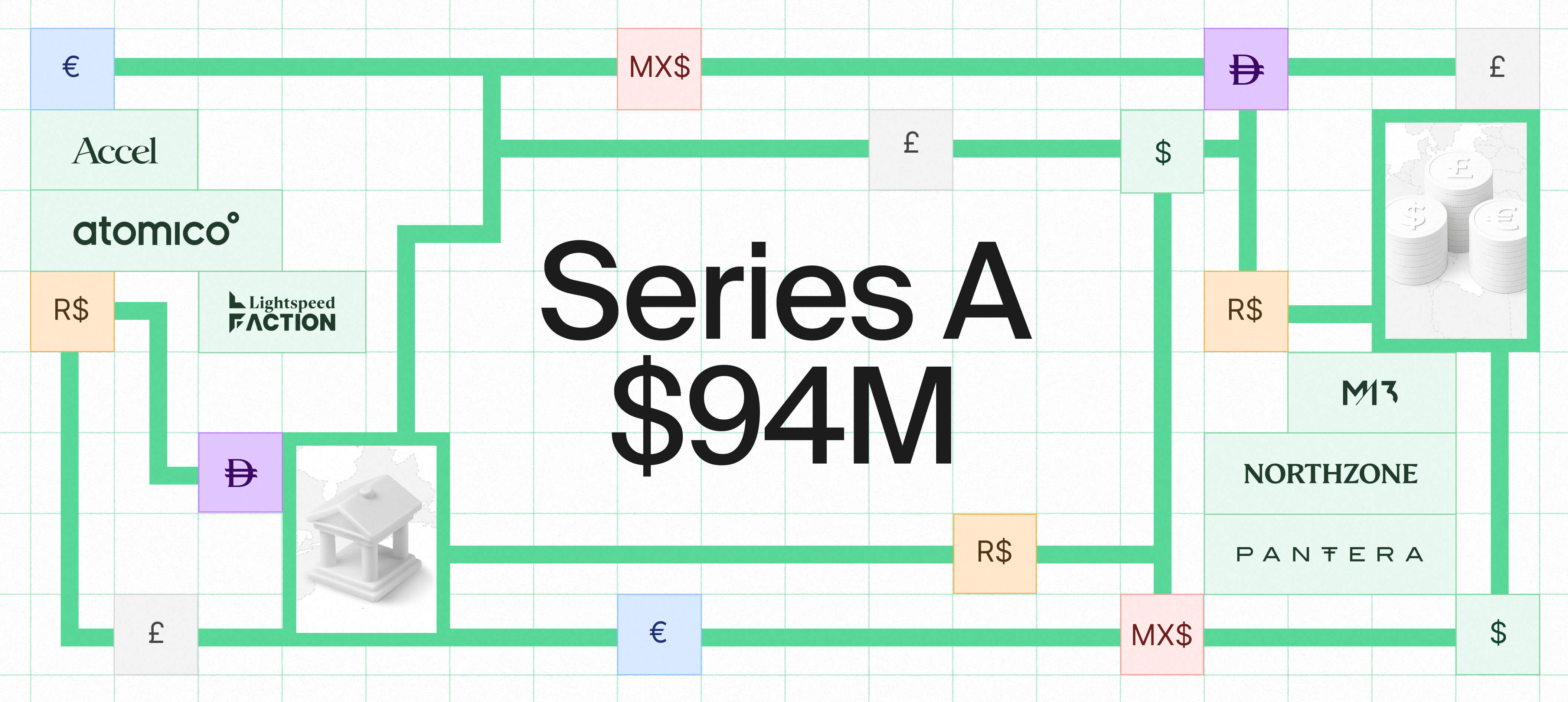
This week we announced that we have raised $94M in our Series A led by luminaries in traditional web2 and emerging web3 space: Accel, Atomico, Lightspeed Faction, M13, Northzone and Pantera.
None of this happened by accident, but because we made a bet eighteen months ago that turned out to be right.
What We Built
Cross-border payments break because domestic payment systems don't talk to each other. India's UPI processes nineteen billion transactions a month. Singapore's PayNow, Thailand's PromptPay, the Philippines' InstaPay – all are instant within their borders, but an “instant” transfer in Manila can still take days to reach Bangkok. The domestic systems are extraordinary, the connections between them are still a half-century old.
A similar story can be told in Latin America, MENA and all across the globe – high-speed domestic rails that fall apart when currency crosses borders.
What is necessary in all of these cases is connective tissue, infrastructure to provide liquidity that doesn’t rely on slow and expensive correspondent banking networks – programmable pipes that link one country's rails to another.
We built a platform that offers all of this on a technology that you might by now be familiar with.
Stablecoins and the Commodification of Payment Rails
The stablecoin payments industry spent 2024 and 2025 in a race to build faster rails. Everyone claimed "instant settlement," every product demo led with speed.
We knew that the industry was right and wrong. Stablecoins could help to bridge the fragmentary currency markets that plagued cross-border finance, but we thought their focus on the blockchain was too narrow: what happens when the “rails” are fast enough?
Moving USDC from one wallet to another now takes seconds, that infrastructure has already been commoditized. But a CFO in New York doesn't need stablecoins moved between wallets, she needs fifty million dollars of Brazilian reais delivered to a supplier's bank account before Monday.
The blockchain transfer is one step in that process – the smallest step.
We found that the true constraint was always **liquidity, and the operational capacity to deploy it end-to-end across the globe. If you can solve for liquidity, everything else follows: faster settlement, lower costs, reliable delivery regardless of scale. To accomplish this, we choose to turn our attention away from the blockchain and towards the entire lifecycle of the payment:
collecting fiat
screening for compliance
on-ramping to stablecoins
converting to local currency
navigating destination payment rails
delivering to a bank account
We wanted to make truly programmable treasury possible.
Expansion into LATAM
Latin America became the test.
We launched the Mexican peso, Brazilian real, and Argentine peso corridors in 2nd half of 2025. These aren't simple markets. Argentina is still suffering under extreme inflation. Brazil's regulatory system is complex, and banking relationships there can take years to establish. Mexico remittance volumes are enormous, but execution quality varies wildly across providers.
We chose these corridors because they're hard. If our thesis held under these sorts of pressures, we knew they would hold anywhere.
Within six weeks, LATAM became our highest-volume region. We had succeeded at scale where so many other players were still struggling with proof of concepts.
The growth wasn't driven by price competition or marketing spend, it came from a straightforward value proposition that treasury teams understood immediately: we could deliver liquidity globally as quickly and reliably as they could move it domestically.
Precisely what PSPs and remittance providers in the region needed, which we understood, because of the way we built our organization.
Built to Scale
The traditional cross-border payments market has been underperforming for decades, partly because the infrastructure was designed from a single vantage point.
The correspondent banking network was built outward from New York and London – hub and spoke, with the hubs deciding how the spokes should work. This kind of architecture always has blind spots. It doesn't understand why a Brazilian bank operates the way it does, or what happens when money lands on Philippine domestic rails. It doesn’t care either, as long as the “markets that matter” keep humming along.
We didn't want to repeat that mistake.
We have team members in Miami, London, Dubai, and Bangalore. Our regional heads are from the regions they serve. We don’t have a single HQ, we are distributed by design.
Payment systems break at local edges. You can't anticipate these failures from a headquarters ten thousand miles away.
We follow this same logic in selecting the investors we’re building this company alongside. Just as we want a organization that gathers the perspectives of experts across the globe, we want one that bridges the insights of investors in both the crypto and traditional finance worlds:
Pantera has been in crypto since Bitcoin was at $65.
Northzone backed Klarna before most people understood what a neobank was.
M13's Latif Peracha has spent years at the intersection between both, watching stablecoin infrastructure mature while traditional finance figured out what it meant.
Atomico's Niklas Zennström built Skype by replacing legacy telecom infrastructure. He recognizes the same play when he sees it.
We chose investors who can see beyond “crypto vs tradfi.” Stablecoins alone won't solve this problems. Banking relationships alone won't solve it. The answer requires both, rails that move at the speed of crypto, with the institutional depth and local integration that only comes from years of building trust with banks, regulators, and payment networks.
Expanding into Southeast Asia
If our LATAM results validated the thesis, Southeast Asia is where we codify it.
Asia presents a contradiction. The region contains some of the most advanced domestic payment systems on Earth: UPI, PayNow, PromptPay, InstaPay. It is a place where instant settlement within borders is essentially solved, but cross-border money movement as often still as slow as its always been because none of these systems speak to one another. The region remains fragmented, with dozens of different governments struggling to create protocols that will work together/
This is exactly the kind of problem we are built to solve. We're launching in Singapore, Hong Kong, and the Philippines. Different regulatory environments, all with the same underlying problem, the need for deep liquidity in corridors where existing infrastructure falls short.
Programmatic Treasury: The Road Ahead
There's a version of treasury operations that hasn't fully arrived yet, but we can see from here.
Today, moving fifty million dollars across borders means logging into Bloomberg, checking the spot rate, calling a relationship manager, negotiating a quote, confirming that quote, and waiting days while the transaction passes through correspondent chains. Humans making phone calls during office hours, traders sending money across the world from Telegram chats, infrastructure designed when fax machines were cutting edge.
That's changing. Treasury systems are becoming automated. Soon, they'll be agentic. When software is expected to manage cash flows at 3am on a Sunday, the APIs it calls on needs to be ready.
We're building for that future, where money moves as easily as a text message and “programmatic treasury” moves from buzzword to the fastest, most reliable way to move money across the globe.
Our $94M Raise
We raised this round to accelerate what's already working.
The capital will go toward deepening LATAM corridors, expanding into Southeast Asia, and continuing to build the regulatory infrastructure and regional expertise that make institutional-grade liquidity possible across the globe.
It will also help us build out our programmatic and agentic tools, empowering customers to grow their businesses faster and more efficiently.
The raise itself is less important than what it represents, it’s a massive vote of confidence that the thesis we made eighteen months ago about where this market was heading is correct. That trust we’ve built with our customers is not a fluke, but a sign that we are moving in the right direction.
For a deeper look at where OpenFX started and what we believe the global financial system could look like in ten years, read the Founder Letter.
Share article
Read other articles
Stay informed with our latest articles on currency launches, institutional FX trends, and global liquidity.