Anatomy of Cross-Border Payments: The Iceberg Model

Harrison Mann
,
Head of Growth
In our last article we laid out how cross-border payments have traditionally functioned – slowly and inefficiently. Every transaction is forced through a gauntlet of complex and expensive intermediaries, a process made even more onerous in emerging economies.
Left partially unsaid in that article is the “answer” that the industry has come to in recent years – stablecoins.
Stablecoins, the technology that underpins our own value transfer model, allow institutions to bypass the correspondent banking network, and move money across the globe faster and more cheaply.
They offer real answers to emerging markets that had been traditionally undeserved by traditional banking, and we believe that they are critically important to the future of modern finance.
We also think they are only one, somewhat incidental part of a much more complex mechanism.
The Iceberg Model: End-to-End Delivery
Every provider in the stablecoin payments industry today is marketing the same three things:
Instant settlement
24/7 availability
Transaction fees in the pennies
These claims are, in a sense, accurate, but each measures something very specific and very narrow – the cost in time and capital to transfer value from one wallet on the blockchain to another.
But a cross-border payment isn't a blockchain transfer.
A CFO in New York sends $50M to a supplier in Bogota. She doesn't need stablecoins moved between wallets, she needs dollars converted to pesos and delivered to a bank account before Monday morning. The blockchain transfer is one step in that process, but it’s not the process.
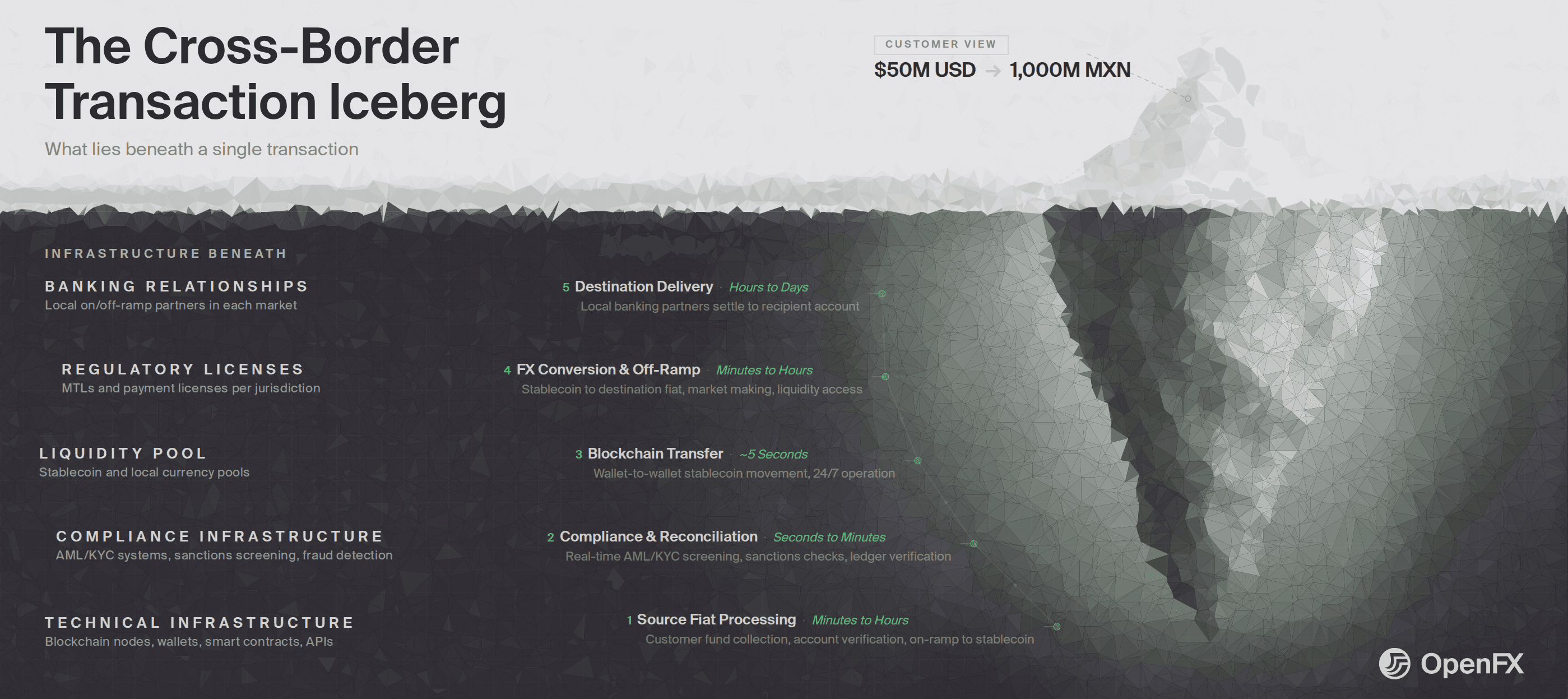
When you think of payments in terms of the actual end-to-end delivery, you realize that cross-border payments is an iceberg and most of the action is happening “beneath the surface.”
Above the Surface: The Visible Layer
Back to our CFO trying to move $50 million to Bogota. Just telling her that the blockchain transfer can be completed in a handful of seconds is ultimately immaterial. What she wants to know is:
How long will it take for that money to hit her supplier's account?
What happens if something goes wrong?
Does the provider have enough available liquidity to complete this same transaction once a month without fail?
These are questions of operations and infrastructure, the portions of end-to-end delivery that sit beneath the surface of our iceberg.
When these pieces are in place and running smoothly, our CEO can move money across the globe as easily as ordering a rideshare. When they are not, no amount of blockchain boosterism is going to help her.
To understand this, let's dive a little deeper.
Below the Surface: The Operations Layer
When our CFO initiates that $50M payment, five distinct steps execute:
Step 1: Source Fiat Processing
Her dollars sit in a US bank account. The provider needs to collect $50M, verify the funds, and convert them to USDC. This means moving money through US banking infrastructure, clearing through domestic payment rails, and on-ramping to stablecoins. The provider's banking relationships in the US determine how smoothly this happens. Best case: minutes. Typical case: hours.
Step 2: Compliance Screening
Before any blockchain transfer, the transaction gets screened. AML checks, KYC verification, sanctions list matching, fraud pattern detection. For a $50M transaction between corporate entities, automated systems handle this in seconds. But edge cases – unusual transaction patterns, first-time counterparties, high-risk jurisdictions – trigger manual review. That can take minutes to hours.
Step 3: Blockchain Transfer
USDC moves from the provider's wallet to their Colombian operations wallet. This is the marketed step: 5 seconds, 24/7, globally. It's also less than 1% of total transaction time.
Step 4: FX Conversion and Off-Ramp
USDC needs to become Colombian pesos. The provider accesses liquidity pools, executes trades with market makers, and converts stablecoins back to fiat. For $50M, execution quality matters. Thin liquidity means slippage. Weak market maker relationships mean delays. Deep pools and strong partnerships can mean the difference between minutes and hours in total settlement time and many basis points in price.
Step 5: Destination Delivery
Pesos moves through Colombia's payment infrastructure – PSE, in this case – into the supplier's bank account. This requires local banking partnerships in Colombia. The provider needs accounts at Colombian banks, relationships with local clearing systems, and integration with domestic payment rails. Settlement time depends on the corridor and local infrastructure. Hours to days.
Total timeline: The 5-second blockchain transfer sits in the middle of a process that can take between minutes and days depending on the skill of the operator. Everything before (collecting dollars, screening) and everything after (executing FX, delivering reais) determines whether our CFO's payment succeeds and how quickly.
Before we can even think about that, we need the infrastructure to make the transaction at all.
Deeper Still: The Infrastructure Layer
That operations timeline only runs if foundational infrastructure exists. Before processing a single transaction, providers need:
Banking Relationships
Moving dollars in the US requires US banking partners. Delivering pesos in Colombia requires Colombian banking partners. These aren't correspondent banks – blockchain replaces that layer. These are direct relationships for fiat on-ramps and off-ramps.
Each corridor needs separate banking infrastructure. You can't serve Colombia without Colombian bank accounts, relationships with local clearing systems, and partnerships with institutions that will convert USDC to pesos. Building these relationships takes months per market. A provider either spent years establishing global banking partnerships, or they're limited to a handful of corridors.
Regulatory Licenses
Operating in Colombia requires payment licenses from Colombian regulators. Operating in the US requires money transmitter licenses in 50+ states. Each jurisdiction has distinct requirements. Each license application takes 12-24 months. Some require local presence, physical offices, or local executives.
You can't process payments in markets where you lack regulatory approval. Global coverage – the ability to serve arbitrary corridors on demand – can require years of sustained regulatory work across dozens of jurisdictions.
Liquidity Pools
Delivering $50M in pesos requires having $50M in pesos available. Or having enough USDC to convert, plus access to deep enough COP liquidity pools that the conversion doesn't move the market.
Providers maintain pre-funded pools across currency pairs. USDC reserves for blockchain transfers. Local currency reserves for off-ramping in each market. Supporting global corridors means maintaining liquidity in dozens of currencies simultaneously, with hedging strategies to manage FX exposure.
Compliance Infrastructure
Screening transactions in real-time at scale requires infrastructure: AML/KYC automation systems, sanctions databases that update continuously, fraud detection algorithms, and compliance teams for manual review escalations.
This infrastructure must handle both the automated path (seconds) and the exception path (minutes to hours) without creating bottlenecks. A $50M transaction can't wait in the queue because the compliance system can't scale.
Technical Infrastructure
Blockchain nodes, wallet management systems, smart contracts, APIs for treasury system integration, and technical connections to banking partners in each market. These are the systems that power the bridge between blockchain and fiat.
Timeline to build all of this: 2-3 years minimum for global coverage. You can't shortcut it. Adding a new corridor requires months of work establishing banking relationships, obtaining regulatory licenses, deploying liquidity, and building technical integrations specific to that market.
What Sits Beneath the Surface
Now that we’ve seen what is actually required to offer end-to-end delivery across the globe, it’s clear why so many providers prefer to stick to marketing the visible surface. The real story is far more complex and far more difficult to sell into.
However, that position is becoming increasingly untenable. The blockchain layer has commoditized. Anyone can quote “5-second” settlements because everyone's operating on the same rails.
Going forward, what will differentiate providers is operational acumen: the breadth of banking relationships, the scope of regulatory coverage, the depth and quality of their liquidity, alongside the robustness of their foundational infrastructure.
These capabilities may be more difficult to describe, but they are key to providing reliable cross-border payments across the globe.
When evaluating providers, knowing their blockchain metrics won't help you. Ask about what sits beneath the surface:
What banking relationships do you have in our specific corridors?
Who are your on-ramp and off-ramp partners in the markets we operate in?
What's your end-to-end settlement time in our corridors at our transaction sizes?
Walk us through a $50M transaction from initiation to final delivery.
How do you handle failures?
What's your incident response process?
How will we know if something needs attention?
What's your liquidity depth?
Can you execute our volume consistently without degradation in execution quality?
These questions force the provider to reveal their operational maturity. The answers determine whether a provider is built for end-to-end delivery, or just building a payment system on blockchain infrastructure.
Share article
Read other articles
Stay informed with our latest articles on currency launches, institutional FX trends, and global liquidity.