Report • Q1 2026

Stablecoins &
Cross-Border Payments

Analysis of 600+ de-pegging events, a breakdown of the $10T liquidity prize, and a 4-region comparative framework.

Summary

In 2019, the entire stablecoin market was worth less than $2 billion. By 2024, transaction volume reached $27.6 trillion, more than Visa and Mastercard processed combined. Market capitalization crossed $300 billion.

90% of financial institutions reported taking some action in the market: Planning, pilots, live deployments. Regulatory frameworks that stalled for years became law across the G7. Bank of America's CEO declared entry into stablecoins a matter of "when, not if."

The headlines write themselves: "A new era in cross-border payments is upon us."

And yet.

Stablecoins remain just 1% of global payment flows, the same share reported in 2023 and 2024, stubbornly unchanged despite explosive growth in absolute terms. When Visa executives were asked to rate institutional adoption on a scale of 1 to 10, the answer came back 0.5. 86% of firms report their infrastructure is "ready," but almost none have deployed stablecoins at scale.

So, are stablecoins the most important evolution in cross-border payments since SWIFT or are they a quirky footnote?

Both narratives are true. The revolution and the stasis. Understanding cross-border payments in 2025 requires holding both of these ideas simultaneously.
In 2019, the entire stablecoin market was worth less than $2 billion. By 2024, transaction volume reached $27.6 trillion, more than Visa and Mastercard processed combined. Market capitalization crossed $300 billion.

90% of financial institutions reported taking some action in the market: Planning, pilots, live deployments. Regulatory frameworks that stalled for years became law across the G7. Bank of America's CEO declared entry into stablecoins a matter of "when, not if."

The headlines write themselves: "A new era in cross-border payments is upon us."

And yet.

Stablecoins remain just 1% of global payment flows, the same share reported in 2023 and 2024, stubbornly unchanged despite explosive growth in absolute terms. When Visa executives were asked to rate institutional adoption on a scale of 1 to 10, the answer came back 0.5. 86% of firms report their infrastructure is "ready," but almost none have deployed stablecoins at scale.

So, are stablecoins the most important evolution in cross-border payments since SWIFT or are they a quirky footnote?

Both narratives are true. The revolution and the stasis. Understanding cross-border payments in 2025 requires holding both of these ideas simultaneously.

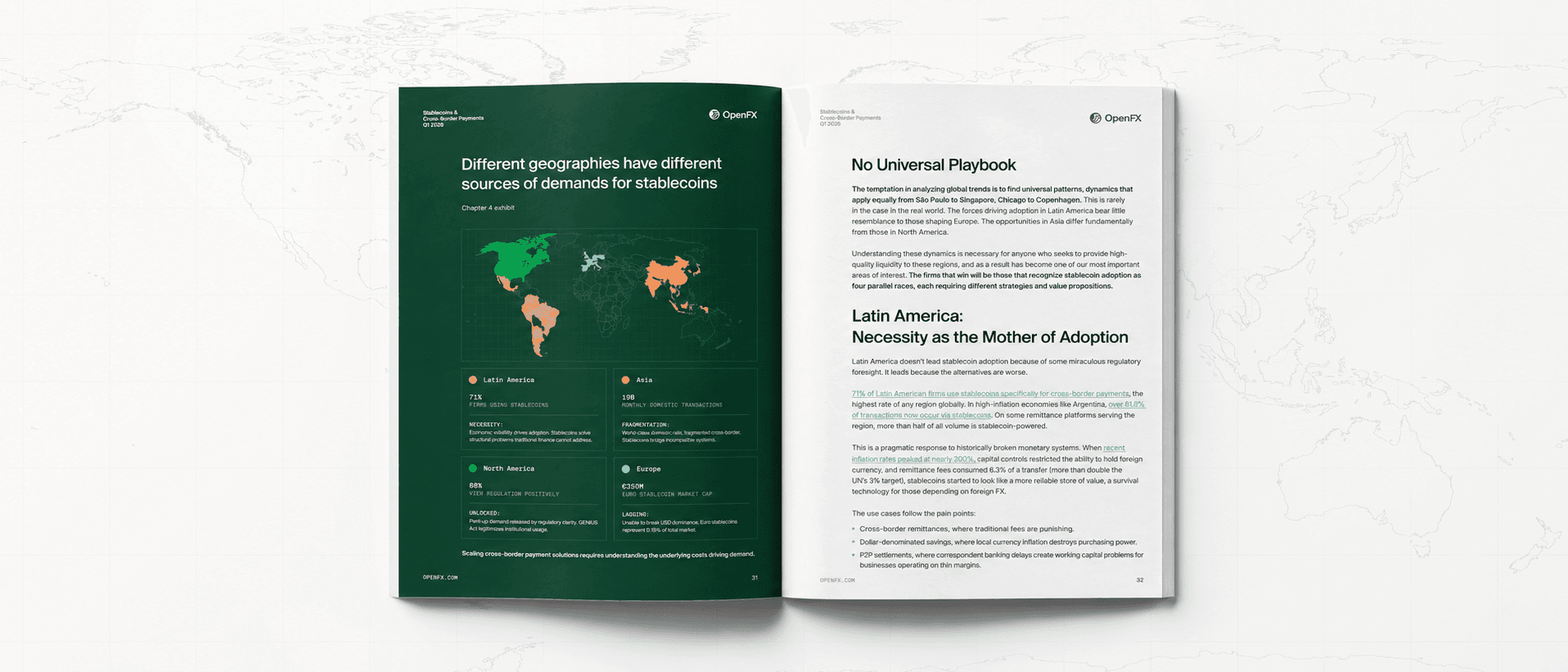
Spread of the Stablecoins and Cross-Border Payments Report, published in Q1 2026 showcasing a map of the world divided by regions and describing the diffrent use cases for stablecoins in each.

What You'll Find Inside

This report is not an argument for stablecoin enthusiasm or skepticism. It is an attempt to see the market clearly, to distinguish what we know from what we don't going into 2026, and what we might be able to predict from that data.

This report is not an argument for stablecoin enthusiasm or skepticism. It is an attempt to see the market clearly, to distinguish what we know from what we don't going into 2026, and what we might be able to predict from that data.

We've structured this analysis into six themes:

We've structured this analysis into six themes:

Chapter 1

Convergence

We examine 2025 as an inflection point for stablecoins, where improving financial infrastructure and regulatory clarity around crypto meets a market increasingly hungry for fast settling, highly liquid cross-border payments.

Chapter 2

The Paradox of Scale

We interrogate the gap between stablecointransaction volumes and actual market share,revealing why infrastructure (not technology)is the binding constraint.

Chapter 3

Incumbents Respond

How traditional players are absorbing thesenew technologies. SWIFT connecting toblockchain networks, Visa integrating stablecoin settlement. The story of adaptation,not displacement.

Chapter 4

The Four Regional Races

The distinct dynamics shaping Latin America,Asia, North America, and Europe. Manyparallel races, not one overarching globaltrend.

Chapter 5

The Dollar Flywheel

The self-reinforcing dominance of USDstablecoins (99% of market value) and itsimplications for monetary sovereignty and theemerging crypto-Eurodollar system.

Conclusion

The Counter-Visions

We engage seriously with the strongestcritiques. Six hundred de-pegging events intwo years suggest real vulnerabilities that willshape adoption speed.

Stablecoin Transactions Total Trillions, but Remain 1% of Global Payment Flows

Our Point of View

The infrastructure gap matters more than the technology gap. Stablecoins solved the technical problem of "fast settlement"; the blockchain is great at moving money in seconds. On- and off- ramping, compliance checks, and reconciliation aren't as easy to crack. Moving money quickly requires improvements in the regulatory and operational infrastructure driving cross-border transactions.

The infrastructure gap matters more than the technology gap. Stablecoins solved the technical problem of "fast settlement"; the blockchain is great at moving money in seconds. On- and off- ramping, compliance checks, and reconciliation aren't as easy to crack. Moving money quickly requires improvements in the regulatory and operational infrastructure driving cross-border transactions.

Speed has overtaken cost as the primary value proposition. The industry pitched cheaper payments, institutional buyers want faster and more reliable payments: 24/7 operations, instant liquidity, knowing where their money is at every step of the process. The $10 trillion frozen in pre-funded accounts globally represents a larger prize than transaction fee reduction.

Speed has overtaken cost as the primary value proposition. The industry pitched cheaper payments, institutional buyers want faster and more reliable payments: 24/7 operations, instant liquidity, knowing where their money is at every step of the process. The $10 trillion frozen in pre-funded accounts globally represents a larger prize than transaction fee reduction.

Incumbents are competing by absorbing change, not resisting it. SWIFT, Visa, and major banks are adopting blockchain infrastructure while competing on advantages (primarily trust and regulatory compliance) that challengers struggle to replicate. The disruption narrative has given way to a hybrid model.

Incumbents are competing by absorbing change, not resisting it. SWIFT, Visa, and major banks are adopting blockchain infrastructure while competing on advantages (primarily trust and regulatory compliance) that challengers struggle to replicate. The disruption narrative has given way to a hybrid model.

Regional context determines everything. Latin America's necessity-driven adoption differs fundamentally from the North American "institutional-readiness" dynamic and the fragmentation story seen in Asia. There are many parallel races, not one overarching global trend.

Regional context determines everything. Latin America's necessity-driven adoption differs fundamentally from the North American "institutional-readiness" dynamic and the fragmentation story seen in Asia. There are many parallel races, not one overarching global trend.

Dollar dominance is structural and sticky. USD concentration in stablecoins reflects self-reinforcing forces that compound over time rather than diminish. Strategies premised on multi-currency diversification face persistent headwinds.

Dollar dominance is structural and sticky. USD concentration in stablecoins reflects self-reinforcing forces that compound over time rather than diminish. Strategies premised on multi-currency diversification face persistent headwinds.

Counter-visions deserve weight. To push the industry forward, we must take critiques seriously, particularly concerns about de-pegging and security. These are substantive challenges that will shape how far and how fast stablecoin adoption can proceed.

Counter-visions deserve weight. To push the industry forward, we must take critiques seriously, particularly concerns about de-pegging and security. These are substantive challenges that will shape how far and how fast stablecoin adoption can proceed.

Cover of the Stablecoins and Cross-Border Payments Report, published in Q1 2026 by OpenFX

Get the Report

Report • Q1 2026

Report • Q1 2026

Stablecoins &
Cross-Border Payments

Stablecoins &
Cross-Border Payments

Analysis of 600+ de-pegging events, a breakdown of the $10T liquidity prize, and a 4-region comparative framework.

Analysis of 600+ de-pegging events, a breakdown of the $10T liquidity prize, and a 4-region comparative framework.

Get the Report

Ask AI about OpenFX

Global network

Teams operating across North America, Europe, Middle East, and Asia

Operating Hours

We never close. Our platform and
support teams are available 24/7/365

Write to us

Red Envelope Delta, Inc, NMLS ID No. 2680829
All rights reserved, © OpenFX 2026.

Ask AI about OpenFX

Global network

Teams operating across North America, Europe, Middle East, and Asia

Operating Hours

We never close. Our platform and support teams are available 24/7/365

Write to us

Red Envelope Delta, Inc, NMLS ID No. 2680829
All rights reserved, © OpenFX 2026.

Ask AI about OpenFX

Global network

Teams operating across North America, Europe, Middle East, and Asia

Operating Hours

We never close. Our platform
and support teams are available 24/7/365

Write to us

Red Envelope Delta, Inc, NMLS ID No. 2680829
All rights reserved, © OpenFX 2026.