Which Building Holds in an Earthquake? High vs. Low Quality Liquidity: A Stability Story

Harrison Mann
,
Head of Growth
Two office towers go up next to each other. Same height, same architectural plans, same stated specifications. Both contractors claim they used "high-grade steel" and "premium concrete." Both buildings pass inspection.
Then an earthquake hits.
One building absorbs the shock and stands firm. The other develops cracks in the foundation; windows shatter, structural supports buckle. The blueprints looked identical. The materials were supposedly equivalent. But when stress hit the system, the difference between what was specified and what was actually delivered became catastrophically clear.
FX liquidity works the same way. Every liquidity provider claims to have "deep liquidity" and "competitive pricing." But when markets shift underfoot, the difference between what was advertised and what gets delivered becomes crucial.
Not all liquidity is created equal. And in FX markets, the gap between high- and low-quality liquidity isn't just semantic. It's the difference between a trade that executes at the price you saw, and one that ... doesn't.
What makes liquidity “high quality”?
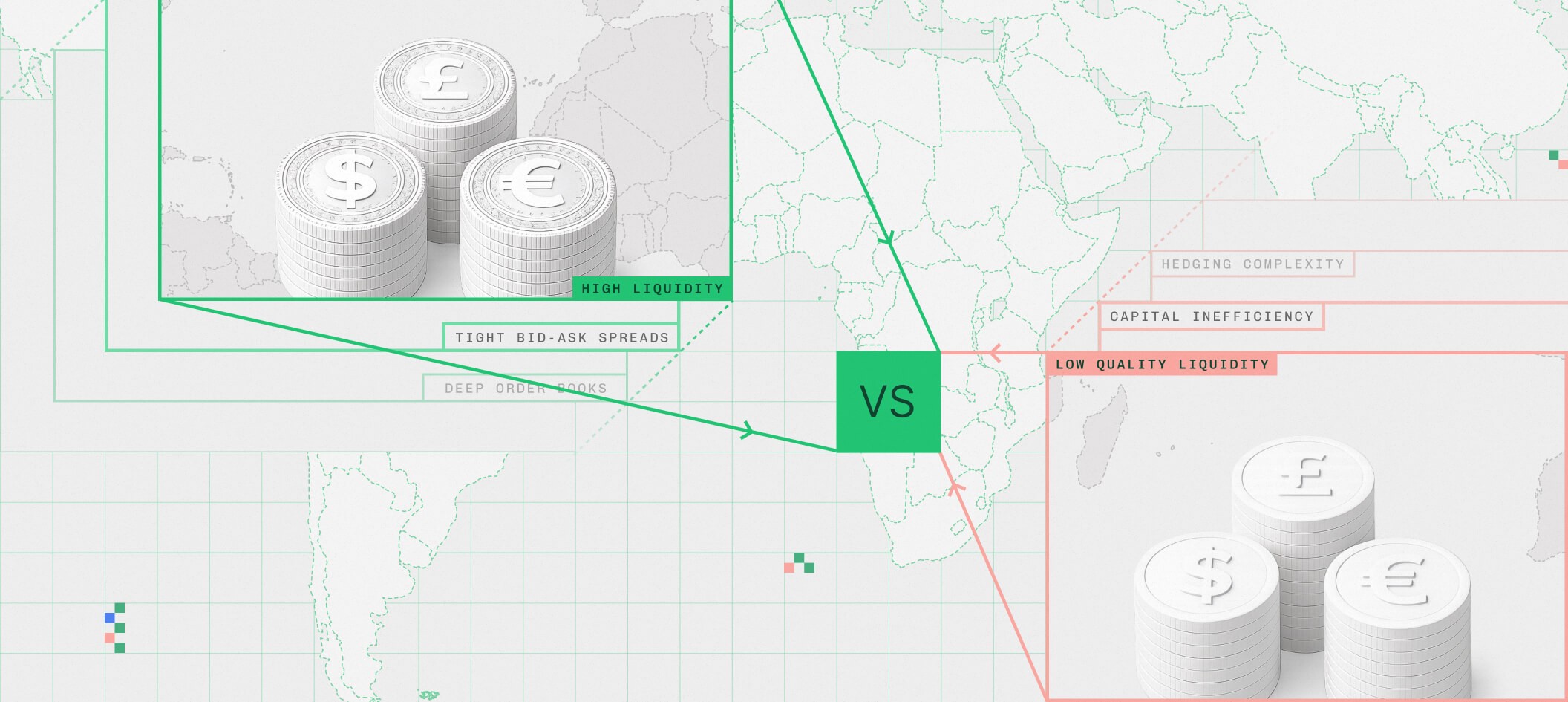
High-quality liquidity has three defining characteristics.
Tight bid-ask spreads are about ensuring that the difference between what you can buy at (the ask) and what you can sell at (the bid) stays narrow. For major FX pairs like EUR/USD, spreads in liquid markets can be as low as one pip (0.0001) or even tighter. Research from the Bank for International Settlements shows bid-ask spreads are amongst the most reliable measures of market liquidity. Narrow spreads signal that market makers can confidently quote prices close together, because there's genuine depth on both sides of the book.
Deep order books mean there's substantial volume available at or near the quoted price. You're not just looking at a single layer of liquidity that evaporates the second you place a large order. High-quality liquidity can absorb size without significant price slippage. The New York Fed's research on Treasury market liquidity uses order book depth as a core metric precisely because it reveals whether liquidity is real or superficial.
Reliable execution under stress is where the quality gap becomes obvious. During periods of volatility—think major central bank announcements, geopolitical shocks, or sudden risk-off moves—high-quality liquidity maintains its characteristics. Spreads might widen somewhat, but they don't go surge price-crazy à la Uber in a snowstorm. Orders still fill at or near the quoted price.
To return to our construction metaphor: High-quality liquidity is the building where the steel and concrete specs weren't just on paper—they were delivered, properly installed, and engineered to handle stress. When an earthquake hits, the building performs as designed. Low-quality liquidity is the one where contractors cut corners and substituted cheaper materials, then hoped nobody would notice.
For a while, maybe nobody does. Then the ground starts shaking and the structure can’t handle the load.
The difference between quoted liquidity and true liquidity
Just because a liquidity provider quotes tight spreads doesn't mean you'll actually trade at those spreads.
The effective spread—what you pay after accounting for slippage, rejections, and price improvements—can differ substantially from the quoted spread. Academic research on bid-ask spreads distinguishes between quoted spreads (what's posted) and effective spreads (what's realized). Effective spreads are considered a better measure of true trading costs because they reflect what happened, not what was advertised.
In low-quality liquidity environments, several things can go wrong between seeing a price and executing at that price:
Last-look rejections. You click to trade at the quoted price and the trade gets rejected. The liquidity provider sees your order, decides they don't want to take the other side, and declines it. You're sent back to the market to try again, often at a worse price. High rejection rates are a hallmark of low-quality liquidity.
Slippage. The price you see isn't the price you get. You try buying EUR/USD at 1.0850, but your order fills at 1.0852. In thin markets or with low-quality providers, this slippage can become substantial, especially on larger orders.
Sudden spread widening. The moment you go to trade, a spread that was 1 pip suddenly becomes 5 or 10 pips—or in extreme cases, 50+ pips. This is particularly common during news releases or in exotic currency pairs, where underlying liquidity is genuinely thin.
Fill-or-kill dynamics. Your order either executes in full or not at all, with no partial fills. This is often a sign that the liquidity provider doesn't have the depth they claim; they can't accommodate your size across different price levels.
In contrast, high-quality liquidity providers maintain spread consistency, minimize rejections, and can absorb size without dramatic price impact. When you trade, what you see is closer to what you get.
How stress tests reveal liquidity quality
The real test of liquidity quality is stress. Anyone can provide tight spreads when markets are calm and orderly. High-quality liquidity proves itself when the unexpected happens.
During the March 2020 COVID shock, research from the New York Fed documented massive widening of bid-ask spreads, even in typically liquid markets like US Treasuries. Effective spreads in the S&P 500 spiked to around 20 basis points from normal levels of just a few basis points. FX markets saw similar dynamics, with spreads in even major pairs widening dramatically as volatility surged.
What separated high-quality from low-quality liquidity during that period wasn't whether spreads widened—they did everywhere—but how much they widened and how quickly they normalized.
High-quality liquidity providers widened spreads proportionately to volatility but kept them relatively predictable. They maintained execution reliability even as volumes surged, and recovered fast after the initial shock (which in this exceptional situation, was days, or a couple of weeks max).
Low-quality liquidity providers, on the other hand? Spreads blew out to 10x or 20x normal levels. There were frequent rejections, or price quoting simply stopped. It took until late April to return to normal operations.
In exotic currency pairs or less liquid corridors, the stress test is even more revealing. When a developing market faces a sudden devaluation or capital control measures, does your liquidity provider still quote prices? More importantly, can you actually execute at those prices? …or do you discover that the "deep liquidity" was only available when need was scarce?
The hidden price of low-quality liquidity
The true costs of low-quality liquidity extend beyond wide spreads. They compound, creating operational drag that's often invisible until it's too late, like the structural integrity of the shoddier building.
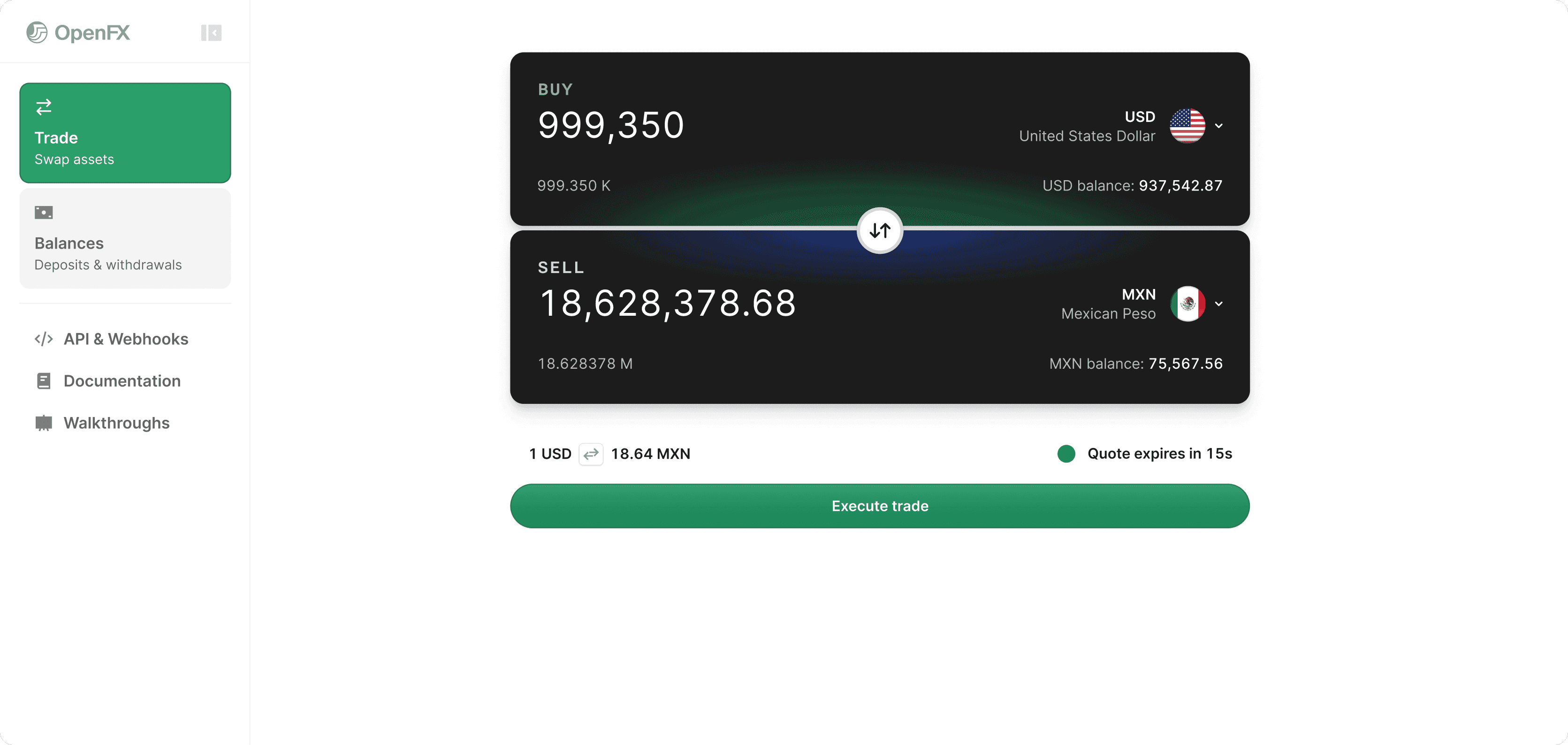
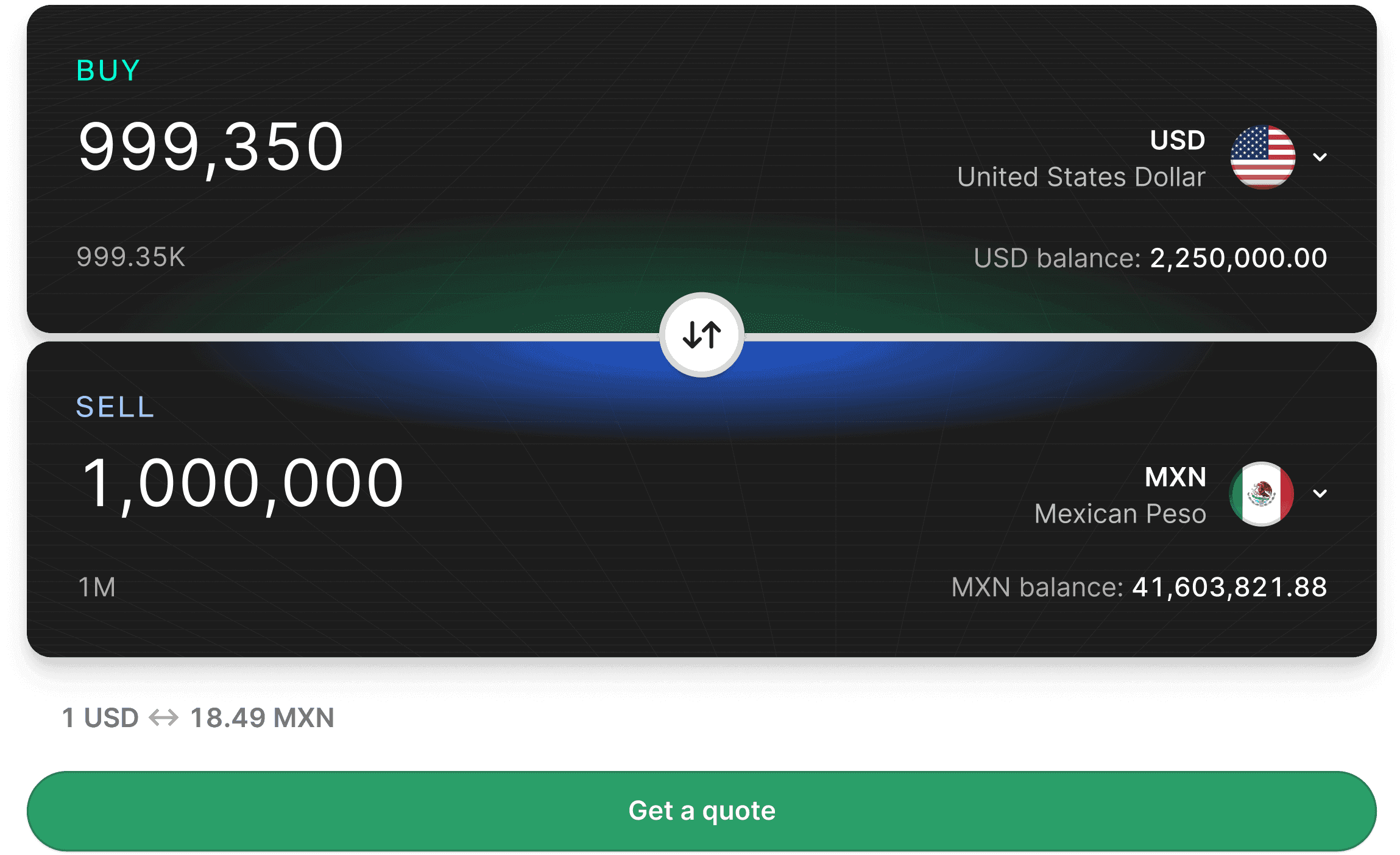
Working capital inefficiency: When you can't reliably execute FX trades at the prices you need, you're forced to hold larger currency buffers. That's capital at rest instead of being deployed productively. A business that needs to convert $10M USD to MXN but can't trust execution quality might keep an extra $500K in buffer funds—an opportunity cost.
Hedging complexity: If you can't trust your liquidity provider to execute consistently, you need more elaborate hedging strategies. That means more trades, more counterparties, more operational overhead. You're building redundancy to protect against a provider you're already paying.
Settlement risk: Low-quality liquidity often comes with slower settlement times. Legacy providers operating on correspondent banking rails can take 2-7 days to settle even straightforward transactions. During that window, currency movements erode value. For businesses operating in volatile currencies, the settlement devaluation risk is substantial.
In a 2-day settlement window on a $10M USD to MXN conversion, a 3% currency swing represents $300K in exposure. With sub-60-minute settlement, that exposure drops to under $10K. That's $290K in risk that simply evaporates with better settlement speed—a characteristic of high-quality liquidity infrastructure.
Operational overhead: When liquidity is unreliable, you need management: Treasury teams monitoring float risk across time zones, FP&A resources forecasting cash availability days in advance, reconciliation processes spanning multiple days and systems. One of our customers reported eliminating an entire treasury headcount dedicated to managing float volatility across 7 currency pairs after switching to higher-quality liquidity with faster settlement.
When customers start calculating value in headcount rather than basis points, you've moved from a cost discussion to an infrastructure discussion.
Structure matters more than price
This brings us to the fundamental insight: Liquidity quality is structural, not operational.
You can't take a low-quality liquidity provider and make them high-quality through better operations. The architecture matters. If your FX provider is built on correspondent banking rails with batch processing and multi-bank intermediation, there's a ceiling on how fast and reliable execution can be. To substantially improve settlement speed and execution quality on legacy infrastructure, you'd have to rebuild it from the ground up—banking relationships, compliance workflows, treasury operations, risk systems.
High-quality liquidity is engineered for speed and reliability from the get-go. That's why we, for example, can process $100M+ volume days with the same settlement speed as $100K transactions—architecture scales horizontally without degrading performance.
Legacy providers slow under load because their architecture requires countless instances of human intervention.
Calculating true costs
People often assume high-quality liquidity costs more. But that's conflating different kinds of costs.
High-quality liquidity providers generally have different pricing structures than low-quality ones. A tier-one bank might quote tighter spreads on EUR/USD than a regional broker—but require larger minimum transaction sizes or relationship deposits. A provider offering sub-60-minute settlement might have similar or even lower headline fees than legacy providers—but you're getting fundamentally different infrastructure.
The real cost difference isn't in the spread or the fee. It's in everything else.
Low-quality liquidity imposes hidden costs that don't show up on the invoice: Working capital locked in float, treasury headcount managing settlement risk, hedging complexity to protect against execution uncertainty, opportunity cost from slower settlement. As shown earlier, one customer eliminated an entire treasury headcount after switching providers—the ROI wasn't in the pricing, it was in labor.
When you calculate total cost of ownership—working capital efficiency, reduced hedging complexity, faster settlement, lower rejection rates, eliminated operational overhead—high-quality liquidity often costs substantially less than its low-quality alternative.
It's just that the savings appear in different budget lines than the costs. The FX fee might be comparable or slightly higher, but you're removing local potentials for error, reducing working capital requirements, and eliminating settlement risk exposure.
The question isn't whether high-quality liquidity is more expensive on paper. Instead, it’s whether you're willing to invest resources in structural integrity for when you actually need it … or whether you'll discover during a crisis that your "high-grade steel" was just regular steel with better marketing—leaving you to pay more in the chaotic aftermath.
Share article
Read other articles
Stay informed with our latest articles on currency launches, institutional FX trends, and global liquidity.