Cross-Border FX Primer: How Money Really Moves Around The World

Harrison Mann
,
Head of Growth

Let's say an American company in Ohio wants to move $10M to Stuttgart, Germany.
Someone in accounts payable opens their banking portal, enters the transaction details and clicks send. A reference number appears, and as far as they are concerned the money is on its way.
But what does "on its way" mean?
The important thing to recognize is that the physical currency in the company's account never leaves Ohio. Those dollars will not be flown anywhere, and will never touch German soil.
What will eventually arrive are euros that were already sitting in Europe before the payment started. Getting those euros the last few feet into the supplier's account could take as little as minutes, but in the worst case, it might take the better part of days.
This is because to "arrive," they must first be processed through an arcane sequence of messages, regulatory checks, and pre-funded institutions.
A pretty complex story that begins inside of the Ohio company's bank.
A Decades Old Messaging System Named SWIFT
When a payment is submitted, the originating bank must first debit the company's dollar account. The bank's system records the event, and the company's account balance goes down accordingly. The dollars themselves go nowhere, they become the bank's, recorded now as an obligation it carries.
The bank's next move is to send a message. That message travels over SWIFT, a cooperative owned by the banks themselves, which despite sitting at the center of every cross-border story moves no funds whatsoever, this is probably the most commonly misunderstood part of cross-border FX. All SWIFT does, all SWIFT can do, is carry instructions.
The particular instruction that leaves Ohio is, in the old shorthand, a MT103: pay this beneficiary, this amount, with these details (we'll discuss this more later, things have changed). That sentence is the only thing that actually crosses the border.
And once it does, things can and often do start to become more complicated.
Nostros, Vostros and the Correspondent Banking System
The Ohio bank that made the SWIFT request keeps no euros in Germany, and has no direct line to the supplier's bank, smaller institutions rarely do. To deliver the euros it hands the payment up to a larger bank that does, referred to as a correspondent, one that maintains euro accounts in Europe and a standing relationship with the German side of the transaction.
That euro account is where the supplier's money comes from. On the correspondent bank's books the account is called a nostro, banker's Latin for ours: our money, held at your bank.
From the German bank's perspective, the same account is a vostro, yours. The euros that will be paid to the supplier were sitting in that pre-funded account before anyone in Ohio touched a keyboard. What has crossed from America is permission to release them. The squaring-up between the banks will happen after the fact.
So this already seems a little strange. A bank in Europe must hold potentially billions of Euros just in case someone in Ohio or Bogota or Tokyo requests them, and must maintain these balances because requests like this come in constantly.
This arrangement must be repeated across every currency a bank wants to be able to pay in. Knowing this, the resting state of the correspondent banking system comes into view: enormous sums in aggregate, trillions by most estimates, sitting pre-positioned in accounts around the world, earning next to nothing, waiting their turn to be sent on their way. The cost of all that idle capital is folded into the price the bank charges for this service.
But this begs the question, what happens if the individual bank does not have enough available liquidity (see: money) to move a transaction of the size requested?
The short answer is that the bank has to find the money, and none of the ways of finding it come free. Sometimes the bank simply waits for the money to trickle in, and the transaction sits in the queue until the balance is there. In this case, a request that could have taken seconds might extend to over a day. If waiting is not an option, the shortfall gets borrowed, usually from an intraday credit line. If even that won't cover the clip, then the balance is handed off to yet another correspondent bank.
No matter which path is taken, the company in Ohio will be paying for it in time and fees.
The Cost of Doing Business
Somewhere in all this handing off, the dollars become euros, and the rate at which they do is seldom the one originally quoted on the company's screen. Any FX conversion carries a margin over the "mid-market rate." The spread applied on a payment this size is often the largest single cost across the entire transaction, and it can be wildly unpredictable.
Every bank that handles the payment is entitled to a fee, and how those fees fall out is governed by a three-letter code tucked into the initial SWIFT instruction. Under the most common one, the sender covers its own bank's charge and the remainder is taken out of the payment as it passes through the system, each handler lifts its fee off the top and typically off the record.
Because of this, the supplier in Stuttgart might be expecting €8.6M, but what will actually arrive is whatever is left after these unpredictable transactions are deducted.
This Also Takes A Lot of Time
On top of the unpredictability of the fees, the payment itself can be slow to settle. For USD to Euro, this isn't usually the case, but for emerging markets it almost always is (we'll look at that later). The delay is not transit, nothing is in transit, most of the hold up comes from finding the requisite liquidity and making sure no one is doing anything illegal.
Each institution that touches the payment must screen it against its own sanctions lists and money-laundering rules. A name resembling a flagged one, or an amount over a pre-defined trigger can halt the payment for manual inspection.
Underneath all of this is the reconciliation problem. Each institution maintains its own ledger, and before funds move, those ledgers must agree with the ledgers of every institution on either side of it. That agreement has to be exact. A misposted amount, a duplicated reference, any deviation at all can mean funds that are gone forever. In a FX transaction, where every value exists in two currencies simultaneously, the odds of error only grow.
Then there is the problem of the calendar. The systems that settle these balances keep office hours. They most typically shut down on weekends, and observe the holidays of two countries at once. A very unlucky payment entered on Friday in Ohio can sit through a German afternoon, then a full weekend, and only clear on Monday-morning.
When that payment clears, the supplier's bank credits the account through the local euro clearing system, and only then is the money, finally, there.
It's critical at this point to once again recall that the euros that have "arrived" have been in Europe the whole time, released by a SWIFT message and reconciled against an account funded weeks before. Three or four institutions touched the transaction, spent time and took significant fees, all to essentially shift a few zeroes across their ledgers.
Unsatisfactory Improvements
None of this is a secret to the industry, which has spent the better part of a decade sprucing up the machinery, at least for transactions like the one we described between G20 nations. A bank can now follow a payment in flight the way a courier follows a parcel. Where these transactions were once opaque, there is now some degree of transparency.
The messaging standard itself was rebuilt to accommodate this: the MT formats that carried payments for fifty years were retired last November for a richer standard. The G20, treating slow and expensive cross-border payments as a problem worth coordinating around, set new targets: business payment fees should average no more than one percent by 2027, and three-quarters of all payments should be credited inside an hour.
Those targets will be missed as we've discussed previously. As early as 2025, the body charged with tracking them said outright that it was unlikely that either improvements would be "satisfactory."
This makes sense, the incentives militate against rapid change. The faster money moves across the system, the shorter it is held, and the fewer fees are collected.
You can try to fix anything you want, but nothing will really change as long as the correspondent banks remain to take their cut.
Best Case Scenario
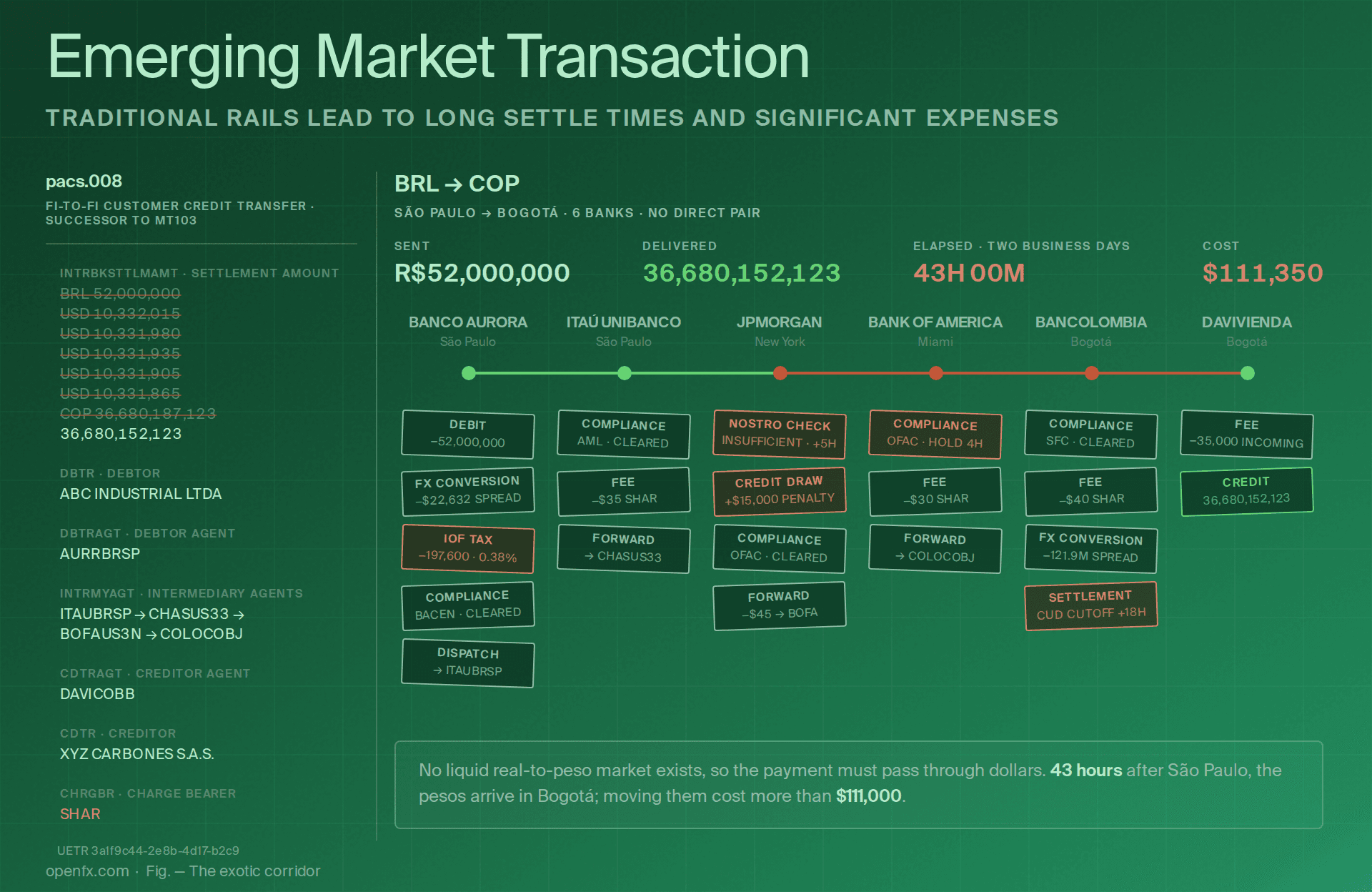
As complicated as this all seems, it's relatively simple when compared to what happens when the pair you're trying to transact is not as liquid as USD and EUR. In cases like that, most transactions have to leap through several additional hops, passing from the source currency to USD before making it to their final destination.
This means more fees, longer settlement times, more risk for traders and a near endless opportunity for errors that can extend transaction time even more.
So What Can Be Done?
The structural problem is not speed or cost, it’s that every institution in the chain maintains its own set of books, and none of them will release funds until their version of the record has been reconciled against everyone else's. That reconciliation is where the majority of the time and money are spent.
The fix is to put the dollars on a single shared ledger that every participant can write to and read from directly. When the movement of funds and the settlement of funds are the same event, recorded in the same place, there is nothing left to reconcile.
Stablecoins are one way to do this, tokenized deposits are another. Both place real dollar claims on a blockchain network capable of settling those claims almost instantly.
While this does solve the structural problem, the operational one remains, the rest of the iceberg required to get real money into client accounts.
Run the Stuttgart payment along the blockchain and most of the transaction time falls away. The company's dollars are on-ramped into a dollar stablecoin at a transparent rate. The stablecoin moves to the supplier's side in one transfer that settles before the sender has closed the tab.
Then it is off-ramped into euros and pays into the supplier's account through the local payments rails. The conversion, the compliance checks, and the payout run as software calls which are visible as they happen, rather than as a relay carried by hand between institutions that distrust one another. What took three or four institutions and the better part of a day takes one transfer with two edges.
Moving dollars on the blockchain is much easier than moving dollars across correspondent banks. This simplicity can and does reduce transaction time and cost substantially.
However, cross-border payment was never really about moving dollars. It is about getting local money into an account on the other side. Dollar Stablecoins, for all their speed, are still dollars. To pay the supplier in Stuttgart you have to turn those dollars into euros somewhere, at some rate, and feed those euros into the German banking system through a local rail. The reverse is true for the dollars going in. Those are the on and off-ramps I described, and most of what the correspondent network used to do badly now happens there instead.
All of the things that needed to happen in the correspondent banking network still have to happen in a stablecoin transaction. Liquidity needs to be found, a price needs to be quoted, and someone needs to take on the risk of that rate at the moment the transaction is agreed upon. The compliance burden doesn't lighten either, two sets of regulators still have to be satisfied. In a clean corridor like dollars to euros, plenty of parties can do all that cheaply. In the corridors that actually need help, exotic corridors where liquidity is scarce and the banking system is still reeling from years of disinvestment from traditional institutions, these problems compound.
So the real solution is something more than stablecoins. The real solution involves understanding the transaction, and everything happening underneath it: finding local liquidity where it is scarce, pricing and timing the FX, clearing compliance efficiently, and routing each payment down whatever path is cheapest and fastest at that moment. You have to do this across dozens of corridors at once, with no one making decisions by hand.
Doing that automatically, in software, is the job of an automated treasury system. That is the rest of the iceberg, and is a longer story we will be discussing more about over the next few months.
FAQs
Where do exchange rates come from in the first place?
From the wholesale market where banks trade currencies with one another. Dealers at large banks quote prices to each other continuously across electronic platforms, and the rate you see on Google is a snapshot of that activity. Several trillion dollars change hands each day, no one sets the “rate,” it’s a moving target.
What exactly is the "mid-market rate," and why doesn't the company get it?
Every dealer in that wholesale market quotes two prices: the rate they will buy, and the rate they will sell. The mid-market rate is the midpoint between them at a given instant. It’s used as a reference, not a price anyone will actually trade at. When a bank converts your payment, it fills the order at a price it determines, adding their “spread.” How wide the spread runs depends on how heavily the currency trades, the size of the transaction, and how much margin the bank chooses to take.
At what moment do the dollars actually become euros, and who does the converting?
Whichever institution in the chain holds accounts in both currencies, typically the correspondent, performs the conversion, debiting its dollar ledger and crediting euros at a rate it sets at processing. Hours can pass between the quote on the screen and the moment it makes the “conversion,” the market moves the whole time. This is why the initial quoted rate and the final rate rarely match.
How can a bank not "have enough liquidity"?
Liquidity in this context means the right currency, in the right account, at the right moment. A correspondent's euro nostro is a finite pool drained and refilled all day by everyone's payments, and a large transfer can arrive after the morning's outflows have emptied it, even though the institution's overall balance sheet is enormous. The money exists, it’s simply parked in other currencies unavailable to fill the request.
What is an intraday credit line?
A loan measured in hours. Central banks and large correspondents allow participating banks to run a negative balance during the business day. The facility exists for exactly the timing mismatch described above, large payments going out before payments come in. Collateral carries a cost, and a position that runs past closing converts into overnight borrowing on much worse terms, that expense will find its way into the fees the bank charges.
What are the three-letter codes that decide who pays the fees?
OUR, SHA, and BEN, written into the payment instruction. Under OUR the sender covers every bank's charge and the full amount is meant to arrive intact, with intermediaries billing the sending bank separately. Under BEN the beneficiary bears everything, and the fees are deducted in transit. SHA splits the difference: the sender pays its own bank's fee, and each intermediary lifts its charge from the principal as it passes. SHA is the prevailing default and is mandatory for many European payments, this is why in our example the supplier doesn’t receive the full amount.
What is "the local euro clearing system" at the end of the chain?
Domestic plumbing. Large euro payments settle across T2, the Eurosystem platform run by Europe's central banks (long known as TARGET2), while ordinary credit transfers move through SEPA, the rough counterparts of Fedwire and ACH in the United States. The entire cross-border apparatus exists to carry the money to the doorstep of one of these systems. The final delivery into the supplier's account is a purely domestic event, which is why it is usually the fastest part of the journey.
Share article
Read other articles
Stay informed with our latest articles on currency launches, institutional FX trends, and global liquidity.