Understanding The USD to ARS FX Corridor

Catherine Kaupert
,
Head of Latin America

Argentina's capital controls (cepo cambiario) governed its FX market from 2019 until April 2025, when most were lifted alongside a $20bn IMF program. Under the cepo, the official rate diverged from the parallel rate by as much as 80%, and profit repatriation was blocked outright. The result was a corridor that was effectively unusable for institutional flows at the official rate. Those constraints have been largely removed. The official, MEP, and parallel rates now trade within a few percent of each other, and the peso floats within a band that adjusts monthly with inflation.
This corridor is in active normalization. Dividend outflows have risen from $24M a month under the controls to $882M in March 2026, but legacy stocks still route through BOPREAL bonds. There is no FX tax: the PAIS surcharge lapsed at the end of 2024.
Argentina ranks first globally for everyday stablecoin readiness, and banks have been authorized to offer crypto services since April 2026.
This document walks a $10M USD->ARS payment through the seven stages of a cross-border transaction, explains how Argentina's payment rails work, and covers intra-regional pairs that route through the dollar.
Corridor at a glance
Currency | Argentine Peso (ARS) |
Regime | Crawling band (ceiling and floor adjust monthly with inflation) |
CLS | No |
Market depth | Thin; no reliable BIS turnover figure due to the cepo period |
Spot | ~1,436 per USD (mid-June 2026) |
Band | ~921–1,518 ARS/USD (late 2025 bounds, inflation-adjusted monthly) |
12-month move | Peso −24% (managed depreciation within the band) |
Domestic instant rail | Transferencias 3.0 (24/7, interoperable QR, >1/3 of electronic payments) |
Large-value RTGS | MEP |
FX tax | None (PAIS lapsed end-2024) |
Regulators | BCRA, CNV |
How the rails work
Transferencias 3.0 is Argentina's domestic instant-payment system, the BCRA's interoperable scheme covering bank accounts (CBU) and payment-provider accounts (CVU) with QR-code payments. It handles over a third of electronic payments and operates around the clock. It is domestic-only.
MEP (Medio Electrónico de Pagos) is the BCRA's real-time gross settlement system for large-value interbank transfers, operating within Buenos Aires business hours. The "dólar MEP" exchange rate mentioned above takes its name from this same system: a dólar MEP transaction settles domestically which is what distinguishes it from contado con liquidación (CCL), the equivalent bond-swap mechanism that settles dollars into international accounts.
The crawling band. The peso does not float freely. It trades within a band whose ceiling and floor are adjusted monthly with inflation, replacing a fixed 1%-per-month crawl used in 2025. The band widens over time. The stated endpoint is a free float, but no date has been set.
Who regulates this corridor
BCRA (Banco Central de la República Argentina), the central bank, sets monetary and FX policy and administers the crawling band. It also runs the country's core payment infrastructure, including Transferencias 3.0 and MEP.
CNV (Comisión Nacional de Valores) regulates Argentina's capital markets and, since a 2024 law, virtual asset service providers as well. It isn't the primary authority for a cross-border payment's FX or settlement mechanics, but it's relevant given how much of this corridor's story runs through crypto.
Anatomy of a USD -> ARS payment
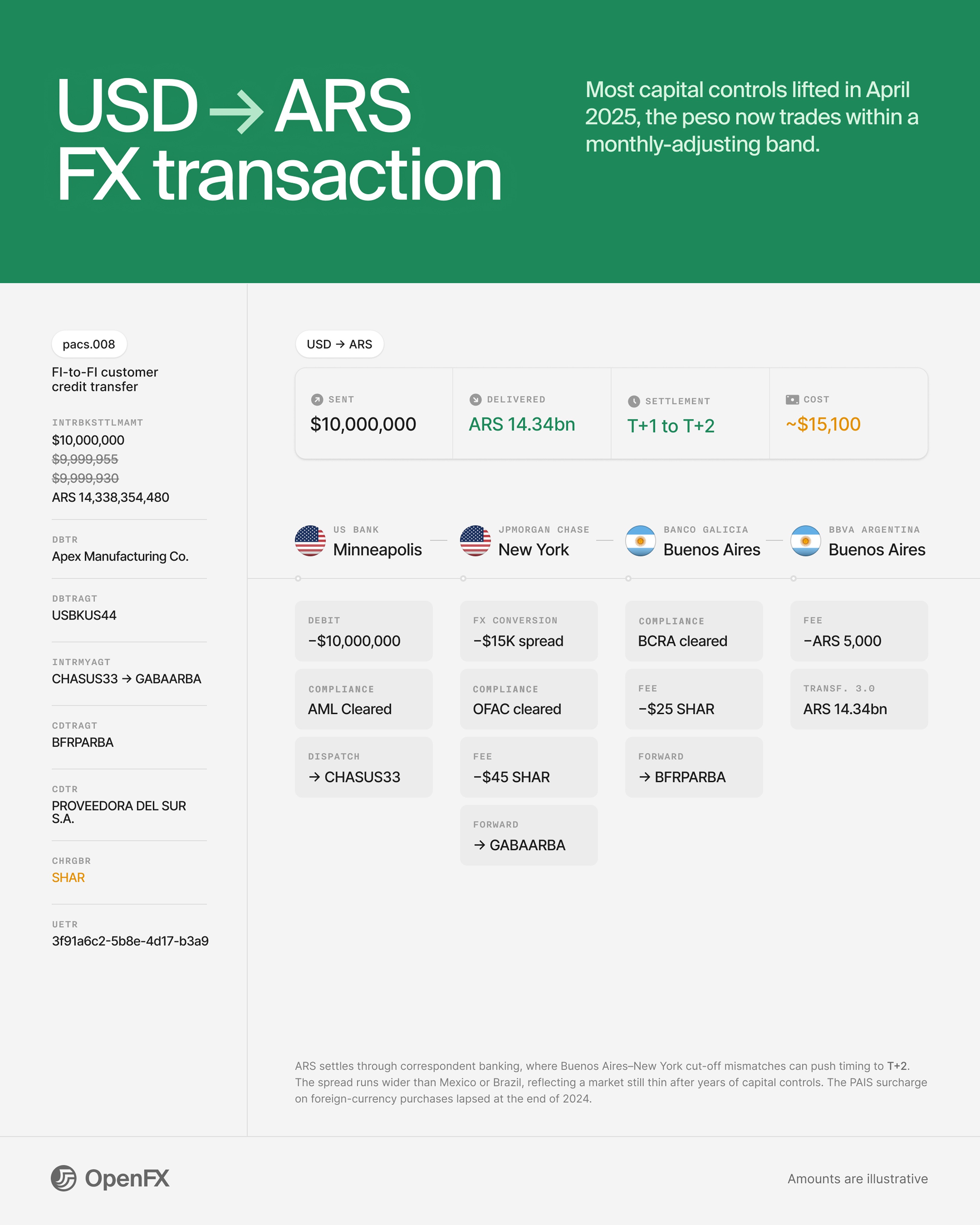
A $10M payment from a US company to an Argentine supplier. Four institutions, no CLS, no FX tax, with a managed exchange rate.
1. Fund the source leg
The US company's bank debits its dollar account.
2. Carry the instruction
The bank dispatches a pacs.008 message over SWIFT to its US correspondent, identifying the beneficiary, the amount, and the fee-bearing code.
3. Convert the currency
The US correspondent or the Argentine correspondent executes the FX conversion at a rate within the crawling band. USD/ARS is a direct pair but thinner than USD/MXN or USD/BRL. The spread on a $10M institutional trade is wider (with quotes ranging between 10 and 20 basis points)
4. Source the destination liquidity
The Argentine correspondent pays out from its prefunded ARS position. Correspondent liquidity can be tighter than MXN or BRL, particularly for very large tickets.
5. Clear compliance
The originating bank screens the payment.
The US correspondent runs the OFAC check on the USD leg.
The Argentine correspondent runs BCRA compliance.
Residual documentation requirements from the cepo period may still apply to legacy-stock dividend repatriation, which routes through BOPREAL bonds.
6. Reach settlement finality
Both legs settle independently through correspondent banking. Buenos Aires and New York cut-offs do not fully overlap, and weekends and holidays in either country extend settlement. T+1 to T+2.
7. Pay out on the local rail
Transferencias 3.0 credits the beneficiary's account. MEP handles large-value settlements within business hours.
Net. Cost on this corridor is the spread plus correspondent fees. There is no FX tax. The spread is wider than on the MXN or BRL corridors because the market is thinner and the band introduces rate uncertainty between agreement and settlement. Spot convention is T+2; commercial payments can settle T+1 within Buenos Aires cut-offs.
When the pair is not USD
Almost no direct FX market exists between Latin American currencies. A EUR->ARS, GBP->ARS, or any intra-regional pair (BRL->ARS, CLP->ARS) routes through the dollar.
For intra-Mercosur trade, the SML settles directly in local currencies at central-bank reference rates without a dollar intermediary. Argentina is a founding SML member (Argentina–Brazil since 2008, Argentina–Uruguay since 2017, Argentina–Paraguay since November 2025), though volumes remain marginal.
FAQ
Is the cepo in Argentina fully lifted?
Not entirely. The remaining exception is legacy balances: dividend stocks that predate 2025 and commercial debt from before December 2023 still route through BOPREAL bonds. Everything else reflects the post-lift state covered in the corridor overview.
Is the PAIS tax in Argentina still charged?
No. The PAIS surcharge on foreign-currency purchases lapsed at the end of 2024.
How does the crawling band work in Argentina?
The peso trades within a band whose ceiling and floor adjust monthly with inflation. The band ran from roughly 921 to 1,518 in late 2025. The adjustment rate is sub-inflation, which drives real appreciation. The stated endpoint is a free float.
Why is stablecoin demand so high after liberalization in Argentina?
The drivers shifted. Under the cepo, demand for USDT reflected dollar scarcity. Since liberalization, the demand has different roots: inflation makes USDT a store of value, and crypto wallets pay more than bank deposits. Government policy helps too: the Milei administration favors open currency competition and has no CBDC. Argentina ranks first globally for everyday stablecoin-use readiness.
Can contracts be written in either dollars or crypto in Argentina?
Yes. Currency competition permits it. Roughly 18% of new Buenos Aires commercial leases are denominated in crypto, alongside long-standing dollar pricing for big-ticket items.
Share article
Read other articles
Stay informed with our latest articles on currency launches, institutional FX trends, and global liquidity.