A Taxonomy For Agentic Treasury

Harrison Mann
,
Head of Growth
What does the word "agentic" mean?
You've definitely heard it before, you've probably heard it a lot. It is used to describe everything from shopping apps to the future of government.
Everything wants to be "agentic."
It was 2023, give or take, when the payments world discovered. This around the same time chatbots were starting to find their footing in the minds of the public. It was the next killer app, the future of everything.
Since then its role has expanded and subsumed all that came before it, it has become a catch-all that might, with the right massaging, describe a file transfer set to go off every day at midnight, or a system that ingests market data and uses it to rebalance treasury positions across a dozen currencies. Along with its kissing cousin "agentic payments," this word has been stretched beyond any kind of technical coherence into what can only really be described as a position of faith, the idea that we are moving from a world of chat trades and brokers to one where machines guide our treasuries with perfect precision.
We've made similar arguments in the past, and we stand by them, not because we think the most florid predictions are correct, but we think there is something directionally interesting here.
Remove the marketing hype and the genuflections and you are left with the one question we think is worth engaging with, "what is actually being automated?"
So today we're going to talk about four different levels of agentic behaviors, in hopes that you might walk away with a definition a bit more reliable than that one currently being sold.
Let's turn our attention to something a bit more concrete.
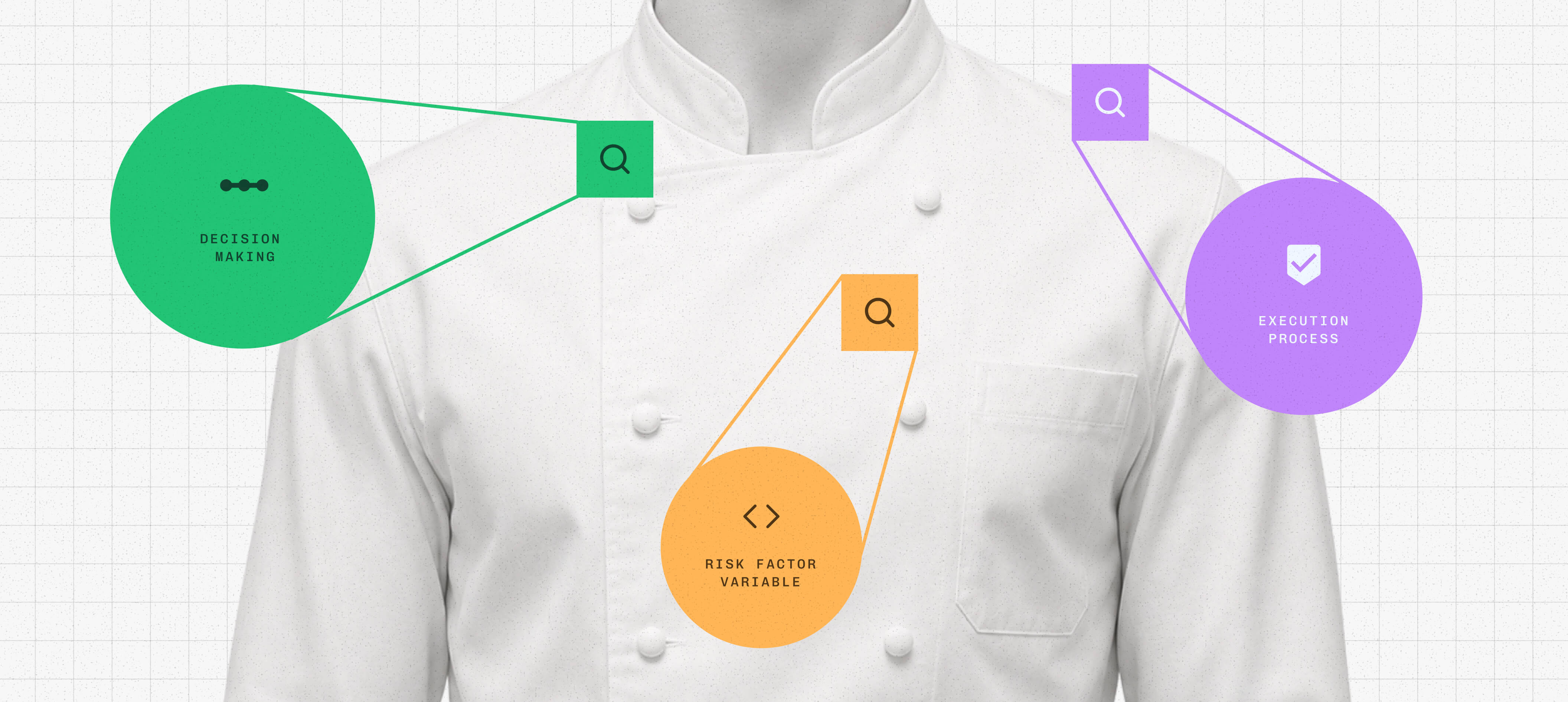
A Kitchen Staffed Four Ways
A commercial kitchen is not too dissimilar from any other complex process. It is made up of a series of tasks that can be automated to different degrees.
As a start, you can pin a recipe to a corkboard and hire someone to follow the directions. This is a wholly rules-based system that expects almost nothing from the person following said rules. Alternatively, you can hire a line cook, unlike the corkboard guy, they can do quite a bit more as long as there is a menu to follow, take away the script and the food is far more likely to be burnt.
A sous-chef can adapt a dish from scratch if they need to, and can operate most of the functions of the kitchen without either corkboard or menu, but they are still improved by oversight.
Finally, you could just hire an Executive Chef, someone with experience enough to run the entire kitchen and capacity enough to adapt to whatever you can throw at them. As long as they know what you're trying to achieve and how many tomatoes you have in the fridge, they can run the whole show without needing a single second of your time.
Treasury automation works in much the same way. The tiers describe how much capacity the “agent” has, and how much oversight they need to complete their goals.
Tier One: Rules-Based Automation
Most of what is called agentic these days would have been called algorithmic in the past. In fact, “algorithm” might be giving many of these systems too much credit. Most algorithmic systems have some amount of world modeling baked into them, they store information and retrieve it to help make decisions. They are much closer to the next tier that we will discuss.
These are simple, mechanical processes, you provide a set of conditions and they follow those conditions until they can’t anymore.
If A happens then B should happen next.
If A and B happen then C should follow.
If an account balance drops below $500, transfer $50,000 from account ABZ345.
Conditions drive actions, and those actions are blind to anything but the conditions that drive them.
Rules-based systems of this kind can be found in everything from your thermostat to your sprinkler system.
They are deterministic, and because of that they are reliable.
Going back to our corkboard example, as long as the person reading the instructions can be trusted to follow them, we can predict the recipe will come out as we expect. But if the recipe calls for milk and we don’t have any, well—
Rules-based systems have been useful for decades, and still are, but make no mistake, they are not “agentic” in the sense much of the marketing claims. We can make this case definitionally, where does the agency sit in one of these systems? It’s not in the machine, it’s with the person whose job it is to watch the machine churn.
Which leads to the problem, rules-based systems are notoriously rigid, if given inputs they can’t recognize they will either fail outright, or keep on churning, resulting in all manner of chaos.
As an example, a treasury team sets up a nightly sweep meant to consolidate balances into a central account. Simple rule, simple trigger.
This system works perfectly for four years until a public holiday hits on the wrong day, which leads the sweep to fire into an account that won't clear until Wednesday. The system shouldn’t have fired, but it did because it lacks a world state. It doesn’t know what day it is, it doesn’t even know days exist.
Chaos.
If the point of an “agentic” system is adaptability, this is far from that goal.
Tier Two: Rules-Based with Exception Handling
So what do you do if you don’t just want a system that breaks whenever underlying conditions change.
You add exception handling. This doesn’t alter the fact that the system itself is still fundamentally rules driven, instead it adds meta-rules to make the system more robust.
If something doesn’t make sense, here are the steps you should take.
Before you execute task A, be sure to ping system B and C.
If you see this error code, adjust the parameters for rule A, B, and D.
The line cook can see you don’t have any milk in the fridge and can maybe come up with an alternative that will still get you where you need to go. They can also tell that the corkboard card might have a typo about cooking time, and avoid burning the whole kitchen down.
They are capable of adaptation and escalation, but still can’t necessarily come up with an entirely new fish dish from scratch.
Exception handling has been, for the last 50 years, one of the primary interests of those who work in automation. For decades, this is what “AI” meant, rules-based systems with robust error-handling. In many domains (games, engineering), it still is.
The same treasury systems described in the last section can be improved with proper error handling. Rather than running the sweep at a particular time of day, you can make sure the system is aware of what day it is. If the account isn’t available for any reason, you can set up an exception that pings someone and lets them know.
This is a kind of limited intelligence, limited in the sense that in order to handle an error the person building it needs to know what it is they are actually looking for. Garbage in, garbage out. The system itself has no capacity to determine what is worth paying attention to outside of the limited confines of its algorithm.
The benefit here is that they retain the predictability of the simple, rules-based tools. The problem is that they are brittle.
A lot of vendors marketing automated treasury tools operate at this tier: rules and exceptions, bring a human being in if broken things need to be fixed. This is a perfectly reasonable way to manage a treasury desk, preferable in many cases, but “agentic” it is not.
Tier Three: ML-Driven Systems with Human Oversight
Now we're cooking.
Machine Learning systems are statistical. They take in information, extract patterns, and use those patterns to make decisions.
Some of these systems are fairly simple, like recommendation engines or whatever is going on with dating apps. Others can be far more complex, like the interlocking algorithms used to pilot autonomous vehicles.
The underlying mechanisms remain identical: observe, pattern, decide.
These systems most often plug into pre-existing infrastructure in order to find the data they need to operate. They might look at your transaction flows and realize that your EUR/USD execution is consistently worse on Friday afternoons, or that every Tuesday transactions coming out of London are 25% more expensive.
They can “make decisions” in a way far more robust that either of the purely rule-based tiers, and they are aware enough of the world around them to make those decisions feel grounded.
Crucially, this particular strain of ML-algorithm cannot act on the insights it gleans without a human being checking its work. While your Netflix algorithm can tell you that you might really like The Saw movies, you’re the one whose going to have to click play. The sous chef can suggest and flag, but if they don’t want to get fired, they better check in before changing the menu.
In many cases, this is the sweet spot for most complex transactions, dramatically increasing speed while offering enough oversight to prevent cascading failures.
Is it agentic? Debatable.
Is it practical? We would say so.
You get the best part of a machine-based system while keeping a human in the loop for consequential decisions.
Tier Four: Autonomous End-to-End Systems
Here's where purists would say the real agentics live.
These are ML-systems without the oversight.
They have goals rather than rules. They can encounter novel situations and react to them sensibly. They are capable of learning from mistakes and self-improving.
They also don’t really exist.
Even the most robust LLM-based systems today lack one or more of these features. They lack world modeling and the ability to “learn,” they are far closer to traditional ML than most boosters would like you to think. In certain respects, they are far less “grounded.”
What they can do that is truly novel is adapt to errors in a way that ML-algorithms simply cannot. They are able to course correct when something happens that would otherwise scuttle their plans.
If your treasury agent identifies an especially risky position being transacted at 3AM, it might decide to hedge that position. It will have access to the quoting endpoint, and it will have authority to make the decision to execute a trade in response. It will also be plugged into systems to monitor that trade and create a log of the full chain of actions it took. All of this while you are fast asleep.
These systems are not deterministic, how they handle the same set of problems might permute wildly depending on initial conditions. It’s impossible to predict precisely what they will do at any given time, and the reasoning that drives these decisions is essentially opaque.
This sounds dangerous because it is, but it’s also quite powerful, particularly in the case described above when a problem arises and there is no human being available to manage it.
Your Executive Chef might be able to run the entire kitchen in their sleep, but they are far less likely than the other people in this chain to take directions kindly.
This tier of automation also opens up a number of important questions, who is responsible when one of these systems makes a consequential mistake? Where does the legal and ethical burden fall? Even more than technical limitations, this is a hard limit to how far agentics can currently be pushed. No one really likes the answer that “the chatbot did it.”
This level of automation requires tools we just haven’t built yet, and frankly, except in certain narrow cases, it’s unclear whether it actually makes any of the processes that define treasury better.
Why We’re Talking Taxonomy at All
The word "agentic" will continue to be used to describe anything that touches an algorithm, that won’t change, there is too much money on this side of the future.
But it's worth knowing what you're actually paying for. A recipe card bolted to a corkboard is not an executive chef. And a sous chef, however talented, is not running the kitchen at 2am without you.
The infrastructure required to operate at Tier Four is specific, and most of it remains unbuilt. So the question worth asking today is a variation of the one we asked earlier, “what exactly do you actually need automated?”
We hope that you now have a much better framework for finding that answer for yourself.
Share article
Read other articles
Stay informed with our latest articles on currency launches, institutional FX trends, and global liquidity.