The Real Reason Cross-Border FX Is Still Slow: Bank Float and the Power of Misaligned Incentives

Harrison Mann
,
Head of Go-to-Market
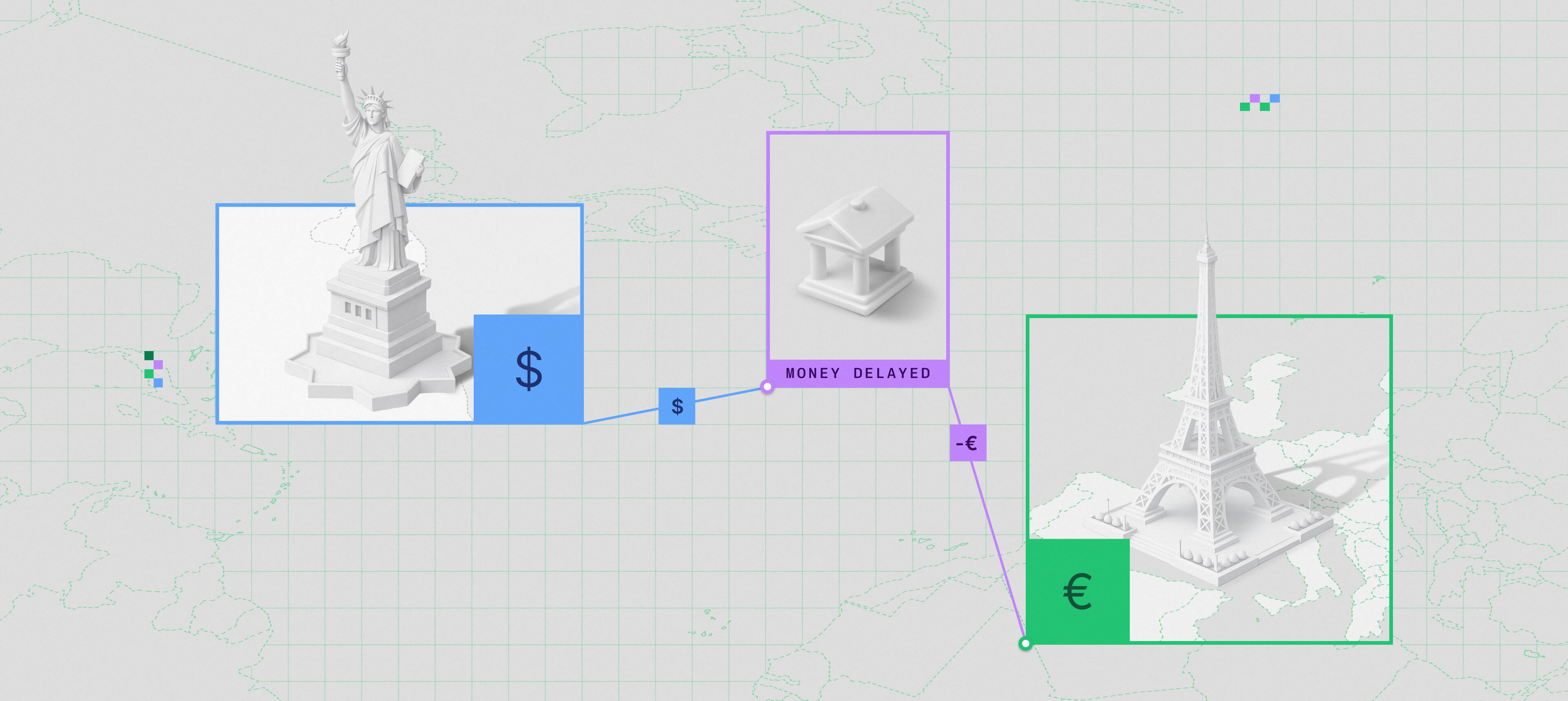
Everyone who encounters cross-border payments for the first time asks the same question. You can text a cat meme to someone on the other side of the world in less than a second, why does sending money take five days?
Here are the standard answers: Intermediaries. Batch processing. Time zones forcing a payment initiated in Singapore on Friday afternoon to be processed in New York on Monday morning. Add to this the fact that regulatory frameworks differ across every jurisdiction and almost never talk to each other. We've written about these at length, and they cannot be denied.
But here's the thing. The payments industry has attracted hundreds of billions in investment over the past decade. SWIFT launched GPI. The G20 assembled an entire roadmap designed to reduce settlement times. The EU mandated 10-second settlement for euro transfers, and fintech companies the world over have thrown everything they have at the problem.
And yet, the numbers have barely budged until fairly recently.
The G20 set targets in 2021 for cross-border payments to be faster, cheaper, and more transparent by 2027. The FSB's 2025 progress report on the enterprise was blunt: there has only been slight improvement since monitoring began, and "it is unlikely that satisfactory improvements at the global level will be achieved" on schedule. Five years of coordinated international effort, and this is where we are.
If the technology exists to settle payments instantly, and serious money and political will have been thrown at the problem, why hasn't it been solved?
Our CEO Prabhakar put it plainly in a recent interview: the reason the world operates on five-to-seven-day settlement isn't purely technological. Part of it is tech, but a significant portion is incentives. Banks are in the business of keeping money. They want to hold it, and sit on the float, for as long as they can.
That's the part of the conversation we want to discuss today.
Following the Money
When a cross-border payment takes five days to settle, the money sits in accounts controlled by the institutions processing it, and those institutions earn on it while it's there.
A large acquiring bank processing $10 billion in monthly card volume with an average 36-hour settlement delay generates roughly $5 million a year in float income from that alone. JPMorgan's corporate banking division earns an estimated $1 to $1.5 billion annually from cash management float, including FX settlement delays. When US regulators imposed maximum check hold periods in 1987, the reduction in float income across the industry was estimated at upward of $3.5 billion a year. That’s a lot of money just for holding checks.
Zoom out from individual transactions and an already massive picture gets even bigger. Cross-border payments require banks to maintain pre-funded accounts, called nostro and vostro accounts, in foreign currencies at partner institutions around the world. These are what make international transfers possible. They're also enormous pools of capital. Estimates of the total amount sitting in nostro/vostro accounts globally range from $5 trillion to $27 trillion. JPMorgan alone estimates $15 to $25 billion across its correspondent relationships. In a 5% rate environment, every billion parked in a settlement account represents about $50 million a year in returns.
This is where the slow-settlement question gets its real answer. Faster settlement doesn't just change processing times, it threatens a revenue model. If settlement is instant, pre-funded nostro accounts start to look unnecessary. If nostro accounts are unnecessary, trillions in capital currently under bank control gets freed up and redeployed elsewhere. The correspondent banking system is, at least in part, because slowness is load-bearing.
The Ecology of Delay
Banks aren't villains in this story. They operate inside incentive structures, same as everyone else. Some have pushed hard for faster settlement. The industry has spent real money on real improvements, but the BIS itself noted that "some private institutions have been cautious about implementing changes that may disrupt their business models," and that language is about as direct as central bankers get.
When the EU mandated instant euro payments in January 2025, 45% of European banks expected to lose significant interest revenue. The regulation had to force the outcome that market incentives alone wouldn't produce.
In the US, the picture is even more explicit. When stablecoin firms began pushing for access to Federal Reserve payment rails in February of this year, the Bank Policy Institute, Clearing House Association, and Financial Services Forum filed a joint letter demanding a 12-month waiting period before newly licensed issuers could even apply. The stated concern was safety. One might argue the real concern was competition.
So "why are cross-border payments still slow?" It’s because the institutions best positioned to fix the problem have been the ones with the least incentive to fix it quickly.
What About Stablecoins?
Stablecoins bypassed the system that profits from delay.
A USDC transfer settles on-chain in minutes for almost nothing. It obviates the need for correspondent banks and pre-funded accounts. Intermediaries? Pushed much further down the chain.
Problem solved?
No.
We wrote recently about the Philippine remittance corridor, where stablecoin integration has cut fees from 11% to 1% on specific routes with near-instant settlement. What we stated here is what we will repeat here, the blockchain transfer was the cheapest and fastest piece to build. The hard part, as always, was everything underneath it: FX liquidity, regulatory buy-in, local wallet integration, banking relationships on both ends. That work has to be repeated in every corridor, and in many jurisdictions it hasn't even started.
But stablecoins did create something the G20 roadmap and a decade of industry working groups hadn't managed: competitive pressure that couldn't be absorbed through incremental improvement. When customers can see that value moves in seconds elsewhere, "3-5 business days" stops being an acceptable answer.
Where This Leaves Us
The old incentive structures haven't disappeared. Correspondent banking still carries the vast majority of cross-border volume. Nostro accounts still hold trillions. Most remittance corridors still charge fees that would be unrecognizable in any other consumer industry.
But the question Prabhakar raised in his interview has gotten louder. The infrastructure to settle payments instantly exists, and the cost of delay, for the first time, is being borne by the institutions that profit from it rather than the customers who pay for it.
As always, it all comes down to incentives.
Share article
Read other articles
Stay informed with our latest articles on currency launches, institutional FX trends, and global liquidity.