Announcing OpenFX's $94M Series A
Prabhakar Reddy
,
Founder & CEO
I believe there are two ways to touch 8 billion lives: get 8 billion individual customers, or get a thousand financial institutions that each serve millions. We chose the latter path. Two years in, $45 billion a year later - it's working.
Today, we're announcing $94M in Series A funding led by Accel, Atomico, Lightspeed Faction, M13, Northzone, and Pantera - with support from existing investors Flybridge, and Hash3.
This is a massive round for a company that’s about 2 years old, indicative of the trust that our investors have in our vision. To understand where that trust came from, you need to understand where we came from, and what we’re working so hard to build.
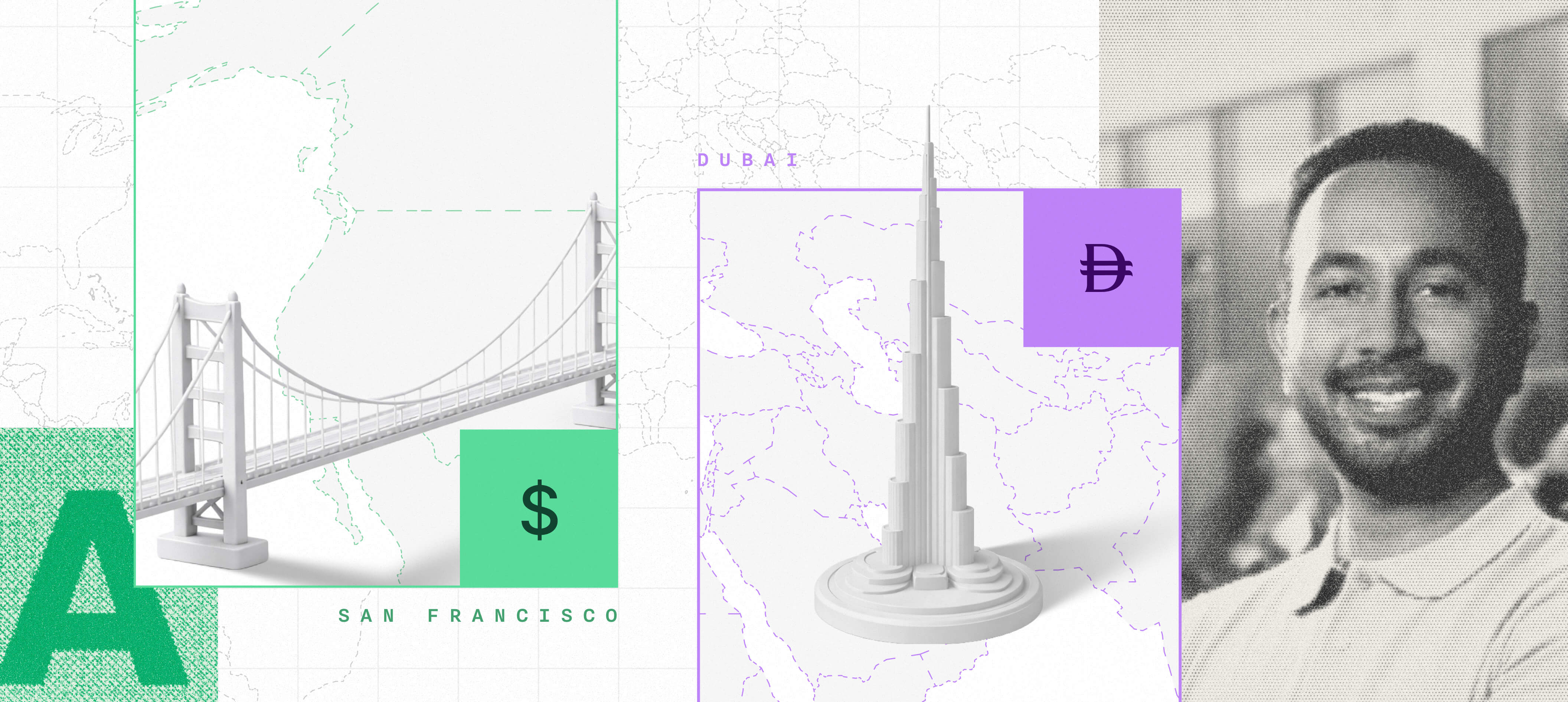
I grew up in Dubai.
Through the '90s and into the 2000s, I'd see lines outside Western Union branches - construction workers and domestic staff, people waiting to send money back home to families who needed it.
Dubai has always been a major remittance corridor, a fact you could see in the streets.
In 2022, when I came back after years in the Bay Area, I saw the same thing. The same lines.
People still pay 5-7% of their paychecks to send money home. Money that might have otherwise gone towards building a better life. Thirty years later, on the other side of a technological revolution that put supercomputers in everyone's pocket - almost nothing had changed. That gap is where OpenFX began.
I started OpenFX two years ago with a simple mission: make money move as freely as data.
Two years in, we're 105 people across four continents. We have come a long way, but I'm more convinced than ever that we're still only on step one of something much larger.
Global cross-border payments system is broken
A 1% increase in international remittances as a percentage of GDP can lead to a 22% decline in the poverty gap ratio, and a 16% decline in poverty severity for emerging nations. This is a statistic from the Asian Development Bank Institute that stopped me cold.
Remittances are a massive share of cross-border payments, and they mostly move money between developed nations and emerging ones. In countries like India and the Philippines they make up a meaningful percentage of total GDP.
They are how families eat and how small businesses get started.
If you can increase the velocity of money moving into them, and reduce the cost structure – what might that mean for these nations? The impact compounds in ways that are hard to fully anticipate.
If this is the case, why hasn’t anyone already solved this problem?
Because the people who built the current system benefit from it staying broken. The global cross-border payments industry has been built – deliberately – to be opaque.
Banks are in the business of holding money, not moving money.
Banks and intermediaries have spent decades constructing a system where fees are hidden inside exchange rates, where settlement delays are treated as immovable facts of nature, where a payment leaving London on a Monday might arrive in Mexico City on Thursday – that’s if everything goes right. That gap isn't an engineering problem. It's a business model. A lucrative one, built on billions in float.
$156 trillion moves across borders every year. The infrastructure moving it was designed for the 1970s.
New rails for a new world
When we started OpenFX, I wasn't trying to improve that system, I wanted to replace it.
The insight was simple but radical: stablecoins could do for money what the internet did for information.
A sender pays in local fiat.
Stablecoins move the value across borders in seconds.
The recipient receives local fiat.
Neither party ever touches crypto.
The legacy rails: the correspondent banks, the nostro accounts, the T+2 settlement windows - become unnecessary.
A system like this could compress prices and reduce settlement times, putting more money in the pockets of those who need it. Settlement collapses from days to minutes. Capital that used to sit idle in pre-funded accounts around the world gets freed up to serve the people and businesses who really need it.
This is not incremental improvement. We're creating a new category.
Consider a construction worker in Dubai sending AED 1000 home to Manila. He opens an app, initiates a transfer. A few minutes later, his family has it, and he's held onto the AED 70 that used to disappear into fees.
Cross-border payments as seamless as sending a text message.
What we’ve built
There is more to moving money than the blockchain, this is something that we think is often ignored in this industry, and something we spend an enormous amount of time thinking about.
We didn’t want to be a crypto company moving Stablecoins, we wanted to be a FX company moving money across the globe.
There are three core mechanics to any cross-border payment: Collections → FX → Pay-Outs. But the full infrastructure stack that financial institutions actually need goes deeper - Banking (treasury and settlement accounts), Earn (yield on idle capital), and the compliance and liquidity architecture that makes it all run reliably at scale. Most companies solve one piece. We're building the entire stack.
This meant focusing on the hardest part of moving that money: FX - the liquidity, the cost, the settlement mechanics - because we knew that whoever solved it first would earn the right to own the rest.
Whether you’re a PSP or a remittance company or a neobank, you need liquidity that is: reliable, scalable and responsive to your needs. You need access to infrastructure that can provide that liquidity at any hour, on any day. And as we move forward into a future where the largest consumers of FX may be AI agents rather than people, you need liquidity that is programmatic, built on powerful APIs that will allow you to automate all of your treasury operations.
We’ve built that kind of infrastructure for 15 currencies. There are 150 currencies in the world. We have a long journey ahead.
Progress
$500,000.
That's how much money OpenFX moved in our entire first month of operations.
8 weeks later, it was $500,000 a week.
3 months later, 500K a day.
Then, almost without us noticing, we were moving $500,000 every minute.
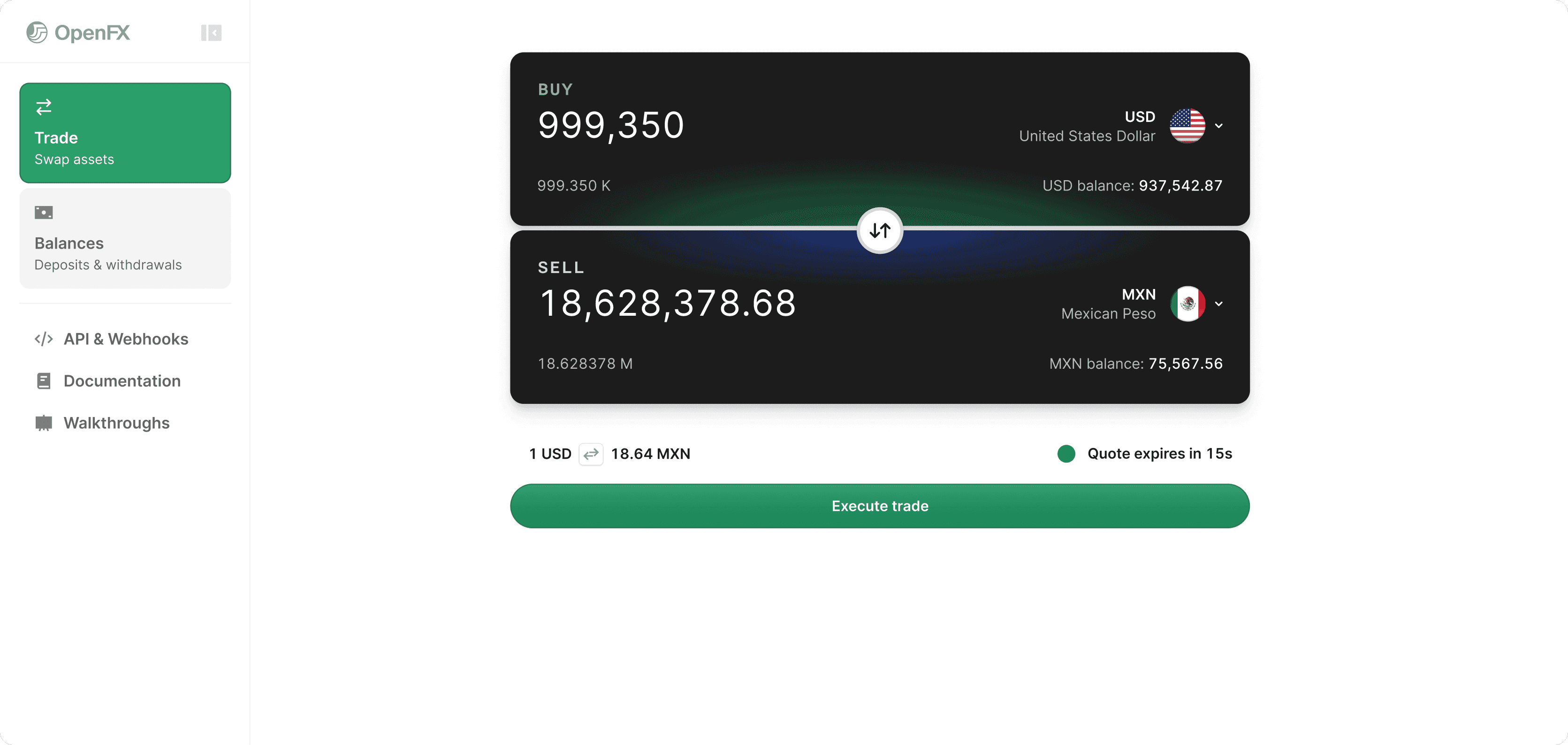
We now move over $45 billion a year across borders, in real time, at a fraction of what it used to cost. 98% of our transactions settle in under 60 minutes.
Since we launched in the UAE, we’ve compressed AED fee structures from 0.30% to mid-single digits, and we are doing the same in every geo we’ve entered: LatAm, South East Asia and Europe.
We have onboarded over 100 global institutional customers: fintechs, neobanks, remittance platforms, payroll processors.
We have hired 105 people across four continents, each a talented entrepreneur in their own right, who have chosen to work alongside us on this important mission.
We have moved from a thesis to a juggernaut that powers some of the fastest growing companies in fintech.
Why the urgency is higher than it's ever been
Two years of operating at hyper-scale has massively increased both the scale of our ambition and our confidence in executing on this vision. The mission hasn't changed, but the world around us has.
Two things are colliding right now that alter the entire calculus.
The first is AI agents. Not AI as a productivity tool, AI as an autonomous economic actor – one that initiates transactions, moves capital, executes payments, manages treasury, settles obligations, all without a human in the loop.
The first generation of these agents is being deployed right now – both internally within OpenFX, and by our clients. Within ten years, I believe AI agents will be the largest category of FX users on the planet.
AI-agents will need infrastructure that operates at machine speed. Not T+2. Not even T+1 hour. Real time, 24/7, across every currency pair that matters. The existing global financial infrastructure is not built to serve them. We are.
The second is what's happening in the world. Wars. Capital controls. Currencies losing 50% of their value during a five-day settlement window. Hyperinflation. The financial system's failure to move money in real time isn't just an inconvenience, for hundreds of millions of people, it's the difference between financial survival and catastrophe.
The urgency is undeniable.
What we're building with $94M
Modular. Programmable. Institutional-grade. API-first. Agentic. Liquidity.
The analogy I keep reaching for is Anthropic. Before Claude, if you wanted AI capabilities in your product, you had to build and train your own models, hire your own ML teams, and manage your own infrastructure. Now you call an API. We're building the equivalent for global financial infrastructure. We are the pipes through which all global FX will flow.
The remittance company in Brazil, the neobank in Singapore, the payroll processor in Dubai - none of them should have to rebuild what we've built. They should just use it.
To build this, we’re carefully hiring exceptional people across product, engineering, operations, and go-to-market. Not everyone thrives in an environment like this, it’s difficult and demanding, but if you are excited by the complexity of the problems I’ve described, you should apply. We're here to bend reality to our will, and we won't settle for anything less.
The financial infrastructure stack is the most complex, most regulated, most relationship-dependent problem I've ever worked on. And this is my fifth journey as an entrepreneur in the past twenty years.
Global licensing takes three times longer than you think. Banking relationships, even with institutions that publicly call themselves "stablecoin-friendly," require more navigation than any press release suggests.
Last-mile liquidity is solved corridor by corridor, and requires grinding persistence.
This problem is extraordinarily hard to solve, the incumbents are extraordinarily entrenched, incentives are misaligned, and the regulatory surface area is extraordinarily large. The journey ahead won't be easy. Challenging the status quo of the global financial ecosystem never is. But the TAM is infinite, the urgency is undeniable, and the team we’ve assembled to accomplish this mission is the best I've ever been a part of.
For fifty years, money moved at the speed of bureaucracy. We are making it move at the speed of the internet. That shift - that one shift - changes everything downstream. That's what we're here to do.
$45B a year today. Trillions by 2030.
Onwards.
Prabhakar Reddy
Founder & CEO, OpenFX
Share article
Read other articles
Stay informed with our latest articles on currency launches, institutional FX trends, and global liquidity.