Consensus 2026: A Cambrian Moment in Cross-Border FX

Jack Vaughn
,
Head of North America
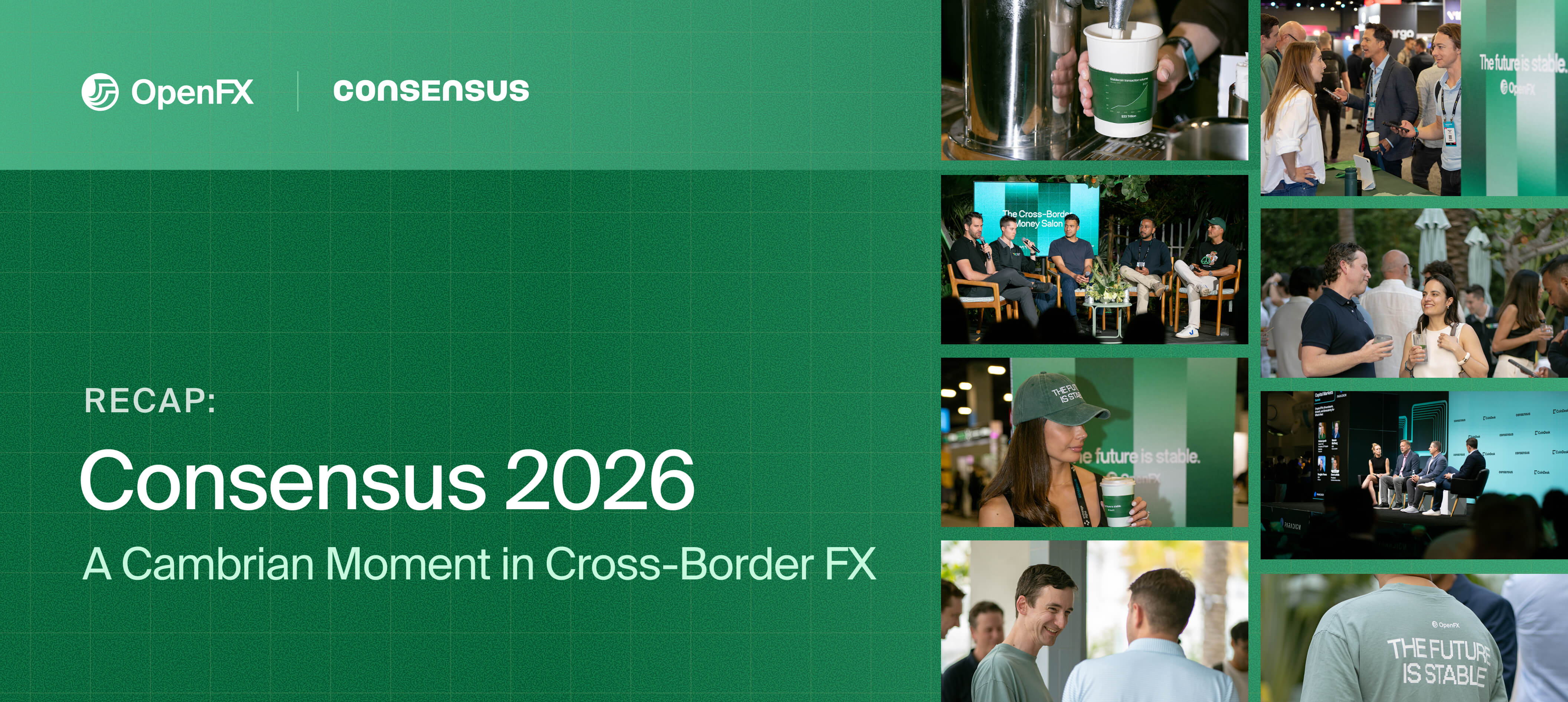
We just got back from Consensus Miami.
For those unfamiliar, Consensus is the largest annual gathering for blockchain and digital assets. This year’s event ran from May 5th to the 7th at the Miami Convention Center, twenty thousand attendees across three days.
This year the room felt different from anything we've experienced..
To start off, Morgan Stanley and JPMorgan were sponsors, their logos were on the lanyards. The CFTC Chairman was there, so was a sitting senator. Roughly 35% of attendees represented institutional capital.
Two years ago, many of these firms would not want to associate with a stablecoin conference, at least not too loudly. Some of them were actively lobbying against crypto companies gaining access to payment rails.
The thing that changed is that things finally started to change.
A Half-Century of Nothing
To appreciate what's happening right now, you need to understand what came before it.
Cross-border FX infrastructure has essentially been the same for fifty years. The same correspondent networks moved the same dollars mostly through the same G7 corridors, everyone else had to stitch together their own solutions. We've written about this at length. There hasn’t been a really big year in cross-border FX since sometime in the 1970s.
Don’t get us wrong, some of the technology has improved. SWIFT launched and CLS helped to mitigate some risks. Payment messaging genuinely goes faster, and G7 settlements are basically instant for all intents and purposes. But the fundamental structure has been static for a long time, driven by incentive structures that agitate against speed.
The people who paid the highest price for that stasis were in emerging markets. If you're moving money from USD and GBP, the old rails work well enough, but let's say you wanted to move $30M between Colombia and Vietnam, or Nigeria and the Philippines, or just about anywhere else really, then be prepared to wait days and sink dozens of basis points because those corridors simply didn't generate enough revenue to justify investment from the institutions that controlled the system.
Which brings us back to the conference.
The Explosion
What we saw at Consensus was an industry trying to figure out what it's becoming.
Three themes dominated.
First, stablecoins were considered a settled matter. People weren’t arguing over whether they should exist, but who should control the corridors. Issuers and fintechs state that they are actively competing to own the plumbing that connects stablecoin rails to local banking systems. Executives from MoonPay, Ripple, Paxos and others spoke clearly about what is still left to solve. Institutional demand now depends not on regulation, but on infrastructure, privacy, and practical payment integration. The iceberg is real.
Second, cross-border infrastructure came up in virtually every meaningful conversation we had. Real-time settlement, transparent pricing, global coverage. The demand is loud and getting louder.
Third, agentic commerce came up everywhere. Consensus dedicated an entire programming track to it. The idea that AI agents become market participants was extremely popular. The same people who wouldn’t talk about Stablecoins except behind closed doors, are now talking about chatbots executing trades. PayPal and Google Cloud executives were there discussing the necessary infrastructure, standardization of merchant catalogs, and methods to manage both risk and liability.
The Fallout
That last thing is very exciting, even if much of it is still hype.
A year ago, many companies in this space were talking about stablecoin-powered cross-border payments as though the problem was essentially solved. The rhetoric was far ahead of the reality. It still is. Some firms were genuinely moving large sums across difficult corridors, but many were repackaging pilots as products. You could drive a truck through the distance between their claims and reality.
Now "agent" is the word on everyone's lips. Autonomous settlement, “nanopayments,” all of it. Some of this will come to pass. A meaningful portion of it won’t.
This is not cynicism, it’s a call to arms.
540 million years ago, during the Cambrian explosion, life went from a relatively small number of simple body plans to a staggering diversity of complex organisms in a geological instant. Open your eyes to a brand new world of flora and fauna. Most of those species are extinct. The vast majority of the body plans that emerged during that period left no descendants, but every complex organism alive today can trace itself back to that lineage.
That's what a Cambrian moment looks like, a burst of experimentation so intense that most of what emerges doesn't survive. The value isn't in any individual organism, it’s in the period itself. The period I think we’re entering, that Consensus is emblematic of.
How To Survive In A New World
For fifty years, the institutions that controlled cross-border FX had very little reason to change. Settlement was slow because slowness was profitable, emerging markets were underserved because serving them wasn't worth the effort. The system ran for the people who ran it.
What's happening today is that the competitive pressure has become impossible to absorb through incremental improvement. JPMorgan knows it, the CFTC knows it. Serious people in serious rooms know that when the world starts really moving, you can’t afford to sit on the sidelines.
A Cambrian explosion.
Not every bet being made right now will pay off. Most won't, some are kind of silly. The companies talking about agentic liquidity management in 2026 may end up looking like companies always do when the panel hangover wears off. But some things will turn out to be real, and the world will change accordingly, and if we have our way we will be a part of that change.
Share article
Read other articles
Stay informed with our latest articles on currency launches, institutional FX trends, and global liquidity.