FX Liquidity Providers: The Market Makers Who Keep Currency Flowing

Harrison Mann
,
Head of Go-to-Market
Ever wonder who’s on the other side of those big trades you make?
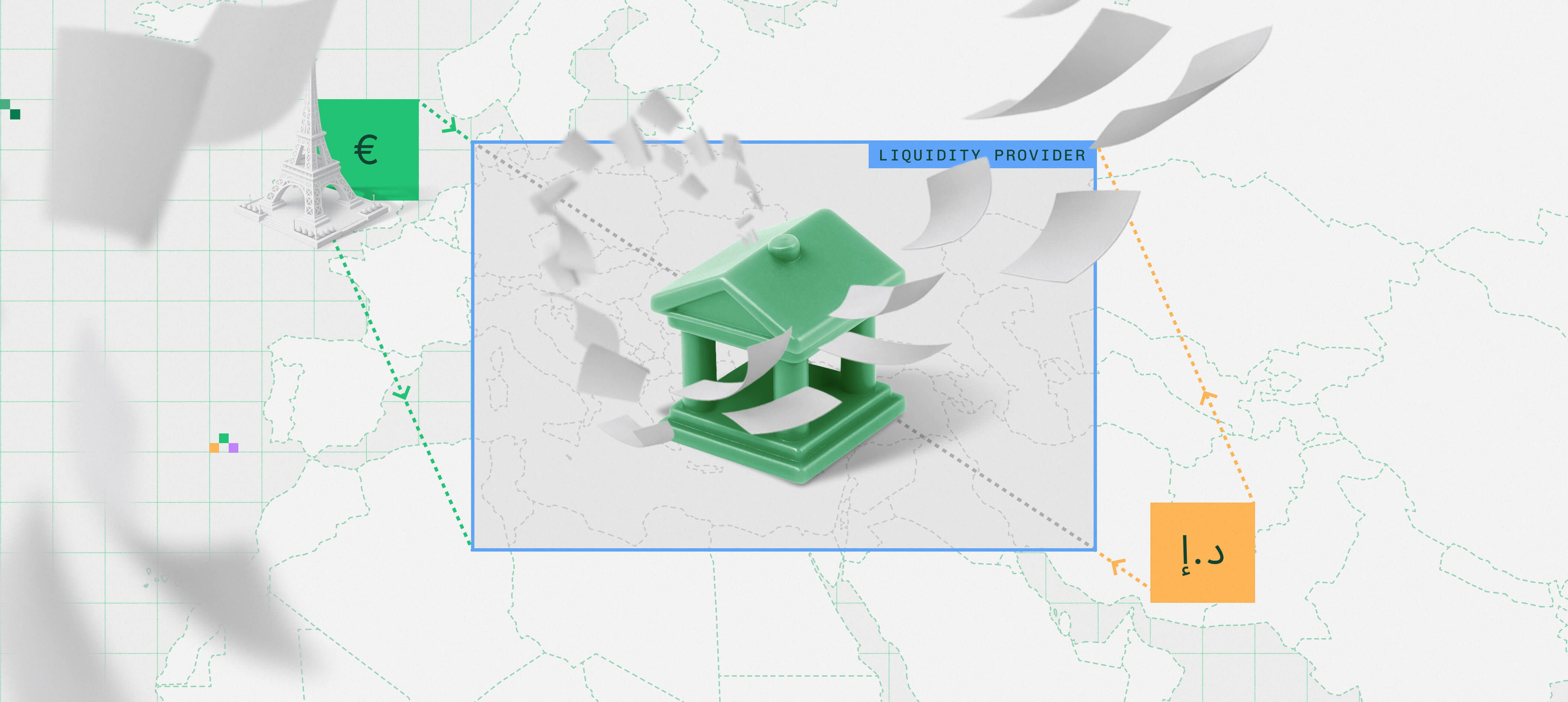
The answer: A liquidity provider - a bank or trading firm standing ready to buy or sell currencies at any moment. These so-called “market makers” are the invisible weavers that make the $9.6 trillion-daily FX market function.
When they work well, currency exchange feels effortless. When they're absent or scarce, markets fragment. Routine transactions become expensive ordeals.
In the world of stablecoins, USDC and USDT increasingly function as market makers in crypto-fiat corridors. It’s a parallel liquidity system being built. Understanding where traditional liquidity comes from, why it concentrates in certain corridors, and why it fails to materialize in others reveals both the strengths of the existing system and the opportunities for new infrastructure.
Sit tight while we talk about liquidity providers: Who they are, how they work, and why some markets have dozens of competing market makers while others struggle with just a handful.
Where does FX liquidity come from?
Liquidity doesn't materialize from thin air. It comes from specific institutions willing to commit capital to continuously quote buy and sell prices, even when market conditions are uncertain.
At the foundation of FX liquidity sit the money center banks - massive global institutions with operations spanning financial centers from New York to Tokyo to London. These include names like Citigroup, JPMorgan Chase, HSBC, Deutsche Bank, and Barclays. Unlike regional banks that rely on deposits, money center banks raise funds through domestic and international money markets, giving them vast capital reserves to deploy.
These banks act as principal market makers, meaning they trade using their own capital rather than simply matching buyers with sellers. When you request that EUR/USD quote, the bank takes the other side of your trade directly - they buy your dollars and sell you euros from their inventory, or vice versa. This creates immediate execution without waiting to find a matching counterparty.
Why do they do this? Because high-volume currency trading, even on razor-thin spreads, generates substantial profits. A bank might make only 0.1-0.5 pips per trade in major pairs, but executing millions of transactions daily transforms those tiny margins into significant revenue. The business model depends on velocity—the faster they can turn over their inventory by offsetting positions with other trades or hedges, the more money they make with less risk.
Now let’s get to know the aggregators: Electronic communication networks (ECNs). ECNs like EBS and Refinitiv (formerly Reuters) connect multiple liquidity providers and allow them to compete for order flow. When you see a quote on your trading platform, it's often the best price aggregated from dozens of banks and non-bank market makers, all submitting their quotes to the ECN.
ECNs dramatically improved FX market efficiency by creating transparent price competition. Before electronic trading, currency dealing happened over the phone, with traders calling to get quotes. Today algorithms scan multiple liquidity sources in milliseconds and route orders to whoever offers the best price. This competition naturally tightens spreads, benefiting end users.
Lastly, we’ve got the new bloods: Non-bank market makers! Over the past decade, high-frequency trading (HFT) firms and specialized market makers have entered FX. These non-bank liquidity providers - companies like Citadel Securities, Jane Street, and XTX Markets - use sophisticated algorithms and technology infrastructure to provide liquidity. Unlike traditional banks, they operate with lean overhead, minimal regulatory compliance costs (at least initially), and aggressive technology that can process orders in microseconds.
These firms typically focus on the most liquid pairs where their technology advantage matters most. They can profit on spreads that would be uneconomical for traditional banks because they have no legacy systems, no global branch networks to maintain, and can deploy capital with extreme efficiency.
The Japanese yen: A case study in liquidity success
To understand why liquidity concentrates in certain currencies, the Japanese yen offers an instructive example. According to the BIS 2025 Triennial Survey, the yen is on one side of 16.8% of all FX trades globally, making USD/JPY the second most-traded currency pair after EUR/USD. What creates this deep liquidity?
First, structural trade flows. Japan exchanges over $250 billion worth of goods and services with the United States annually. Every Japanese exporter selling products to America receives dollars and needs to convert them to yen. Every American company buying Japanese components needs to convert dollars to yen. This creates natural, continuous demand from real economic activity—not speculation, but actual business needs. These flows provide a stable baseline of volume that makes market making profitable.
Second, the yen's safe-haven status. During market stress—geopolitical tensions, economic uncertainty, financial crises—investors worldwide move into perceived safe-haven assets. The yen, backed by Japan's consistent current account surplus, low inflation, and stable institutions, has historically appreciated during risk-off periods. This means that when volatility spikes and volume surges across markets, yen trading volume increases dramatically. Market makers price this in: They know yen liquidity won't disappear when they need it most.
Third, deep hedging markets. The Chicago Mercantile Exchange (CME) offers highly liquid Japanese yen futures contracts. Banks and institutions can hedge yen exposure almost instantly using standardized futures, options, and forwards. When a market maker takes a position in USD/JPY, they can offset currency risk within seconds using these derivatives. This ability to hedge reduces the risk premium they need to charge, which tightens spreads and attracts more trading volume.
Fourth, the carry trade ecosystem. For years, Japan maintained near-zero interest rates while other countries offered higher yields. This created the yen carry trade: Investors borrow yen at low rates, convert to higher-yielding currencies, and earn the interest differential. While this strategy carries currency risk, it generates enormous yen trading volume. Even as the carry trade has unwound and rewound through various cycles, it established deep market maker expertise in yen pairs that persists today.
These four factors create a self-reinforcing cycle. High volume attracts market makers. More market makers create tighter spreads. Tighter spreads attract more volume. The yen sits at the center of this virtuous cycle, which is why trading USD/JPY feels as reliable and liquid as trading EUR/USD.
Why exotic corridors remain fragmented
If creating liquidity in major pairs is a self-reinforcing cycle, the inverse is also true: Low-liquidity corridors struggle in a self-defeating spiral. Understanding why exotic currency markets remain fragmented, despite decades of financial globalization, reveals structural barriers that traditional banking infrastructure cannot easily overcome.
Market makers in exotic pairs face a fundamental math problem. EUR/USD might trade $2 trillion per day. USD/TRY (US dollar to Turkish lira) might trade a few billion. That three-orders-of-magnitude difference in volume completely changes the economics of market making.
In EUR/USD, a market maker can buy euros from one client and sell them to another within seconds, perhaps making 0.5 pips on the round trip. They turn their inventory over thousands of times per day. It’s low margin, high velocity, substantial profit.
In USD/TRY, a market maker might take a position and hold it for minutes or even hours before finding a counterparty to offset. During that time, the exchange rate could move significantly against them. To compensate for this inventory risk and slower turnover, they quote wider spreads - perhaps 75-100 pips instead of 0.5. This wider spread discourages trading, which further reduces volume, which makes market making even less attractive. The spiral continues.
No derivatives to offset risk: A hedging problem
For most emerging market currencies, liquid exchange-traded derivatives simply don't exist. There are no CME futures for the Nigerian naira or South African rand like there are for the yen. Some currencies trade non-deliverable forwards (NDFs) - cash-settled derivatives referencing an offshore exchange rate - but these instruments have wide spreads and limited depth.
Without hedging instruments, market makers must warehouse directional currency risk. They're not just earning the bid-ask spread; they're taking a bet on whether the currency will appreciate or depreciate while they hold it. This fundamentally changes their risk profile and capital requirements. Banks' risk management teams impose position limits and charge internal capital costs for this exposure, making exotic market making expensive even before considering the operational challenges.
Limited relationships and higher risk: A credit problem
Credit is the hidden architecture of FX markets. When JPMorgan trades with Citibank in the EUR/USD market, they operate within well-established bilateral credit lines that extend into the billions. These relationships have been built over decades, backed by credit models, legal agreements, and the knowledge that both institutions operate under similar regulatory frameworks.
Extending credit to counterparties in emerging markets is fundamentally different. Credit officers must assess:
Political risk: Will capital controls be imposed? Could the government freeze foreign exchange transactions?
Legal enforceability: If a counterparty defaults, can the bank recover funds through local courts?
Settlement risk: Many exotic currencies don't settle through CLS Bank, introducing principal risk where one party might deliver currency while the counterparty fails to pay.
These credit assessments take time, require due diligence, and result in much lower credit limits than for G7 counterparties. Lower credit limits mean market makers can quote prices for smaller transaction sizes, which further fragments liquidity.
Capital requirements obstruct profit: A regulatory problem
Post-2008, financial regulations dramatically increased the capital requirements for banks' trading activities. Basel III rules require banks to hold capital against their trading book positions, with the amount depending on the position's risk. Emerging market currency positions, being more volatile and harder to hedge, require more capital.
This creates a profitability squeeze. The wider spreads in exotic pairs might seem attractive, but when you account for the capital costs of holding those positions, the return on equity often doesn't justify the business. Many global banks have actively retreated from emerging market FX market making, focusing their resources on high-volume G7 pairs where the economics work even with tight spreads.
Fundamentally, traditional banking infrastructure was optimized for a different era and different market conditions. The correspondent banking network - where banks maintain accounts with each other to facilitate cross-border payments - was designed for lower volumes, longer settlement times, and a world where real-time price transparency didn't exist.
Today's expectations - instant execution, tight spreads, 24/7 availability - clash with the realities of correspondent banking's manual processes, credit relationship requirements, and settlement delays. Banks need to make massive infrastructure investments to improve exotic currency liquidity through traditional means, and the business case for these investments is weak when volumes remain low.
This is where stablecoins enter the picture - not as replacement for all FX liquidity, but as an alternative infrastructure layer particularly suited to corridors that traditional banking simply doesn’t focus on.
USDC and USDT effectively function as market makers in crypto-fiat corridors. When someone in Nigeria wants to convert naira to dollars, they increasingly use a stablecoin as an intermediate step: Naira → USDC → onward destination. Local cryptocurrency exchanges and OTC desks provide the liquidity, quoting spreads that are often tighter than traditional bank wires.
Why can they do this when banks struggle? Several reasons:
Lower capital requirements. Crypto market makers don't face Basel III capital rules. They can deploy capital more aggressively and take positions that would be uneconomical for traditional banks.
Atomic settlement eliminates principal risk. Blockchain-based swaps can execute both legs of a transaction simultaneously through smart contracts, removing the settlement risk that plagues exotic currency trades.
24/7 operation. Stablecoin markets provide continuous liquidity when traditional banking is unavailable.
Reduced credit friction. While credit still matters for off-chain obligations, the on-chain settlement component doesn't require decades-old banking relationships. A market maker in Brazil can transact with a counterparty in Vietnam without traditional correspondent banking.
The data shows growing adoption. Stablecoin transaction volumes reached $33 trillion in 2025, up 72% year-over-year. Business-to-business payments via stablecoins hit an annualized rate of $36 billion. The Singapore-China corridor has become one of the most active channels for stablecoin flows - precisely the kind of exotic corridor where traditional banking infrastructure is weakest.
Tradeability and the future of exotic corridors
Understanding where liquidity comes from is only half the story. The other half is understanding tradeability - the factors that determine whether a quoted price actually results in an executed trade. This is where the future of exotic corridor liquidity will be decided.
What determines tradeability?
When you request a quote, several factors determine whether the market maker will execute at that price:
Inventory position: Market makers manage inventory carefully. If they're already heavily long on a currency, they'll be reluctant to buy more and may widen the spread on the buy side or decline the trade. Their inventory management systems track positions in real-time and may automatically reject trades that would push them beyond risk limits.
Available credit: Every client has a credit limit. If you've already used most of your allocated credit on other trades, a new request might be rejected until previous trades settle. This is particularly relevant in exotic currencies where credit lines are smaller and more carefully monitored.
Trade size relative to market depth: A $1 million EUR/USD trade barely registers. A $1 million USD/NGN trade might represent a significant portion of that day's market volume. Market makers quote different prices for different sizes, and large trades in thin markets may be rejected or require manual pricing.
Market volatility: During periods of high volatility, market makers widen spreads and may implement “last look” practices - giving themselves a final opportunity to reject trades if the market has moved significantly in the milliseconds since they quoted a price. We'll explore last look in detail separately, but for now it's important to understand that volatility reduces tradeability by making market makers more cautious.
Timing and market hours: Liquidity varies significantly by time of day. EUR/USD is most liquid during the London-New York overlap. Exotic Asian currencies are most liquid during Asian trading hours. Attempting to trade outside peak hours often results in wider spreads or outright rejection as fewer market makers are actively quoting.
In exotic currency pairs, these tradeability factors compound to create a crisis of confidence. Even when a market maker quotes a price, there's significant uncertainty about whether the trade will actually execute:
You might get a quote, click to trade, and face rejection due to sudden market movement
The quoted price might be valid only for tiny sizes, requiring manual negotiation for larger amounts
Even if accepted, settlement might fail days later due to credit issues or operational problems
Uncertainty is costly. Corporate treasurers must build in extra time for FX execution when operating in exotic markets. They might need to split large trades across multiple days to avoid market impact, and often keep larger cash buffers to handle exchange rate uncertainty during multi-day settlement windows. All these workarounds represent costs that reduce the efficiency of international business.
The future of liquidity is a multiverse
The FX market's liquidity structure reflects decades of institutional evolution. Major banks dominate G7 pairs through a combination of capital scale, established relationships, and sophisticated technology. Their market making creates the tight spreads and reliable execution that makes international business function smoothly.
This same infrastructure fails in exotic corridors. Low volumes, limited hedging markets, credit constraints, and regulatory capital requirements make traditional market making uneconomical. Thus we see fragmented markets with wide spreads, uncertain execution, and limited tradeability.
In the future, we’re likely to see multiple layers of liquidity infrastructure serving different needs. EUR/USD will continue to trade primarily through traditional banking channels—the existing system works too well to replace. But USD/NGN, or BRL/KES, or any number of exotic pairs might increasingly flow through stablecoin rails where the economics and technology make more sense.
Much like today, the channel will determine the market makers you end up working with. The main difference will be that in the future, liquidity will be able to pool just as much outside the G7 corridors as within it.
Frequently Asked Questions
Why don't High-Frequency Trading (HFT) firms fix the exotic markets?
Because their "superpower" (speed) is useless there. HFT firms like XTX or Citadel thrive on Velocity. They make money by trading millions of times a day to capture tiny spreads.
Exotic markets have Low Velocity. If an HFT buys Nigerian Naira, they can't flip it 10 milliseconds later because there is no buyer. Their algorithms are designed for speed, not for warehousing risk over multiple days. They stay on the "paved roads" (G7) because that's where their Ferrari engines work; they don't drive off-road.
Why is "Tradeability" different from just "Liquidity"?
Liquidity is what you see (the price on the screen). Tradeability is what you get (the execution). You might see a tight spread for USD/ZAR on your screen, but that is often "Phantom Liquidity." If you try to trade $5 million, the market maker might reject it because:
Credit: You exceeded your limit.
Inventory: They are already "full" on ZAR and can't take more.
Volatility: They pulled the quote in the 10ms it took you to click.
"Tradeability" measures whether the price is real and executable.
How exactly do stablecoins bypass the "Credit Problem"?
By replacing Trust with Pre-funding.
In the traditional world, a bank needs a credit line to trade with you because they trust you to pay in 2 days (T+2 settlement). Establishing that trust takes years of legal diligence.
In the stablecoin world, the settlement is Atomic. You cannot buy the dollar unless you already have the naira in your wallet. The smart contract swaps them instantly. Because the risk of default is zero, you don't need a 20-year banking relationship to be a market maker.
Will the new "Non-Bank" market makers eventually be regulated like banks?
This is the big open question.
Right now, crypto market makers have a massive advantage because they don't have to comply with Basel III capital requirements. This allows them to use their capital much more efficiently than a traditional bank (JPMorgan).
If regulators eventually force these firms to hold similar capital buffers, their spreads would likely widen, looking more like traditional banks. For now, this "Regulatory Arbitrage" is a key reason stablecoin liquidity is often cheaper.
As a Treasurer, how should I handle the "Multiverse" of liquidity?
Stop looking for a "Single Pane of Glass."
Accept that you are operating in two distinct worlds:
World A (G7): Use traditional banks and aggregators. Focus on price competition.
World B (Exotics): Use stablecoin rails or specialized providers. Focus on Reliability. If you try to force World B flows through World A pipes, you will face rejections, delays, and phantom pricing.
Share article
Read other articles
Stay informed with our latest articles on currency launches, institutional FX trends, and global liquidity.