February 5, 2026

Understanding FX and Cross-Border Payments in Colombia (Updated: 2026)

OpenFX logo

OpenFX

Stylized stacks of Colombian Pesos

Colombia is one of Latin America’s most important cross‑border corridors. Remittance inflows alone reached a staggering $11.85 billion in 2024 (+17.4% YoY) about 2.8% of GDP, a figure surpassed only by the country’s oil export revenue (U.S. $13.58 billion). Yet, for a nation so reliant on the movement of money, its financial rails can be notoriously complex and expensive. Traditional transfers often come with fees above 5.5% and can take five days or more to settle.

Every FX transaction must be registered through the Declaración de Importación (DI) or Declaración de Cambio (DC) and routed through an authorized intermediary, with the central bank’s SIC platform capturing the data. The rules aim for stability and transparency, but the trade-off is paperwork and delay. The good news: since 2023, SIC upgrades have simplified reporting.

The Colombian economy is currently navigating a period of recovery and recalibration, marked both by this unique regulatory environment and a nation-wide embrace of e-commerce and digital wallets, creating immense opportunities for businesses operating within its borders.

To understand this landscape, it helps to look at the nation's core statistics.

Colombia at a Glance

  • Population: Colombia is home to approximately 53.4 million people, with a high urbanization rate of 80.5% and a median age of 32.5 years.

  • Economic Output: The nation's nominal GDP was approximately $418.5 billion in 2024with macroeconomic forecasts pointing toward 2.4% to 2.5% GDP growth in 2025

  • Trade Balance: Trade represents about 40% of Colombia's GDP. In 2024, exports totaled $49.6 billion, while imports stood at $64.1 billion, resulting in a significant trade deficit. The country's primary exports are mineral fuels (45.3%), gems (8.7%), coffee (7.2%), and flowers (4.8%). The top destinations for these exports were: United States (30.2%), Panama (8.7%), India (5.4%), China (4.8%), Mexico (3.95%), and Brazil (3.89%). 

  • Remittances: Inflows from personal remittances are a cornerstone of the economy, totaling $11.85 billion in 2024. This amount is equivalent to 2.3% of GDP and 79% of the nation's oil export revenues.

  • Digital Economy: The e-commerce sector is exploding, hitting $52 billion in volume in 2024 and projected to grow 16% annually to US $81 billion by 2027. An impressive 88% of adults make online purchases, and 95% have an account with a financial institution. Mobile devices dominate, accounting for 87% of e-commerce sales.

  • Cryptocurrency Adoption: Colombia ranks 3rd in Latin America for crypto transaction volume, processing over $70 billion in 2023. The government has even created a regulatory sandbox, “La Arenera,” for fintechs to test digital asset products.

A Story of Uneven Recovery

Colombia's economic growth is primarily being driven by two key areas: household consumption and fixed investment.

Lower interest rates and moderating inflation are giving households more purchasing power, boosting spending on goods and services. At the same time, businesses are increasing investment in machinery and equipment to expand capacity, with housing construction expected to follow.

However, this recovery isn't uniform. While sectors like agriculture and tourism are performing well, key industrial areas like manufacturing and construction have remained weak, painting a picture of a complex and multi-speed economy.

Inflation and Currency Volatility

While Colombia has made significant strides in taming inflation, which has been on a consistent downward trajectory from a peak of 11.7% in 2023, inflation remains sticky, projected to be around 5% at the end of 2025, and 4.3% in 2026. This remains above the 3% target rate

The policy rate remains high (9.5% at the end of 2024), projected to fall to 9.25 by the end of 2025 and 8.50% by the end of 2026.

The divergence between falling headline inflation and persistent core inflation creates a challenging environment for businesses. The central bank cannot lower interest rates as aggressively as might be desired to stimulate growth. For businesses engaged in international trade or holding foreign currency debt, this environment translates into significant exchange rate uncertainty.

Reliance on Foreign Direct Investment

Foreign Direct Investment is a cornerstone of Colombia's economy, providing the necessary capital to fund long-term development projects. FDI inflows reached US $17.44 billion in 2023, moderating to US $14.23 billion by 2024. 

The Colombian government actively encourages FDI, establishing the same investment regulations on foreign investors as it does on domestic ones. Recently, Colombia introduced a special tax regime for large investments, providing tax breaks and other incentives. Additional cut outs are provided for investments in the creative/innovative industries

The sources of this investment are concentrated among a few key partners:

  • The United States (32.4%)

  • Anguilla (14.1%)

  • Spain (13.3%)

  • England (8.1%)

  • Switzerland (6.9%)


These large-scale investments generate significant cross-border FX transactions, not only in the initial investment phase but  for ongoing operational expenses, profit repatriation, and payments to international suppliers and service providers.

Understanding Colombia's Dual FX Regime

At the heart of Colombia's cross-border payment complexity is its dual regulatory system, widely considered one of the most bureaucratic in Latin America. The system divides all FX transactions into two distinct markets:

  1. The Regulated FX Market: This is for transactions considered crucial to the macroeconomy. All payments in this category must be channeled through authorized financial intermediaries (known as IMCs) and involve extensive paperwork. This includes the core of B2B activity:

    • Payments for imports and exports

    • Foreign direct investment (FDI)

    • Foreign debt payments

    • Financial derivatives

  2. The "Free" Market: This category covers everything not mandated for the regulated market. This typically includes personal transfers like tourism expenses and other small remittances. While these can also be handled by official banks, they are often processed through licensed exchange houses (casas de cambio).

For businesses operating in the regulated market, nearly every transaction requires navigating a maze of detailed declarations, notifications to the Central Bank, and constant coordination with payment providers, creating significant operational drag and delays.

FX Tailwinds and Stormclouds

This environment presents both powerful tailwinds for growth and significant structural challenges for businesses.

Tailwinds

  • Massive Remittance Flows: The nearly $12 billion remittance corridor creates a consistent and massive demand for more efficient and lower-cost payment solutions.

  • Booming Digital Commerce: With e-commerce projected to hit $81 billion by 2027 and a highly banked, digitally-active population, the infrastructure and consumer appetite for modern payment rails are already in place.

  • Progressive Stance on Fintech: Colombia's Open Finance decree (1297 of 2022) and its "La Arenera" sandbox show a clear government interest in modernizing the financial system, encouraging innovation in payments and data sharing.

  • High Crypto and Stablecoin Adoption: Colombian individuals and SMEs are already using on-chain transfers and stablecoins to hedge against peso volatility and facilitate payments, indicating a high level of comfort with digital assets.

Stormclouds

  • Significant Bureaucratic Drag: The dual FX regime and mandatory reporting for all transactions create substantial delays, increase operational costs, and introduce settlement risks for businesses.

  • Sticky Inflation and High Interest Rates: While headline inflation is falling, it remains above the 3% target. This forces the central bank to keep interest rates high, which can stifle growth and create uncertainty for businesses managing debt and currency exposure.

  • Reliance on Foreign Investment: FDI is a cornerstone of the economy, but its concentration among a few key partners (led by the U.S. at 32.4%) makes the country's capital inflows vulnerable to shifts in investor sentiment from those specific nations.

  • Low FX Liquidity: For its size, Colombia's FX market has surprisingly low liquidity, especially for non-USD currency pairs. This often forces payments to be routed through the U.S. dollar, adding extra conversion steps, costs, and settlement time.

Where OpenFX Fits

Colombia's market is defined by a deep-seated need for efficiency. The combination of a complex, bureaucratic FX regime and a population that is highly receptive to digital finance creates a perfect opportunity for faster, more cost effective rails. 

SMEs and remittance providers are burdened by high costs, slow settlement times, and the operational drag of the dual regulatory system. Liquidity issues also force unnecessary currency hops through the USD, which only add to these pain points.

OpenFX can provide more reliable access to liquidity, helping businesses bypass traditional rails, reducing settlement times and costs. Given Colombia's appetite for stablecoin-driven solutions, the market is primed for new financial infrastructure that offers a more streamlined alternative.

Macroeconomics

Indicator
2024 (actual)
2025 (forecast)
2026 (forecast)
Real GDP growth
1.7 % expansion in 2024
~2.5 % projected for 2025
~2.7 % projected for 2026
Inflation (CPI)
Headline inflation fell to 4.8 % (y/y) in June 2025
~5.0 % expected end‑2025
~4.3 % expected in 2026
Fiscal balance (% GDP)
Central government fiscal deficit 6.7 % of GDP in 2024
Budget targets 6.2 % deficit in 2026
Public debt (% GDP)
61.2% of GDP end‑2024
Current account balance
Deficit narrowed to 1.7% of GDP in 2024
Projected to widen to ~2.5% of GDP in 2025


Colombia is one of Latin America’s most important cross‑border corridors. Remittance inflows alone reached a staggering $11.85 billion in 2024 (+17.4% YoY) about 2.8% of GDP, a figure surpassed only by the country’s oil export revenue (U.S. $13.58 billion). Yet, for a nation so reliant on the movement of money, its financial rails can be notoriously complex and expensive. Traditional transfers often come with fees above 5.5% and can take five days or more to settle.

Every FX transaction must be registered through the Declaración de Importación (DI) or Declaración de Cambio (DC) and routed through an authorized intermediary, with the central bank’s SIC platform capturing the data. The rules aim for stability and transparency, but the trade-off is paperwork and delay. The good news: since 2023, SIC upgrades have simplified reporting.

The Colombian economy is currently navigating a period of recovery and recalibration, marked both by this unique regulatory environment and a nation-wide embrace of e-commerce and digital wallets, creating immense opportunities for businesses operating within its borders.

To understand this landscape, it helps to look at the nation's core statistics.

Colombia at a Glance

  • Population: Colombia is home to approximately 53.4 million people, with a high urbanization rate of 80.5% and a median age of 32.5 years.

  • Economic Output: The nation's nominal GDP was approximately $418.5 billion in 2024with macroeconomic forecasts pointing toward 2.4% to 2.5% GDP growth in 2025

  • Trade Balance: Trade represents about 40% of Colombia's GDP. In 2024, exports totaled $49.6 billion, while imports stood at $64.1 billion, resulting in a significant trade deficit. The country's primary exports are mineral fuels (45.3%), gems (8.7%), coffee (7.2%), and flowers (4.8%). The top destinations for these exports were: United States (30.2%), Panama (8.7%), India (5.4%), China (4.8%), Mexico (3.95%), and Brazil (3.89%). 

  • Remittances: Inflows from personal remittances are a cornerstone of the economy, totaling $11.85 billion in 2024. This amount is equivalent to 2.3% of GDP and 79% of the nation's oil export revenues.

  • Digital Economy: The e-commerce sector is exploding, hitting $52 billion in volume in 2024 and projected to grow 16% annually to US $81 billion by 2027. An impressive 88% of adults make online purchases, and 95% have an account with a financial institution. Mobile devices dominate, accounting for 87% of e-commerce sales.

  • Cryptocurrency Adoption: Colombia ranks 3rd in Latin America for crypto transaction volume, processing over $70 billion in 2023. The government has even created a regulatory sandbox, “La Arenera,” for fintechs to test digital asset products.

A Story of Uneven Recovery

Colombia's economic growth is primarily being driven by two key areas: household consumption and fixed investment.

Lower interest rates and moderating inflation are giving households more purchasing power, boosting spending on goods and services. At the same time, businesses are increasing investment in machinery and equipment to expand capacity, with housing construction expected to follow.

However, this recovery isn't uniform. While sectors like agriculture and tourism are performing well, key industrial areas like manufacturing and construction have remained weak, painting a picture of a complex and multi-speed economy.

Inflation and Currency Volatility

While Colombia has made significant strides in taming inflation, which has been on a consistent downward trajectory from a peak of 11.7% in 2023, inflation remains sticky, projected to be around 5% at the end of 2025, and 4.3% in 2026. This remains above the 3% target rate

The policy rate remains high (9.5% at the end of 2024), projected to fall to 9.25 by the end of 2025 and 8.50% by the end of 2026.

The divergence between falling headline inflation and persistent core inflation creates a challenging environment for businesses. The central bank cannot lower interest rates as aggressively as might be desired to stimulate growth. For businesses engaged in international trade or holding foreign currency debt, this environment translates into significant exchange rate uncertainty.

Reliance on Foreign Direct Investment

Foreign Direct Investment is a cornerstone of Colombia's economy, providing the necessary capital to fund long-term development projects. FDI inflows reached US $17.44 billion in 2023, moderating to US $14.23 billion by 2024. 

The Colombian government actively encourages FDI, establishing the same investment regulations on foreign investors as it does on domestic ones. Recently, Colombia introduced a special tax regime for large investments, providing tax breaks and other incentives. Additional cut outs are provided for investments in the creative/innovative industries

The sources of this investment are concentrated among a few key partners:

  • The United States (32.4%)

  • Anguilla (14.1%)

  • Spain (13.3%)

  • England (8.1%)

  • Switzerland (6.9%)


These large-scale investments generate significant cross-border FX transactions, not only in the initial investment phase but  for ongoing operational expenses, profit repatriation, and payments to international suppliers and service providers.

Understanding Colombia's Dual FX Regime

At the heart of Colombia's cross-border payment complexity is its dual regulatory system, widely considered one of the most bureaucratic in Latin America. The system divides all FX transactions into two distinct markets:

  1. The Regulated FX Market: This is for transactions considered crucial to the macroeconomy. All payments in this category must be channeled through authorized financial intermediaries (known as IMCs) and involve extensive paperwork. This includes the core of B2B activity:

    • Payments for imports and exports

    • Foreign direct investment (FDI)

    • Foreign debt payments

    • Financial derivatives

  2. The "Free" Market: This category covers everything not mandated for the regulated market. This typically includes personal transfers like tourism expenses and other small remittances. While these can also be handled by official banks, they are often processed through licensed exchange houses (casas de cambio).

For businesses operating in the regulated market, nearly every transaction requires navigating a maze of detailed declarations, notifications to the Central Bank, and constant coordination with payment providers, creating significant operational drag and delays.

FX Tailwinds and Stormclouds

This environment presents both powerful tailwinds for growth and significant structural challenges for businesses.

Tailwinds

  • Massive Remittance Flows: The nearly $12 billion remittance corridor creates a consistent and massive demand for more efficient and lower-cost payment solutions.

  • Booming Digital Commerce: With e-commerce projected to hit $81 billion by 2027 and a highly banked, digitally-active population, the infrastructure and consumer appetite for modern payment rails are already in place.

  • Progressive Stance on Fintech: Colombia's Open Finance decree (1297 of 2022) and its "La Arenera" sandbox show a clear government interest in modernizing the financial system, encouraging innovation in payments and data sharing.

  • High Crypto and Stablecoin Adoption: Colombian individuals and SMEs are already using on-chain transfers and stablecoins to hedge against peso volatility and facilitate payments, indicating a high level of comfort with digital assets.

Stormclouds

  • Significant Bureaucratic Drag: The dual FX regime and mandatory reporting for all transactions create substantial delays, increase operational costs, and introduce settlement risks for businesses.

  • Sticky Inflation and High Interest Rates: While headline inflation is falling, it remains above the 3% target. This forces the central bank to keep interest rates high, which can stifle growth and create uncertainty for businesses managing debt and currency exposure.

  • Reliance on Foreign Investment: FDI is a cornerstone of the economy, but its concentration among a few key partners (led by the U.S. at 32.4%) makes the country's capital inflows vulnerable to shifts in investor sentiment from those specific nations.

  • Low FX Liquidity: For its size, Colombia's FX market has surprisingly low liquidity, especially for non-USD currency pairs. This often forces payments to be routed through the U.S. dollar, adding extra conversion steps, costs, and settlement time.

Where OpenFX Fits

Colombia's market is defined by a deep-seated need for efficiency. The combination of a complex, bureaucratic FX regime and a population that is highly receptive to digital finance creates a perfect opportunity for faster, more cost effective rails. 

SMEs and remittance providers are burdened by high costs, slow settlement times, and the operational drag of the dual regulatory system. Liquidity issues also force unnecessary currency hops through the USD, which only add to these pain points.

OpenFX can provide more reliable access to liquidity, helping businesses bypass traditional rails, reducing settlement times and costs. Given Colombia's appetite for stablecoin-driven solutions, the market is primed for new financial infrastructure that offers a more streamlined alternative.

Macroeconomics

Indicator
2024 (actual)
2025 (forecast)
2026 (forecast)
Real GDP growth
1.7 % expansion in 2024
~2.5 % projected for 2025
~2.7 % projected for 2026
Inflation (CPI)
Headline inflation fell to 4.8 % (y/y) in June 2025
~5.0 % expected end‑2025
~4.3 % expected in 2026
Fiscal balance (% GDP)
Central government fiscal deficit 6.7 % of GDP in 2024
Budget targets 6.2 % deficit in 2026
Public debt (% GDP)
61.2% of GDP end‑2024
Current account balance
Deficit narrowed to 1.7% of GDP in 2024
Projected to widen to ~2.5% of GDP in 2025


Colombia is one of Latin America’s most important cross‑border corridors. Remittance inflows alone reached a staggering $11.85 billion in 2024 (+17.4% YoY) about 2.8% of GDP, a figure surpassed only by the country’s oil export revenue (U.S. $13.58 billion). Yet, for a nation so reliant on the movement of money, its financial rails can be notoriously complex and expensive. Traditional transfers often come with fees above 5.5% and can take five days or more to settle.

Every FX transaction must be registered through the Declaración de Importación (DI) or Declaración de Cambio (DC) and routed through an authorized intermediary, with the central bank’s SIC platform capturing the data. The rules aim for stability and transparency, but the trade-off is paperwork and delay. The good news: since 2023, SIC upgrades have simplified reporting.

The Colombian economy is currently navigating a period of recovery and recalibration, marked both by this unique regulatory environment and a nation-wide embrace of e-commerce and digital wallets, creating immense opportunities for businesses operating within its borders.

To understand this landscape, it helps to look at the nation's core statistics.

Colombia at a Glance

  • Population: Colombia is home to approximately 53.4 million people, with a high urbanization rate of 80.5% and a median age of 32.5 years.

  • Economic Output: The nation's nominal GDP was approximately $418.5 billion in 2024with macroeconomic forecasts pointing toward 2.4% to 2.5% GDP growth in 2025

  • Trade Balance: Trade represents about 40% of Colombia's GDP. In 2024, exports totaled $49.6 billion, while imports stood at $64.1 billion, resulting in a significant trade deficit. The country's primary exports are mineral fuels (45.3%), gems (8.7%), coffee (7.2%), and flowers (4.8%). The top destinations for these exports were: United States (30.2%), Panama (8.7%), India (5.4%), China (4.8%), Mexico (3.95%), and Brazil (3.89%). 

  • Remittances: Inflows from personal remittances are a cornerstone of the economy, totaling $11.85 billion in 2024. This amount is equivalent to 2.3% of GDP and 79% of the nation's oil export revenues.

  • Digital Economy: The e-commerce sector is exploding, hitting $52 billion in volume in 2024 and projected to grow 16% annually to US $81 billion by 2027. An impressive 88% of adults make online purchases, and 95% have an account with a financial institution. Mobile devices dominate, accounting for 87% of e-commerce sales.

  • Cryptocurrency Adoption: Colombia ranks 3rd in Latin America for crypto transaction volume, processing over $70 billion in 2023. The government has even created a regulatory sandbox, “La Arenera,” for fintechs to test digital asset products.

A Story of Uneven Recovery

Colombia's economic growth is primarily being driven by two key areas: household consumption and fixed investment.

Lower interest rates and moderating inflation are giving households more purchasing power, boosting spending on goods and services. At the same time, businesses are increasing investment in machinery and equipment to expand capacity, with housing construction expected to follow.

However, this recovery isn't uniform. While sectors like agriculture and tourism are performing well, key industrial areas like manufacturing and construction have remained weak, painting a picture of a complex and multi-speed economy.

Inflation and Currency Volatility

While Colombia has made significant strides in taming inflation, which has been on a consistent downward trajectory from a peak of 11.7% in 2023, inflation remains sticky, projected to be around 5% at the end of 2025, and 4.3% in 2026. This remains above the 3% target rate

The policy rate remains high (9.5% at the end of 2024), projected to fall to 9.25 by the end of 2025 and 8.50% by the end of 2026.

The divergence between falling headline inflation and persistent core inflation creates a challenging environment for businesses. The central bank cannot lower interest rates as aggressively as might be desired to stimulate growth. For businesses engaged in international trade or holding foreign currency debt, this environment translates into significant exchange rate uncertainty.

Reliance on Foreign Direct Investment

Foreign Direct Investment is a cornerstone of Colombia's economy, providing the necessary capital to fund long-term development projects. FDI inflows reached US $17.44 billion in 2023, moderating to US $14.23 billion by 2024. 

The Colombian government actively encourages FDI, establishing the same investment regulations on foreign investors as it does on domestic ones. Recently, Colombia introduced a special tax regime for large investments, providing tax breaks and other incentives. Additional cut outs are provided for investments in the creative/innovative industries

The sources of this investment are concentrated among a few key partners:

  • The United States (32.4%)

  • Anguilla (14.1%)

  • Spain (13.3%)

  • England (8.1%)

  • Switzerland (6.9%)


These large-scale investments generate significant cross-border FX transactions, not only in the initial investment phase but  for ongoing operational expenses, profit repatriation, and payments to international suppliers and service providers.

Understanding Colombia's Dual FX Regime

At the heart of Colombia's cross-border payment complexity is its dual regulatory system, widely considered one of the most bureaucratic in Latin America. The system divides all FX transactions into two distinct markets:

  1. The Regulated FX Market: This is for transactions considered crucial to the macroeconomy. All payments in this category must be channeled through authorized financial intermediaries (known as IMCs) and involve extensive paperwork. This includes the core of B2B activity:

    • Payments for imports and exports

    • Foreign direct investment (FDI)

    • Foreign debt payments

    • Financial derivatives

  2. The "Free" Market: This category covers everything not mandated for the regulated market. This typically includes personal transfers like tourism expenses and other small remittances. While these can also be handled by official banks, they are often processed through licensed exchange houses (casas de cambio).

For businesses operating in the regulated market, nearly every transaction requires navigating a maze of detailed declarations, notifications to the Central Bank, and constant coordination with payment providers, creating significant operational drag and delays.

FX Tailwinds and Stormclouds

This environment presents both powerful tailwinds for growth and significant structural challenges for businesses.

Tailwinds

  • Massive Remittance Flows: The nearly $12 billion remittance corridor creates a consistent and massive demand for more efficient and lower-cost payment solutions.

  • Booming Digital Commerce: With e-commerce projected to hit $81 billion by 2027 and a highly banked, digitally-active population, the infrastructure and consumer appetite for modern payment rails are already in place.

  • Progressive Stance on Fintech: Colombia's Open Finance decree (1297 of 2022) and its "La Arenera" sandbox show a clear government interest in modernizing the financial system, encouraging innovation in payments and data sharing.

  • High Crypto and Stablecoin Adoption: Colombian individuals and SMEs are already using on-chain transfers and stablecoins to hedge against peso volatility and facilitate payments, indicating a high level of comfort with digital assets.

Stormclouds

  • Significant Bureaucratic Drag: The dual FX regime and mandatory reporting for all transactions create substantial delays, increase operational costs, and introduce settlement risks for businesses.

  • Sticky Inflation and High Interest Rates: While headline inflation is falling, it remains above the 3% target. This forces the central bank to keep interest rates high, which can stifle growth and create uncertainty for businesses managing debt and currency exposure.

  • Reliance on Foreign Investment: FDI is a cornerstone of the economy, but its concentration among a few key partners (led by the U.S. at 32.4%) makes the country's capital inflows vulnerable to shifts in investor sentiment from those specific nations.

  • Low FX Liquidity: For its size, Colombia's FX market has surprisingly low liquidity, especially for non-USD currency pairs. This often forces payments to be routed through the U.S. dollar, adding extra conversion steps, costs, and settlement time.

Where OpenFX Fits

Colombia's market is defined by a deep-seated need for efficiency. The combination of a complex, bureaucratic FX regime and a population that is highly receptive to digital finance creates a perfect opportunity for faster, more cost effective rails. 

SMEs and remittance providers are burdened by high costs, slow settlement times, and the operational drag of the dual regulatory system. Liquidity issues also force unnecessary currency hops through the USD, which only add to these pain points.

OpenFX can provide more reliable access to liquidity, helping businesses bypass traditional rails, reducing settlement times and costs. Given Colombia's appetite for stablecoin-driven solutions, the market is primed for new financial infrastructure that offers a more streamlined alternative.

Macroeconomics

Indicator
2024 (actual)
2025 (forecast)
2026 (forecast)
Real GDP growth
1.7 % expansion in 2024
~2.5 % projected for 2025
~2.7 % projected for 2026
Inflation (CPI)
Headline inflation fell to 4.8 % (y/y) in June 2025
~5.0 % expected end‑2025
~4.3 % expected in 2026
Fiscal balance (% GDP)
Central government fiscal deficit 6.7 % of GDP in 2024
Budget targets 6.2 % deficit in 2026
Public debt (% GDP)
61.2% of GDP end‑2024
Current account balance
Deficit narrowed to 1.7% of GDP in 2024
Projected to widen to ~2.5% of GDP in 2025


FAQs

1. What is the "dual FX regime" in Colombia? It's a system that splits foreign exchange transactions into two categories. A "regulated market" for major economic activities like imports, exports, and foreign investment, which has strict rules and requires using authorized banks. A "free market" exists for other transactions like tourism expenses, which has more relaxed rules.

2. Why are cross-border payments in Colombia so bureaucratic? The government requires that nearly every FX transaction in the main regulated market be reported to the Central Bank through the Declaración de Cambio. This need to register and channel payments through specific intermediaries creates significant paperwork and delays.

3. What keeps fees elevated on some corridors? Thin liquidity on non-USD crosses, intermediary costs, and compliance overhead, all magnified for smaller tickets.

4. What are "compensation accounts"? These are special offshore accounts that Colombian residents can register with the central bank. They allow residents to hold foreign currency (like U.S. dollars) and even use it to pay other residents without having to convert to and from pesos for every transaction, offering some flexibility.

5. How is Colombia embracing new financial technology? The government issued an Open Finance decree in 2022 to promote data sharing and transparency in the financial sector. It also created a regulatory "sandbox" called La Arenera for fintechs to test new products, like those using digital assets, in a supervised environment.

6. Is crypto mainstream for business payments? Not officially mainstream, but stablecoin familiarity is high. In practice, some firms leverage on-chain rails for speed and weekend liquidity, then on/off-ramp into fiat.

7. What are the biggest FX risks for businesses in Colombia? The primary risks are operational delays from the heavy bureaucracy, high costs from fees and poor liquidity on non-USD currency pairs, and currency volatility driven by persistent inflation and high interest rates.

FAQs

1. What is the "dual FX regime" in Colombia? It's a system that splits foreign exchange transactions into two categories. A "regulated market" for major economic activities like imports, exports, and foreign investment, which has strict rules and requires using authorized banks. A "free market" exists for other transactions like tourism expenses, which has more relaxed rules.

2. Why are cross-border payments in Colombia so bureaucratic? The government requires that nearly every FX transaction in the main regulated market be reported to the Central Bank through the Declaración de Cambio. This need to register and channel payments through specific intermediaries creates significant paperwork and delays.

3. What keeps fees elevated on some corridors? Thin liquidity on non-USD crosses, intermediary costs, and compliance overhead, all magnified for smaller tickets.

4. What are "compensation accounts"? These are special offshore accounts that Colombian residents can register with the central bank. They allow residents to hold foreign currency (like U.S. dollars) and even use it to pay other residents without having to convert to and from pesos for every transaction, offering some flexibility.

5. How is Colombia embracing new financial technology? The government issued an Open Finance decree in 2022 to promote data sharing and transparency in the financial sector. It also created a regulatory "sandbox" called La Arenera for fintechs to test new products, like those using digital assets, in a supervised environment.

6. Is crypto mainstream for business payments? Not officially mainstream, but stablecoin familiarity is high. In practice, some firms leverage on-chain rails for speed and weekend liquidity, then on/off-ramp into fiat.

7. What are the biggest FX risks for businesses in Colombia? The primary risks are operational delays from the heavy bureaucracy, high costs from fees and poor liquidity on non-USD currency pairs, and currency volatility driven by persistent inflation and high interest rates.

FAQs

1. What is the "dual FX regime" in Colombia? It's a system that splits foreign exchange transactions into two categories. A "regulated market" for major economic activities like imports, exports, and foreign investment, which has strict rules and requires using authorized banks. A "free market" exists for other transactions like tourism expenses, which has more relaxed rules.

2. Why are cross-border payments in Colombia so bureaucratic? The government requires that nearly every FX transaction in the main regulated market be reported to the Central Bank through the Declaración de Cambio. This need to register and channel payments through specific intermediaries creates significant paperwork and delays.

3. What keeps fees elevated on some corridors? Thin liquidity on non-USD crosses, intermediary costs, and compliance overhead, all magnified for smaller tickets.

4. What are "compensation accounts"? These are special offshore accounts that Colombian residents can register with the central bank. They allow residents to hold foreign currency (like U.S. dollars) and even use it to pay other residents without having to convert to and from pesos for every transaction, offering some flexibility.

5. How is Colombia embracing new financial technology? The government issued an Open Finance decree in 2022 to promote data sharing and transparency in the financial sector. It also created a regulatory "sandbox" called La Arenera for fintechs to test new products, like those using digital assets, in a supervised environment.

6. Is crypto mainstream for business payments? Not officially mainstream, but stablecoin familiarity is high. In practice, some firms leverage on-chain rails for speed and weekend liquidity, then on/off-ramp into fiat.

7. What are the biggest FX risks for businesses in Colombia? The primary risks are operational delays from the heavy bureaucracy, high costs from fees and poor liquidity on non-USD currency pairs, and currency volatility driven by persistent inflation and high interest rates.

Share article

FX liquidity available 24/7

Settle multiple times a day. Withdraw in under 60 mins.

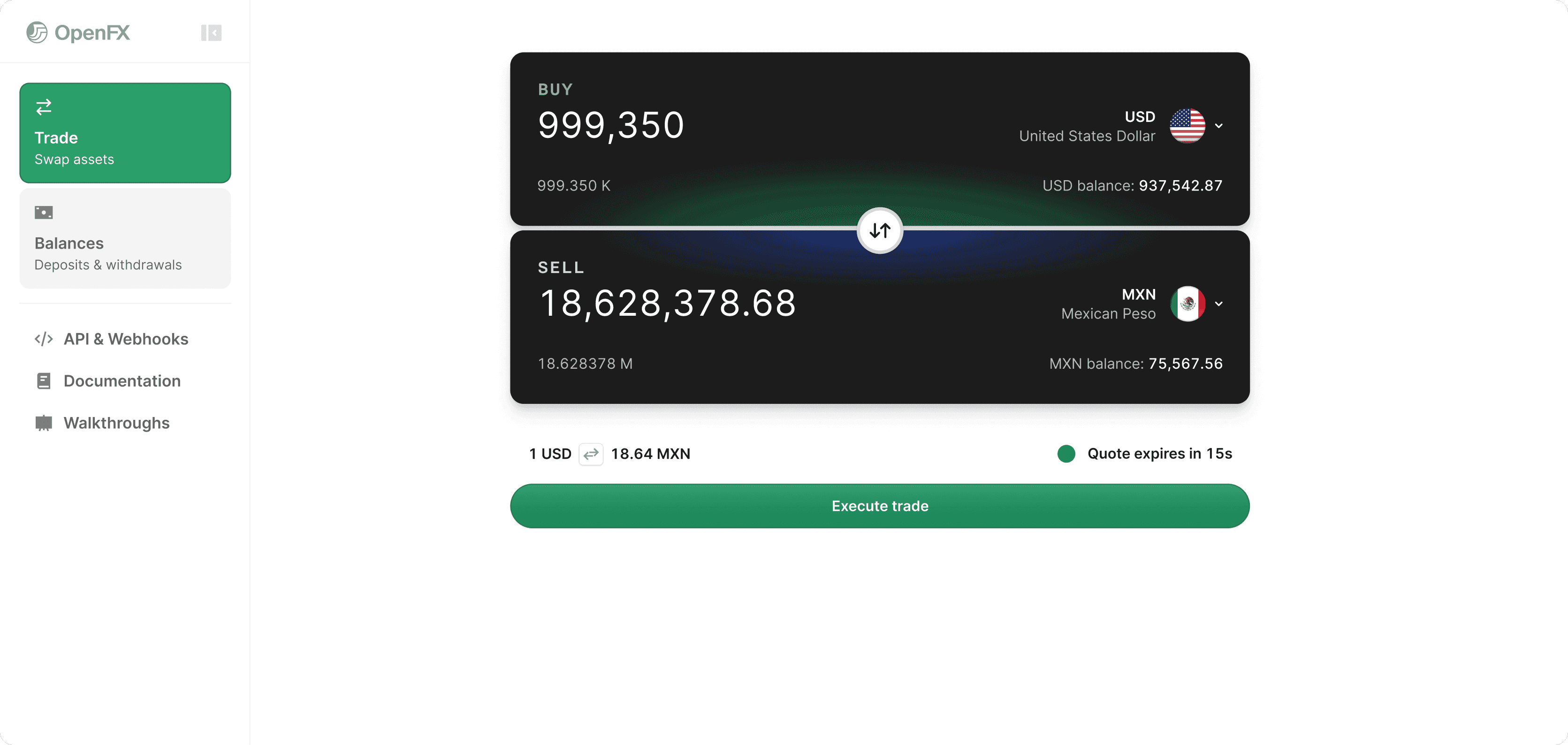
OpenFX trading interface.

FX liquidity available 24/7

Settle multiple times a day. Withdraw in under 60 mins.

FX liquidity available 24/7

Settle multiple times a day. Withdraw in under 60 mins.

OpenFX trading interface.

Ask AI about OpenFX

Global network

Teams operating across North America, Europe, Middle East, and Asia

Operating Hours

We never close. Our platform and
support teams are available 24/7/365

Write to us

Red Envelope Delta, Inc, NMLS ID No. 2680829
All rights reserved, © OpenFX 2026.

Ask AI about OpenFX

Global network

Teams operating across North America, Europe, Middle East, and Asia

Operating Hours

We never close. Our platform and support teams are available 24/7/365

Write to us

Red Envelope Delta, Inc, NMLS ID No. 2680829
All rights reserved, © OpenFX 2026.

Ask AI about OpenFX

Global network

Teams operating across North America, Europe, Middle East, and Asia

Operating Hours

We never close. Our platform
and support teams are available 24/7/365

Write to us

Red Envelope Delta, Inc, NMLS ID No. 2680829
All rights reserved, © OpenFX 2026.