January 23, 2026

10 Years of Cross-Border Payments Innovation (Sort Of)

Harrison Mann, Head of Growth of OpenFX

Harrison Mann,

Head of Growth

Stylized image of OpenFX logo over green glass 3D shapes.

People change a ton in 10 years. Businesses and industries do too, so we thought we’d check in: Have cross-border payments changed much in a decade? (Spoiler: Meh.)

10 years ago

In 2016, sending money anywhere outside of the G7 was miserable:

  • 3-5 day settlement times, at minimum.

  • Opaque, unpredictable fees stacked up at every intermediary.

  • A near complete lack of transparency, with no way of knowing when and sometimes if the recipient actually received their funds.

It was error-prone, manual, and not much different from the 1970s. While people knew the problem existed, they kinda let it fester, because most of the “transactions that mattered” were moving pretty fast.

This was fine if all you wanted to do was transfer money between New York and London, Singapore and Tokyo, but it was a disaster if your pairs touched Latin America, much of Asia, and the entire global South.

SWIFT was the backbone of all of this. Founded in 1973, it spent decades operating as the messaging standard for international transfers. It worked … in the sense that messages eventually got delivered. But it was slow, expensive, and completely blind—once you sent a payment, you just hoped it arrived.

Credit where it’s due: SWIFT realized this wasn’t ideal, so it launched Global Payments Innovation (GPI) in 2017. This partially addressed the problem, improving speed and traceability across the network.

10 years later

Banks loved GPI! It was adopted by more than 4,000 financial institutions, and roughly $530 billion in value (82% of all SWIFT payments) are sent through GPI. Nearly 60% of payments arrive within an hour and nearly 100% arrive on the same day.

Two big caveats:

  • That speed refers to arrival at destination banks, not in customers’ accounts

  • It pretty much only applies to major corridors.

“Exotic corridors” still see days-long delays. You still can’t move money between Colombia and Nigeria without an intermediary hop through USD and maybe a week’s time between transfer and settlement, assuming you’re very lucky.

Ten years have passed, much innovation has been had, but ultimately the core problem from 2016 remains unchanged. At least for traditional finance.

Over that same period, fintechs have been using stablecoins as a way to shortcut the traditional correspondent banking systems. This has allowed them to speed settlements, increase transparency, and reduce cost across corridors that traditional finance has long neglected.

Like the Eye of Sauron, SWIFT saw all. And it moved with its characteristic speed to neutralize the threat. Some months ago, it announced plans to launch its own digital ledger, transitioning from a pure messaging service to a blockchain infrastructure provider. It’s also working with a coalition of international banks to trial “global interoperability services for both digital and fiat assets”.

So ten years on, their answer to the question, “how do we quickly and reliably move money across the entire globe,” is just… stablecoins.

People change a ton in 10 years. Businesses and industries do too, so we thought we’d check in: Have cross-border payments changed much in a decade? (Spoiler: Meh.)

10 years ago

In 2016, sending money anywhere outside of the G7 was miserable:

  • 3-5 day settlement times, at minimum.

  • Opaque, unpredictable fees stacked up at every intermediary.

  • A near complete lack of transparency, with no way of knowing when and sometimes if the recipient actually received their funds.

It was error-prone, manual, and not much different from the 1970s. While people knew the problem existed, they kinda let it fester, because most of the “transactions that mattered” were moving pretty fast.

This was fine if all you wanted to do was transfer money between New York and London, Singapore and Tokyo, but it was a disaster if your pairs touched Latin America, much of Asia, and the entire global South.

SWIFT was the backbone of all of this. Founded in 1973, it spent decades operating as the messaging standard for international transfers. It worked … in the sense that messages eventually got delivered. But it was slow, expensive, and completely blind—once you sent a payment, you just hoped it arrived.

Credit where it’s due: SWIFT realized this wasn’t ideal, so it launched Global Payments Innovation (GPI) in 2017. This partially addressed the problem, improving speed and traceability across the network.

10 years later

Banks loved GPI! It was adopted by more than 4,000 financial institutions, and roughly $530 billion in value (82% of all SWIFT payments) are sent through GPI. Nearly 60% of payments arrive within an hour and nearly 100% arrive on the same day.

Two big caveats:

  • That speed refers to arrival at destination banks, not in customers’ accounts

  • It pretty much only applies to major corridors.

“Exotic corridors” still see days-long delays. You still can’t move money between Colombia and Nigeria without an intermediary hop through USD and maybe a week’s time between transfer and settlement, assuming you’re very lucky.

Ten years have passed, much innovation has been had, but ultimately the core problem from 2016 remains unchanged. At least for traditional finance.

Over that same period, fintechs have been using stablecoins as a way to shortcut the traditional correspondent banking systems. This has allowed them to speed settlements, increase transparency, and reduce cost across corridors that traditional finance has long neglected.

Like the Eye of Sauron, SWIFT saw all. And it moved with its characteristic speed to neutralize the threat. Some months ago, it announced plans to launch its own digital ledger, transitioning from a pure messaging service to a blockchain infrastructure provider. It’s also working with a coalition of international banks to trial “global interoperability services for both digital and fiat assets”.

So ten years on, their answer to the question, “how do we quickly and reliably move money across the entire globe,” is just… stablecoins.

People change a ton in 10 years. Businesses and industries do too, so we thought we’d check in: Have cross-border payments changed much in a decade? (Spoiler: Meh.)

10 years ago

In 2016, sending money anywhere outside of the G7 was miserable:

  • 3-5 day settlement times, at minimum.

  • Opaque, unpredictable fees stacked up at every intermediary.

  • A near complete lack of transparency, with no way of knowing when and sometimes if the recipient actually received their funds.

It was error-prone, manual, and not much different from the 1970s. While people knew the problem existed, they kinda let it fester, because most of the “transactions that mattered” were moving pretty fast.

This was fine if all you wanted to do was transfer money between New York and London, Singapore and Tokyo, but it was a disaster if your pairs touched Latin America, much of Asia, and the entire global South.

SWIFT was the backbone of all of this. Founded in 1973, it spent decades operating as the messaging standard for international transfers. It worked … in the sense that messages eventually got delivered. But it was slow, expensive, and completely blind—once you sent a payment, you just hoped it arrived.

Credit where it’s due: SWIFT realized this wasn’t ideal, so it launched Global Payments Innovation (GPI) in 2017. This partially addressed the problem, improving speed and traceability across the network.

10 years later

Banks loved GPI! It was adopted by more than 4,000 financial institutions, and roughly $530 billion in value (82% of all SWIFT payments) are sent through GPI. Nearly 60% of payments arrive within an hour and nearly 100% arrive on the same day.

Two big caveats:

  • That speed refers to arrival at destination banks, not in customers’ accounts

  • It pretty much only applies to major corridors.

“Exotic corridors” still see days-long delays. You still can’t move money between Colombia and Nigeria without an intermediary hop through USD and maybe a week’s time between transfer and settlement, assuming you’re very lucky.

Ten years have passed, much innovation has been had, but ultimately the core problem from 2016 remains unchanged. At least for traditional finance.

Over that same period, fintechs have been using stablecoins as a way to shortcut the traditional correspondent banking systems. This has allowed them to speed settlements, increase transparency, and reduce cost across corridors that traditional finance has long neglected.

Like the Eye of Sauron, SWIFT saw all. And it moved with its characteristic speed to neutralize the threat. Some months ago, it announced plans to launch its own digital ledger, transitioning from a pure messaging service to a blockchain infrastructure provider. It’s also working with a coalition of international banks to trial “global interoperability services for both digital and fiat assets”.

So ten years on, their answer to the question, “how do we quickly and reliably move money across the entire globe,” is just… stablecoins.

Share article

FX liquidity available 24/7

Settle multiple times a day. Withdraw in under 60 mins.

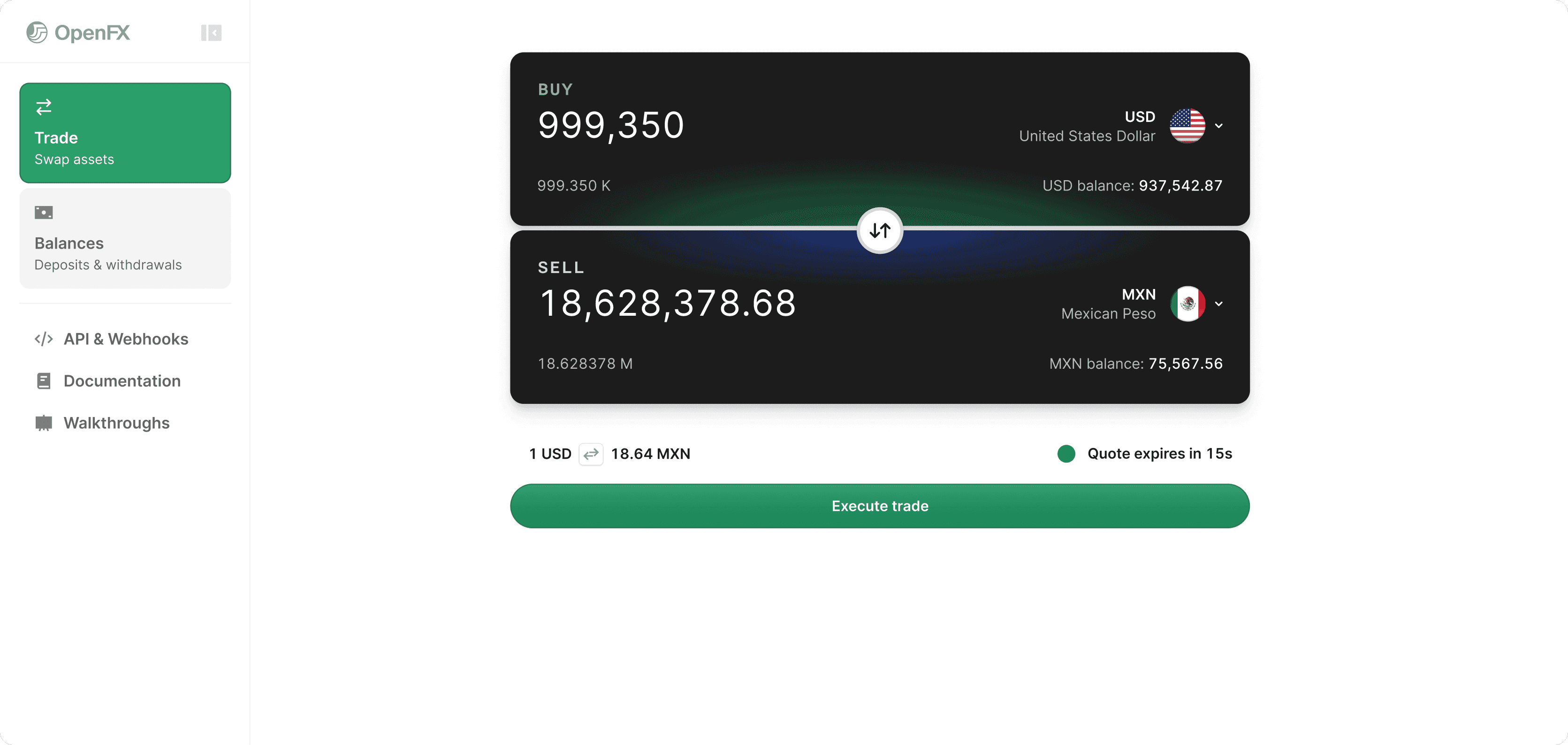
OpenFX trading interface.

FX liquidity available 24/7

Settle multiple times a day. Withdraw in under 60 mins.

FX liquidity available 24/7

Settle multiple times a day. Withdraw in under 60 mins.

OpenFX trading interface.

Ask AI about OpenFX

Global network

Teams operating across North America, Europe, Middle East, and Asia

Operating Hours

We never close. Our platform and
support teams are available 24/7/365

Write to us

Red Envelope Delta, Inc, NMLS ID No. 2680829
All rights reserved, © OpenFX 2026.

Ask AI about OpenFX

Global network

Teams operating across North America, Europe, Middle East, and Asia

Operating Hours

We never close. Our platform and support teams are available 24/7/365

Write to us

Red Envelope Delta, Inc, NMLS ID No. 2680829
All rights reserved, © OpenFX 2026.

Ask AI about OpenFX

Global network

Teams operating across North America, Europe, Middle East, and Asia

Operating Hours

We never close. Our platform
and support teams are available 24/7/365

Write to us

Red Envelope Delta, Inc, NMLS ID No. 2680829
All rights reserved, © OpenFX 2026.