January 27, 2026

Understanding FX and Cross-Border Payments in Argentina (Updated: 2026)

OpenFX logo

OpenFX

Stylized image of stacks of Argentine Pesos

Understanding FX and Cross-Border Payments in Argentina (Updated: 2025)

For years, Argentina’s economy operated under a cloud of crippling currency controls. Businesses faced long waits to pay for imports, and regular folks were forced to navigate a thriving black market to access foreign exchange (usually at extortionate rates). But a dramatic shift seems to be underway.

Recent, sweeping reforms under President Javier Milei are dismantling the old system. Since April 2025, the government has ended most capital controls, allowing businesses and individuals to freely buy dollars and settle international payments with far less bureaucratic drag.

This liberalization, backed by a $20 billion IMF deal, a $20 billion U.S. pledge to backstop the country's financial system, and the end of the “dollar blend” system (explored below), aims to normalize trade, tame inflation, and bring cross-border payments out of the black market and back onto official rails.

To understand the scale of this transformation, it helps to understand a bit more about the Argentine economy.

Argentina at a Glance

  • Population: Argentina is home to approximately 45.85 million people as of mid-2025, with a highly urbanized population (96%) and a median age of 32.9 years.

  • Economic Output: The nation's nominal GDP stood at roughly $633 billion in 2024.

  • Trade Balance: Trade accounts for about 27% of GDP. In 2024, Argentina posted a strong trade surplus of $18.9 billion, with exports of $79.7 billion and imports of $60.8 (down 17.5%) billion.

  • Remittances: Inflows from personal remittances are relatively small, totaling $1.04 billion in 2024, or just 0.2% of GDP.

  • Digital Economy: The e-commerce sector is booming, generating $26.7 billion in 2023 and seeing revenue grow by a staggering 248% in 2024. Digital wallets are on track to make up 59% of e-commerce payments by 2027, with mobile devices accounting for 70% of online purchases.

  • Cryptocurrency Adoption: Argentina has the highest crypto adoption rate globally, with 30% of the population owning digital assets in 2024. The country processes $91.1 billion in crypto volume, a figure that represents over 61% of Latin America's entire stablecoin market. Ripio, Lemon Cash and SatoshiTango are popular platforms in the nation.

Before the Reforms

The old regime, known as cepo cambiario was marked chiefly by: 

  • High inflation, leading to significant currency risk

  • Long settlement times that exacerbated these risks

  • Extremely high cross-border payment fees 

  • Significant bureaucratic drag

In the best possible case, moving money into and out of the country was difficult and expensive.

Businesses buying U.S. dollars were hit with the official exchange rate plus a 17.5% PAIS tax, meaning that their effective rate could be thousands of basis points. Banks and brokers took their own steep fees on FX, often charging between 50-150 points above the mid-market rate. 

Consumers faced even steeper costs, which pushed many to the infamous “blue dollar” black market, which offered a parallel (and often significantly lower) exchange rate for USD. To work around the system, companies resorted to complex maneuvers like pre-funding offshore accounts or using “blue-chip swaps.”

The human cost was immense. In late 2024 alone, the deepening currency crisis contributed to the closure of 16,500 SMEs, resulting in the loss of nearly 160,000 jobs.

Understand the Dollar Blend

At the center of the old export system was a mechanism known as the "dollar blend." 

Imagine you're a farmer who sells $100 worth of apples abroad. The government has two official exchange rates:

  • The Official Rate (MULC): This is a low, controlled rate, let's say 800 pesos per dollar.

  • The Financial Rate (CCL/MEP): This is a higher, market-driven rate, let's say 1,000 pesos per dollar.

Under the "dollar blend" rules, you can't just change your $100 at the best rate. Instead, you have to split it:

  • The 80% Portion: You are required to sell the first $80 of your earnings at the low, official rate.

    • 80×800 pesos/dollar=64,000 pesos.

  • The 20% "Sweetener": You are allowed to sell the remaining $20 at the much better financial rate.

    • 20×1,000 pesos/dollar=20,000 pesos.

You add both amounts together: 64,000+20,000=84,000 pesos for your $100 export.

The result was a "blended" average rate (840 pesos per dollar) that was better than the official one, acting as a small incentive for exporters. 

While this system did provide some benefits for exporters, it added significant complexity and distortions to the FX market. Without a single, clear exchange rate it was difficult for businesses to forecast costs and price goods efficiently. Importers also didn’t benefit from dollar blend, and were forced to not only pay the official rate but also the PAIS tax. 

Alongside the significant restrictions on repatriating profits, this discouraged foreign investment, and added major risks for anyone who wanted to participate in the Argentinian markets.  

This program was officially repealed in April 2025 (via Decree 269/2025), and now 100% of export proceeds must be sold at the single official market rate.

The End of Cepo Cambiario

On top of ending the dollar blend, the Milei reforms have lifted many other restrictions on the FX market:

  • No more caps on buying dollars via bank transfers: Individuals and companies can now purchase as many U.S. dollars as they wish through the official market. The old US $200 monthly cap for bank transfers is gone.

  • Importers no longer wait 30 days: Companies can pay for imported goods immediately once customs clearance is complete. There are special provisions for SMEs and capital‑goods imports to ensure they get access as soon as shipments land.

  • Profit repatriation is allowed: Argentine companies can now access the official market to repatriate profits and pay dividends to foreign shareholders.

  • Black‑market money changers (“arbolitos”) are losing relevance: As official and informal (“blue dollar”) rates converge, the need for black market money exchange has begun to shrink.

FX Tailwinds and Stormclouds

This new environment presents both powerful tailwinds and significant lingering challenges for Argentinian businesses. 

Tailwinds

Liberalization of the FX regime – Removing the cepo cambiario has dramatically opened up access to FX markets, reducing fees and speeding settlements. Businesses no longer have to navigate as many onerous regulations or pay punitive taxes just to buy dollars.

Export rebound – A favorable 2024/25 harvest and strong commodity prices should increase FX inflows. Repealing the dollar blend encourages exporters to settle proceeds through official channels, reinforcing the peso’s credibility internationally.

Digital commerce boom – E‑commerce growth and mobile payments adoption are creating demand for low‑cost FX and payment solutions. The sector accounted for US $26.7 billion in transaction volume in 2023, with projections it will grow 17% CAGR until 2027. While it was economic volatility that initially spurred this trend, it is likely that the sector will continue to grow as consumers get used to the speed and efficiency of digital commerce.

Fintech & stablecoins – Argentina leads South America in stablecoin usage. Stablecoins are used informally to hedge peso risk and to move money over weekends when banks are closed. According to a Chainalysis survey (Montagner 2023), the country is the largest stablecoin user in LATAM. This appetite for digital assets creates fertile ground for modern payment rails.

Stormclouds

Currency volatility & inflation – Despite reforms, core inflation remains high and the peso is expected to depreciate in the short term, leaving SMEs exposed. Hedging instruments are still limited and require credit lines.

Informal economy – A vast informal sector still relies on the black market to avoid taxes, sustaining demand for arbolitos despite rate convergence

“And there will still be demand for the black market from the country's large informal workforce, said Federico Filippini, chief economist at financial consultancy Adcap in Buenos Aires. Both informal workers and business owners with undeclared income use the black market for exchange to avoid attention from the tax authorities.” 

US $266.8B are still held in “mattress dollars” outside of the formal economic system, while this is down from 2024 it still represents a massive economic drag. 

Liquidity & market depth – Even with unified rates, onshore liquidity can be thin, causing wider spreads for exotic pairs or large ticket purchases. Many cross‑currency payments still route through USD, adding cost and complexity. Rates have reached as high as 25-30% during crisis periods, though this has settled somewhat since reforms

Austerity - Despite the improvements in inflation, austerity measures are cutting into citizens ability to save,

“Many Argentines have also traditionally converted part of their peso income into dollars as a bulwark against volatility. But, said Guadalupe Calvano, a high school teacher in Buenos Aires, the reality was that many now did not have enough spare cash to convert it into dollars - on the black market or otherwise. ‘People lost their capacity to save,’ said Calvano. She said she used to put aside 10% of her salary to buy dollars but has stopped doing so because her salary has not increased to match a recent uptick in the cost of goods and the price of her utility bills.”

Wages have remained largely stagnant while cost of living has skyrocketed. Rents, food and services are all more expensive, leaving many households struggling to keep up.

Poverty Rate and Economic Vulnerability: The poverty rate surged to 52.9% in early 2024 after a sharp currency devaluation. As inflation slowed later in the year, the poverty rate fell back to 38.1%, which is still incredibly high. In addition, Argentina’s economy remains highly dependent on a few key trade goods: soybeans, corn, oil and lithium, making it vulnerable to commodity price swings.

Macroeconomic Trauma: After numerous economic shocks, many Argentines have grown to distrust their currency. It’s common to convert pesos to USD almost immediately upon receiving it, a phenomenon dubbed dólar ahorro. Safety deposit box demand far outstrips banking capacity, with 800,000 boxes around the country filled with USD

Where OpenFX Fits

  • Argentina is at an inflection point. Even after reforms, cross-border payments often involve costly intermediary hops (e.g., ARS to USD to a third currency), and significant currency risk remains. 

  • Liquidity is also a major problem, with many exotic pairs thinly traded and extremely expensive to settle. 

  • SMEs are uniquely exposed, over 100K SMEs failed at the end of 2024, and with depreciation potentially hitting them with another wave of economic turmoil, this is a period where getting access to more reliable rails could be immensely valuable.

Macroeconomics

Indicators

Indicator
2023 (Actual)
2024 (Estimate)
2025 (Forecast)
2026 (Forecast)

Real GDP Growth (%)
-1.6%
-1.8%
5.5%
4.5%

Annual Inflation (Average, %)
133.5%
219.9%
36.0%
14.5%

Fiscal Balance (% of GDP)
-4.6%
0.7%
0.5%
0.9%

Public Debt (% of GDP)
155.4%
85.3%
78.9%
74.6%

Sources: World Bank, IMF , OECD, FRED.


Imports/Exports

Partner
Value (USD Billion)
Share of Total

Top 5 Export Destinations (2024)


Brazil
$13.62
17.1%

United States
$6.48
8.1%

Chile
$6.34
7.9%

China
$5.98
7.5%

India
$3.93
4.9%

Top 5 Import Sources (2024)


Brazil
$14.35
23.6%

China
$11.56
19.0%

United States
$6.08
10.0%

Paraguay
$3.04
5.0%

Germany
$2.43
4.0%


Sources: INDEC , Trading Economics

Understanding FX and Cross-Border Payments in Argentina (Updated: 2025)

For years, Argentina’s economy operated under a cloud of crippling currency controls. Businesses faced long waits to pay for imports, and regular folks were forced to navigate a thriving black market to access foreign exchange (usually at extortionate rates). But a dramatic shift seems to be underway.

Recent, sweeping reforms under President Javier Milei are dismantling the old system. Since April 2025, the government has ended most capital controls, allowing businesses and individuals to freely buy dollars and settle international payments with far less bureaucratic drag.

This liberalization, backed by a $20 billion IMF deal, a $20 billion U.S. pledge to backstop the country's financial system, and the end of the “dollar blend” system (explored below), aims to normalize trade, tame inflation, and bring cross-border payments out of the black market and back onto official rails.

To understand the scale of this transformation, it helps to understand a bit more about the Argentine economy.

Argentina at a Glance

  • Population: Argentina is home to approximately 45.85 million people as of mid-2025, with a highly urbanized population (96%) and a median age of 32.9 years.

  • Economic Output: The nation's nominal GDP stood at roughly $633 billion in 2024.

  • Trade Balance: Trade accounts for about 27% of GDP. In 2024, Argentina posted a strong trade surplus of $18.9 billion, with exports of $79.7 billion and imports of $60.8 (down 17.5%) billion.

  • Remittances: Inflows from personal remittances are relatively small, totaling $1.04 billion in 2024, or just 0.2% of GDP.

  • Digital Economy: The e-commerce sector is booming, generating $26.7 billion in 2023 and seeing revenue grow by a staggering 248% in 2024. Digital wallets are on track to make up 59% of e-commerce payments by 2027, with mobile devices accounting for 70% of online purchases.

  • Cryptocurrency Adoption: Argentina has the highest crypto adoption rate globally, with 30% of the population owning digital assets in 2024. The country processes $91.1 billion in crypto volume, a figure that represents over 61% of Latin America's entire stablecoin market. Ripio, Lemon Cash and SatoshiTango are popular platforms in the nation.

Before the Reforms

The old regime, known as cepo cambiario was marked chiefly by: 

  • High inflation, leading to significant currency risk

  • Long settlement times that exacerbated these risks

  • Extremely high cross-border payment fees 

  • Significant bureaucratic drag

In the best possible case, moving money into and out of the country was difficult and expensive.

Businesses buying U.S. dollars were hit with the official exchange rate plus a 17.5% PAIS tax, meaning that their effective rate could be thousands of basis points. Banks and brokers took their own steep fees on FX, often charging between 50-150 points above the mid-market rate. 

Consumers faced even steeper costs, which pushed many to the infamous “blue dollar” black market, which offered a parallel (and often significantly lower) exchange rate for USD. To work around the system, companies resorted to complex maneuvers like pre-funding offshore accounts or using “blue-chip swaps.”

The human cost was immense. In late 2024 alone, the deepening currency crisis contributed to the closure of 16,500 SMEs, resulting in the loss of nearly 160,000 jobs.

Understand the Dollar Blend

At the center of the old export system was a mechanism known as the "dollar blend." 

Imagine you're a farmer who sells $100 worth of apples abroad. The government has two official exchange rates:

  • The Official Rate (MULC): This is a low, controlled rate, let's say 800 pesos per dollar.

  • The Financial Rate (CCL/MEP): This is a higher, market-driven rate, let's say 1,000 pesos per dollar.

Under the "dollar blend" rules, you can't just change your $100 at the best rate. Instead, you have to split it:

  • The 80% Portion: You are required to sell the first $80 of your earnings at the low, official rate.

    • 80×800 pesos/dollar=64,000 pesos.

  • The 20% "Sweetener": You are allowed to sell the remaining $20 at the much better financial rate.

    • 20×1,000 pesos/dollar=20,000 pesos.

You add both amounts together: 64,000+20,000=84,000 pesos for your $100 export.

The result was a "blended" average rate (840 pesos per dollar) that was better than the official one, acting as a small incentive for exporters. 

While this system did provide some benefits for exporters, it added significant complexity and distortions to the FX market. Without a single, clear exchange rate it was difficult for businesses to forecast costs and price goods efficiently. Importers also didn’t benefit from dollar blend, and were forced to not only pay the official rate but also the PAIS tax. 

Alongside the significant restrictions on repatriating profits, this discouraged foreign investment, and added major risks for anyone who wanted to participate in the Argentinian markets.  

This program was officially repealed in April 2025 (via Decree 269/2025), and now 100% of export proceeds must be sold at the single official market rate.

The End of Cepo Cambiario

On top of ending the dollar blend, the Milei reforms have lifted many other restrictions on the FX market:

  • No more caps on buying dollars via bank transfers: Individuals and companies can now purchase as many U.S. dollars as they wish through the official market. The old US $200 monthly cap for bank transfers is gone.

  • Importers no longer wait 30 days: Companies can pay for imported goods immediately once customs clearance is complete. There are special provisions for SMEs and capital‑goods imports to ensure they get access as soon as shipments land.

  • Profit repatriation is allowed: Argentine companies can now access the official market to repatriate profits and pay dividends to foreign shareholders.

  • Black‑market money changers (“arbolitos”) are losing relevance: As official and informal (“blue dollar”) rates converge, the need for black market money exchange has begun to shrink.

FX Tailwinds and Stormclouds

This new environment presents both powerful tailwinds and significant lingering challenges for Argentinian businesses. 

Tailwinds

Liberalization of the FX regime – Removing the cepo cambiario has dramatically opened up access to FX markets, reducing fees and speeding settlements. Businesses no longer have to navigate as many onerous regulations or pay punitive taxes just to buy dollars.

Export rebound – A favorable 2024/25 harvest and strong commodity prices should increase FX inflows. Repealing the dollar blend encourages exporters to settle proceeds through official channels, reinforcing the peso’s credibility internationally.

Digital commerce boom – E‑commerce growth and mobile payments adoption are creating demand for low‑cost FX and payment solutions. The sector accounted for US $26.7 billion in transaction volume in 2023, with projections it will grow 17% CAGR until 2027. While it was economic volatility that initially spurred this trend, it is likely that the sector will continue to grow as consumers get used to the speed and efficiency of digital commerce.

Fintech & stablecoins – Argentina leads South America in stablecoin usage. Stablecoins are used informally to hedge peso risk and to move money over weekends when banks are closed. According to a Chainalysis survey (Montagner 2023), the country is the largest stablecoin user in LATAM. This appetite for digital assets creates fertile ground for modern payment rails.

Stormclouds

Currency volatility & inflation – Despite reforms, core inflation remains high and the peso is expected to depreciate in the short term, leaving SMEs exposed. Hedging instruments are still limited and require credit lines.

Informal economy – A vast informal sector still relies on the black market to avoid taxes, sustaining demand for arbolitos despite rate convergence

“And there will still be demand for the black market from the country's large informal workforce, said Federico Filippini, chief economist at financial consultancy Adcap in Buenos Aires. Both informal workers and business owners with undeclared income use the black market for exchange to avoid attention from the tax authorities.” 

US $266.8B are still held in “mattress dollars” outside of the formal economic system, while this is down from 2024 it still represents a massive economic drag. 

Liquidity & market depth – Even with unified rates, onshore liquidity can be thin, causing wider spreads for exotic pairs or large ticket purchases. Many cross‑currency payments still route through USD, adding cost and complexity. Rates have reached as high as 25-30% during crisis periods, though this has settled somewhat since reforms

Austerity - Despite the improvements in inflation, austerity measures are cutting into citizens ability to save,

“Many Argentines have also traditionally converted part of their peso income into dollars as a bulwark against volatility. But, said Guadalupe Calvano, a high school teacher in Buenos Aires, the reality was that many now did not have enough spare cash to convert it into dollars - on the black market or otherwise. ‘People lost their capacity to save,’ said Calvano. She said she used to put aside 10% of her salary to buy dollars but has stopped doing so because her salary has not increased to match a recent uptick in the cost of goods and the price of her utility bills.”

Wages have remained largely stagnant while cost of living has skyrocketed. Rents, food and services are all more expensive, leaving many households struggling to keep up.

Poverty Rate and Economic Vulnerability: The poverty rate surged to 52.9% in early 2024 after a sharp currency devaluation. As inflation slowed later in the year, the poverty rate fell back to 38.1%, which is still incredibly high. In addition, Argentina’s economy remains highly dependent on a few key trade goods: soybeans, corn, oil and lithium, making it vulnerable to commodity price swings.

Macroeconomic Trauma: After numerous economic shocks, many Argentines have grown to distrust their currency. It’s common to convert pesos to USD almost immediately upon receiving it, a phenomenon dubbed dólar ahorro. Safety deposit box demand far outstrips banking capacity, with 800,000 boxes around the country filled with USD

Where OpenFX Fits

  • Argentina is at an inflection point. Even after reforms, cross-border payments often involve costly intermediary hops (e.g., ARS to USD to a third currency), and significant currency risk remains. 

  • Liquidity is also a major problem, with many exotic pairs thinly traded and extremely expensive to settle. 

  • SMEs are uniquely exposed, over 100K SMEs failed at the end of 2024, and with depreciation potentially hitting them with another wave of economic turmoil, this is a period where getting access to more reliable rails could be immensely valuable.

Macroeconomics

Indicators

Indicator
2023 (Actual)
2024 (Estimate)
2025 (Forecast)
2026 (Forecast)

Real GDP Growth (%)
-1.6%
-1.8%
5.5%
4.5%

Annual Inflation (Average, %)
133.5%
219.9%
36.0%
14.5%

Fiscal Balance (% of GDP)
-4.6%
0.7%
0.5%
0.9%

Public Debt (% of GDP)
155.4%
85.3%
78.9%
74.6%

Sources: World Bank, IMF , OECD, FRED.


Imports/Exports

Partner
Value (USD Billion)
Share of Total

Top 5 Export Destinations (2024)


Brazil
$13.62
17.1%

United States
$6.48
8.1%

Chile
$6.34
7.9%

China
$5.98
7.5%

India
$3.93
4.9%

Top 5 Import Sources (2024)


Brazil
$14.35
23.6%

China
$11.56
19.0%

United States
$6.08
10.0%

Paraguay
$3.04
5.0%

Germany
$2.43
4.0%


Sources: INDEC , Trading Economics

Understanding FX and Cross-Border Payments in Argentina (Updated: 2025)

For years, Argentina’s economy operated under a cloud of crippling currency controls. Businesses faced long waits to pay for imports, and regular folks were forced to navigate a thriving black market to access foreign exchange (usually at extortionate rates). But a dramatic shift seems to be underway.

Recent, sweeping reforms under President Javier Milei are dismantling the old system. Since April 2025, the government has ended most capital controls, allowing businesses and individuals to freely buy dollars and settle international payments with far less bureaucratic drag.

This liberalization, backed by a $20 billion IMF deal, a $20 billion U.S. pledge to backstop the country's financial system, and the end of the “dollar blend” system (explored below), aims to normalize trade, tame inflation, and bring cross-border payments out of the black market and back onto official rails.

To understand the scale of this transformation, it helps to understand a bit more about the Argentine economy.

Argentina at a Glance

  • Population: Argentina is home to approximately 45.85 million people as of mid-2025, with a highly urbanized population (96%) and a median age of 32.9 years.

  • Economic Output: The nation's nominal GDP stood at roughly $633 billion in 2024.

  • Trade Balance: Trade accounts for about 27% of GDP. In 2024, Argentina posted a strong trade surplus of $18.9 billion, with exports of $79.7 billion and imports of $60.8 (down 17.5%) billion.

  • Remittances: Inflows from personal remittances are relatively small, totaling $1.04 billion in 2024, or just 0.2% of GDP.

  • Digital Economy: The e-commerce sector is booming, generating $26.7 billion in 2023 and seeing revenue grow by a staggering 248% in 2024. Digital wallets are on track to make up 59% of e-commerce payments by 2027, with mobile devices accounting for 70% of online purchases.

  • Cryptocurrency Adoption: Argentina has the highest crypto adoption rate globally, with 30% of the population owning digital assets in 2024. The country processes $91.1 billion in crypto volume, a figure that represents over 61% of Latin America's entire stablecoin market. Ripio, Lemon Cash and SatoshiTango are popular platforms in the nation.

Before the Reforms

The old regime, known as cepo cambiario was marked chiefly by: 

  • High inflation, leading to significant currency risk

  • Long settlement times that exacerbated these risks

  • Extremely high cross-border payment fees 

  • Significant bureaucratic drag

In the best possible case, moving money into and out of the country was difficult and expensive.

Businesses buying U.S. dollars were hit with the official exchange rate plus a 17.5% PAIS tax, meaning that their effective rate could be thousands of basis points. Banks and brokers took their own steep fees on FX, often charging between 50-150 points above the mid-market rate. 

Consumers faced even steeper costs, which pushed many to the infamous “blue dollar” black market, which offered a parallel (and often significantly lower) exchange rate for USD. To work around the system, companies resorted to complex maneuvers like pre-funding offshore accounts or using “blue-chip swaps.”

The human cost was immense. In late 2024 alone, the deepening currency crisis contributed to the closure of 16,500 SMEs, resulting in the loss of nearly 160,000 jobs.

Understand the Dollar Blend

At the center of the old export system was a mechanism known as the "dollar blend." 

Imagine you're a farmer who sells $100 worth of apples abroad. The government has two official exchange rates:

  • The Official Rate (MULC): This is a low, controlled rate, let's say 800 pesos per dollar.

  • The Financial Rate (CCL/MEP): This is a higher, market-driven rate, let's say 1,000 pesos per dollar.

Under the "dollar blend" rules, you can't just change your $100 at the best rate. Instead, you have to split it:

  • The 80% Portion: You are required to sell the first $80 of your earnings at the low, official rate.

    • 80×800 pesos/dollar=64,000 pesos.

  • The 20% "Sweetener": You are allowed to sell the remaining $20 at the much better financial rate.

    • 20×1,000 pesos/dollar=20,000 pesos.

You add both amounts together: 64,000+20,000=84,000 pesos for your $100 export.

The result was a "blended" average rate (840 pesos per dollar) that was better than the official one, acting as a small incentive for exporters. 

While this system did provide some benefits for exporters, it added significant complexity and distortions to the FX market. Without a single, clear exchange rate it was difficult for businesses to forecast costs and price goods efficiently. Importers also didn’t benefit from dollar blend, and were forced to not only pay the official rate but also the PAIS tax. 

Alongside the significant restrictions on repatriating profits, this discouraged foreign investment, and added major risks for anyone who wanted to participate in the Argentinian markets.  

This program was officially repealed in April 2025 (via Decree 269/2025), and now 100% of export proceeds must be sold at the single official market rate.

The End of Cepo Cambiario

On top of ending the dollar blend, the Milei reforms have lifted many other restrictions on the FX market:

  • No more caps on buying dollars via bank transfers: Individuals and companies can now purchase as many U.S. dollars as they wish through the official market. The old US $200 monthly cap for bank transfers is gone.

  • Importers no longer wait 30 days: Companies can pay for imported goods immediately once customs clearance is complete. There are special provisions for SMEs and capital‑goods imports to ensure they get access as soon as shipments land.

  • Profit repatriation is allowed: Argentine companies can now access the official market to repatriate profits and pay dividends to foreign shareholders.

  • Black‑market money changers (“arbolitos”) are losing relevance: As official and informal (“blue dollar”) rates converge, the need for black market money exchange has begun to shrink.

FX Tailwinds and Stormclouds

This new environment presents both powerful tailwinds and significant lingering challenges for Argentinian businesses. 

Tailwinds

Liberalization of the FX regime – Removing the cepo cambiario has dramatically opened up access to FX markets, reducing fees and speeding settlements. Businesses no longer have to navigate as many onerous regulations or pay punitive taxes just to buy dollars.

Export rebound – A favorable 2024/25 harvest and strong commodity prices should increase FX inflows. Repealing the dollar blend encourages exporters to settle proceeds through official channels, reinforcing the peso’s credibility internationally.

Digital commerce boom – E‑commerce growth and mobile payments adoption are creating demand for low‑cost FX and payment solutions. The sector accounted for US $26.7 billion in transaction volume in 2023, with projections it will grow 17% CAGR until 2027. While it was economic volatility that initially spurred this trend, it is likely that the sector will continue to grow as consumers get used to the speed and efficiency of digital commerce.

Fintech & stablecoins – Argentina leads South America in stablecoin usage. Stablecoins are used informally to hedge peso risk and to move money over weekends when banks are closed. According to a Chainalysis survey (Montagner 2023), the country is the largest stablecoin user in LATAM. This appetite for digital assets creates fertile ground for modern payment rails.

Stormclouds

Currency volatility & inflation – Despite reforms, core inflation remains high and the peso is expected to depreciate in the short term, leaving SMEs exposed. Hedging instruments are still limited and require credit lines.

Informal economy – A vast informal sector still relies on the black market to avoid taxes, sustaining demand for arbolitos despite rate convergence

“And there will still be demand for the black market from the country's large informal workforce, said Federico Filippini, chief economist at financial consultancy Adcap in Buenos Aires. Both informal workers and business owners with undeclared income use the black market for exchange to avoid attention from the tax authorities.” 

US $266.8B are still held in “mattress dollars” outside of the formal economic system, while this is down from 2024 it still represents a massive economic drag. 

Liquidity & market depth – Even with unified rates, onshore liquidity can be thin, causing wider spreads for exotic pairs or large ticket purchases. Many cross‑currency payments still route through USD, adding cost and complexity. Rates have reached as high as 25-30% during crisis periods, though this has settled somewhat since reforms

Austerity - Despite the improvements in inflation, austerity measures are cutting into citizens ability to save,

“Many Argentines have also traditionally converted part of their peso income into dollars as a bulwark against volatility. But, said Guadalupe Calvano, a high school teacher in Buenos Aires, the reality was that many now did not have enough spare cash to convert it into dollars - on the black market or otherwise. ‘People lost their capacity to save,’ said Calvano. She said she used to put aside 10% of her salary to buy dollars but has stopped doing so because her salary has not increased to match a recent uptick in the cost of goods and the price of her utility bills.”

Wages have remained largely stagnant while cost of living has skyrocketed. Rents, food and services are all more expensive, leaving many households struggling to keep up.

Poverty Rate and Economic Vulnerability: The poverty rate surged to 52.9% in early 2024 after a sharp currency devaluation. As inflation slowed later in the year, the poverty rate fell back to 38.1%, which is still incredibly high. In addition, Argentina’s economy remains highly dependent on a few key trade goods: soybeans, corn, oil and lithium, making it vulnerable to commodity price swings.

Macroeconomic Trauma: After numerous economic shocks, many Argentines have grown to distrust their currency. It’s common to convert pesos to USD almost immediately upon receiving it, a phenomenon dubbed dólar ahorro. Safety deposit box demand far outstrips banking capacity, with 800,000 boxes around the country filled with USD

Where OpenFX Fits

  • Argentina is at an inflection point. Even after reforms, cross-border payments often involve costly intermediary hops (e.g., ARS to USD to a third currency), and significant currency risk remains. 

  • Liquidity is also a major problem, with many exotic pairs thinly traded and extremely expensive to settle. 

  • SMEs are uniquely exposed, over 100K SMEs failed at the end of 2024, and with depreciation potentially hitting them with another wave of economic turmoil, this is a period where getting access to more reliable rails could be immensely valuable.

Macroeconomics

Indicators

Indicator
2023 (Actual)
2024 (Estimate)
2025 (Forecast)
2026 (Forecast)

Real GDP Growth (%)
-1.6%
-1.8%
5.5%
4.5%

Annual Inflation (Average, %)
133.5%
219.9%
36.0%
14.5%

Fiscal Balance (% of GDP)
-4.6%
0.7%
0.5%
0.9%

Public Debt (% of GDP)
155.4%
85.3%
78.9%
74.6%

Sources: World Bank, IMF , OECD, FRED.


Imports/Exports

Partner
Value (USD Billion)
Share of Total

Top 5 Export Destinations (2024)


Brazil
$13.62
17.1%

United States
$6.48
8.1%

Chile
$6.34
7.9%

China
$5.98
7.5%

India
$3.93
4.9%

Top 5 Import Sources (2024)


Brazil
$14.35
23.6%

China
$11.56
19.0%

United States
$6.08
10.0%

Paraguay
$3.04
5.0%

Germany
$2.43
4.0%


Sources: INDEC , Trading Economics

FAQs

What was the cepo cambiario and is it really gone?
The cepo cambiario, or "exchange trap," was a broad set of capital controls that severely restricted the ability of individuals and businesses to buy foreign currency, like U.S. dollars. The April 2025 reforms eliminated most of these restrictions, particularly the monthly USD purchase limits for transfers and long waiting periods for importers, effectively ending the cepo as it was known.

Can individuals and businesses freely buy U.S. dollars now?
Yes, for the most part. The quantitative limits on buying dollars through bank transfers have been removed for both individuals and companies. The primary restriction that remains is a monthly limit on purchasing physical cash dollars.

What is the "blue dollar" and is it still relevant?
The "blue dollar" is the unofficial, black market exchange rate for the U.S. dollar, facilitated by street changers called arbilotos. It thrived when official channels were heavily restricted and taxed. Now that the official and financial rates have converged and access is easier, the massive premium on the "dollar blue" has vanished, making it far less relevant for most transactions.

Why is cryptocurrency so popular in Argentina?
Argentinians have the highest rate of crypto adoption in the world, primarily using it as a tool to protect their savings from peso devaluation and high inflation. Stablecoins (digital currencies pegged to the U.S. dollar) are especially popular, allowing people to effectively save in "dollars" and make transfers 24/7, even when banks are closed.

If the rules have improved, why are there still economic risks?
While the reforms have fixed the mechanics of the FX market, Argentina still struggles with deep-rooted challenges. These include extremely high inflation, the economic pain caused by government austerity measures, and a widespread cultural distrust of the peso after decades of currency crises. These factors ensure that currency volatility remains a significant risk.

How does Argentina’s digital‑commerce boom affect cross‑border payments?
Argentina’s e‑commerce revenue jumped 248% in 2024, with digital wallets projected to handle 59% of e‑commerce payments by 2027 and 70% of online purchases already occurring via mobile device. This rapid shift to digital buying drives demand for low‑cost, real‑time FX services for merchants and consumers.

FAQs

What was the cepo cambiario and is it really gone?
The cepo cambiario, or "exchange trap," was a broad set of capital controls that severely restricted the ability of individuals and businesses to buy foreign currency, like U.S. dollars. The April 2025 reforms eliminated most of these restrictions, particularly the monthly USD purchase limits for transfers and long waiting periods for importers, effectively ending the cepo as it was known.

Can individuals and businesses freely buy U.S. dollars now?
Yes, for the most part. The quantitative limits on buying dollars through bank transfers have been removed for both individuals and companies. The primary restriction that remains is a monthly limit on purchasing physical cash dollars.

What is the "blue dollar" and is it still relevant?
The "blue dollar" is the unofficial, black market exchange rate for the U.S. dollar, facilitated by street changers called arbilotos. It thrived when official channels were heavily restricted and taxed. Now that the official and financial rates have converged and access is easier, the massive premium on the "dollar blue" has vanished, making it far less relevant for most transactions.

Why is cryptocurrency so popular in Argentina?
Argentinians have the highest rate of crypto adoption in the world, primarily using it as a tool to protect their savings from peso devaluation and high inflation. Stablecoins (digital currencies pegged to the U.S. dollar) are especially popular, allowing people to effectively save in "dollars" and make transfers 24/7, even when banks are closed.

If the rules have improved, why are there still economic risks?
While the reforms have fixed the mechanics of the FX market, Argentina still struggles with deep-rooted challenges. These include extremely high inflation, the economic pain caused by government austerity measures, and a widespread cultural distrust of the peso after decades of currency crises. These factors ensure that currency volatility remains a significant risk.

How does Argentina’s digital‑commerce boom affect cross‑border payments?
Argentina’s e‑commerce revenue jumped 248% in 2024, with digital wallets projected to handle 59% of e‑commerce payments by 2027 and 70% of online purchases already occurring via mobile device. This rapid shift to digital buying drives demand for low‑cost, real‑time FX services for merchants and consumers.

FAQs

What was the cepo cambiario and is it really gone?
The cepo cambiario, or "exchange trap," was a broad set of capital controls that severely restricted the ability of individuals and businesses to buy foreign currency, like U.S. dollars. The April 2025 reforms eliminated most of these restrictions, particularly the monthly USD purchase limits for transfers and long waiting periods for importers, effectively ending the cepo as it was known.

Can individuals and businesses freely buy U.S. dollars now?
Yes, for the most part. The quantitative limits on buying dollars through bank transfers have been removed for both individuals and companies. The primary restriction that remains is a monthly limit on purchasing physical cash dollars.

What is the "blue dollar" and is it still relevant?
The "blue dollar" is the unofficial, black market exchange rate for the U.S. dollar, facilitated by street changers called arbilotos. It thrived when official channels were heavily restricted and taxed. Now that the official and financial rates have converged and access is easier, the massive premium on the "dollar blue" has vanished, making it far less relevant for most transactions.

Why is cryptocurrency so popular in Argentina?
Argentinians have the highest rate of crypto adoption in the world, primarily using it as a tool to protect their savings from peso devaluation and high inflation. Stablecoins (digital currencies pegged to the U.S. dollar) are especially popular, allowing people to effectively save in "dollars" and make transfers 24/7, even when banks are closed.

If the rules have improved, why are there still economic risks?
While the reforms have fixed the mechanics of the FX market, Argentina still struggles with deep-rooted challenges. These include extremely high inflation, the economic pain caused by government austerity measures, and a widespread cultural distrust of the peso after decades of currency crises. These factors ensure that currency volatility remains a significant risk.

How does Argentina’s digital‑commerce boom affect cross‑border payments?
Argentina’s e‑commerce revenue jumped 248% in 2024, with digital wallets projected to handle 59% of e‑commerce payments by 2027 and 70% of online purchases already occurring via mobile device. This rapid shift to digital buying drives demand for low‑cost, real‑time FX services for merchants and consumers.

Share article

FX liquidity available 24/7

Settle multiple times a day. Withdraw in under 60 mins.

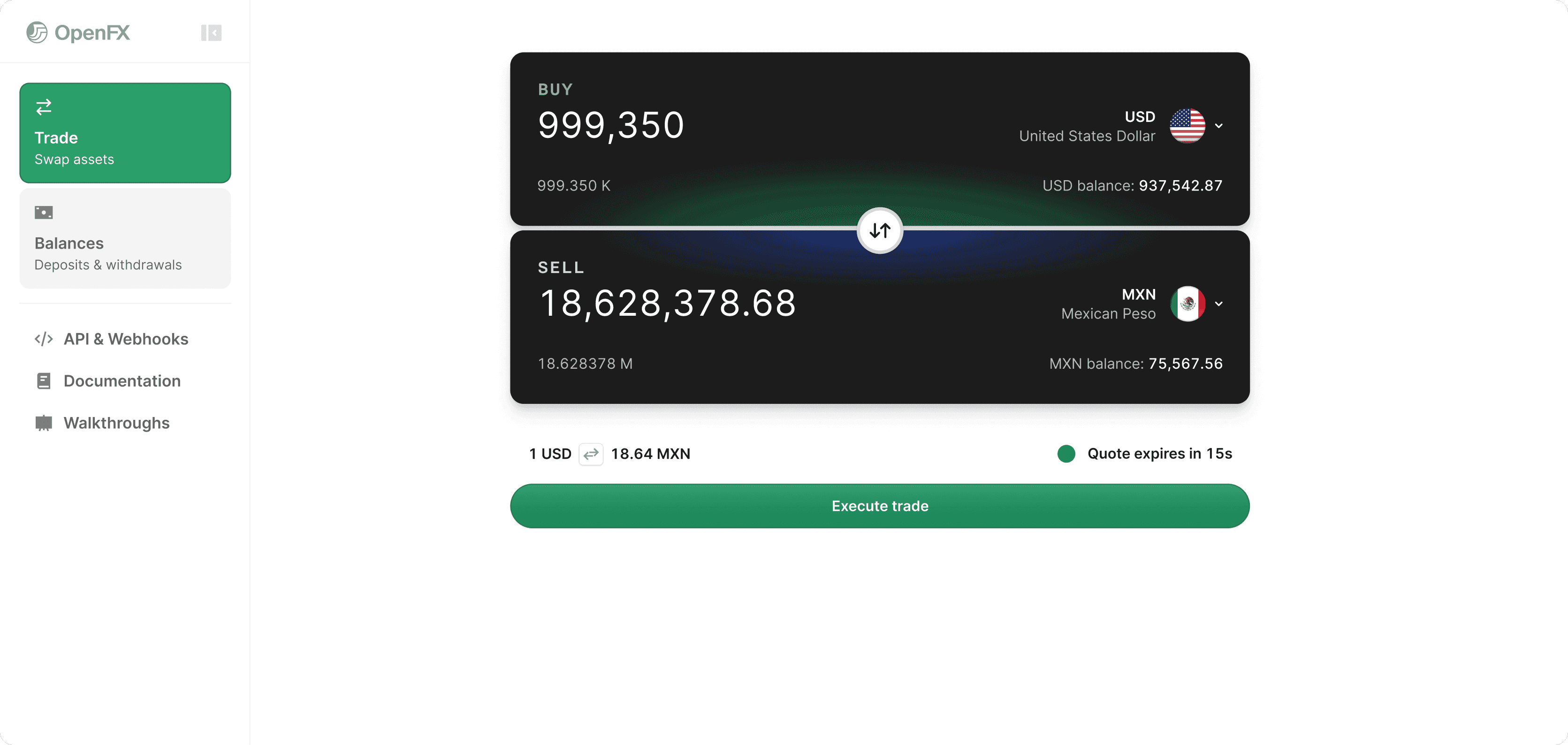
OpenFX trading interface.

FX liquidity available 24/7

Settle multiple times a day. Withdraw in under 60 mins.

FX liquidity available 24/7

Settle multiple times a day. Withdraw in under 60 mins.

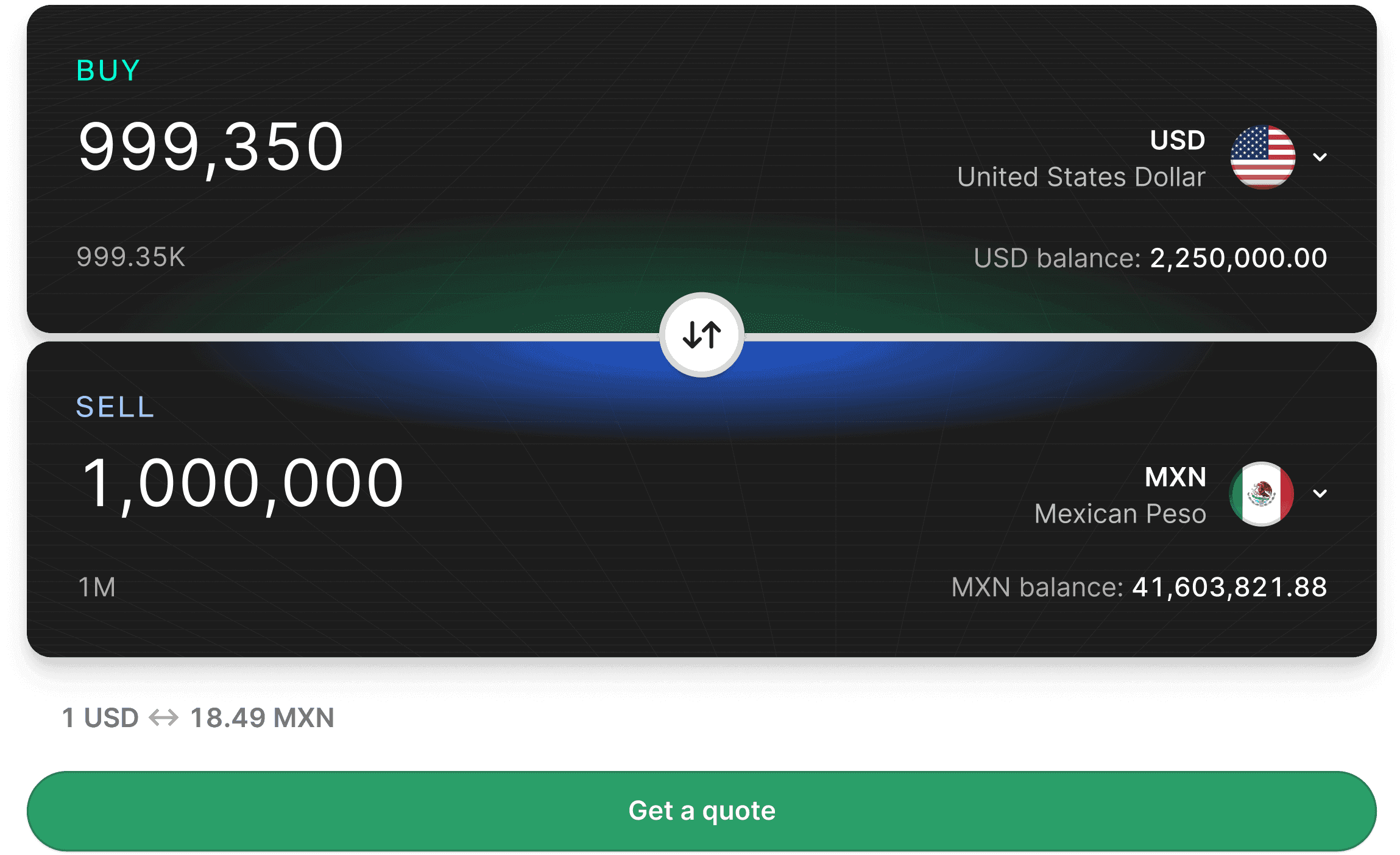
OpenFX trading interface.

Ask AI about OpenFX

Global network

Teams operating across North America, Europe, Middle East, and Asia

Operating Hours

We never close. Our platform and
support teams are available 24/7/365

Write to us

Red Envelope Delta, Inc, NMLS ID No. 2680829
All rights reserved, © OpenFX 2026.

Ask AI about OpenFX

Global network

Teams operating across North America, Europe, Middle East, and Asia

Operating Hours

We never close. Our platform and support teams are available 24/7/365

Write to us

Red Envelope Delta, Inc, NMLS ID No. 2680829
All rights reserved, © OpenFX 2026.

Ask AI about OpenFX

Global network

Teams operating across North America, Europe, Middle East, and Asia

Operating Hours

We never close. Our platform
and support teams are available 24/7/365

Write to us

Red Envelope Delta, Inc, NMLS ID No. 2680829
All rights reserved, © OpenFX 2026.