February 3, 2026

How We Grew Our TPV From $4B to $45B in 2025, And Why 2026 Will Separate Operators From Everyone Else

Harrison Mann, Head of Growth of OpenFX

Harrison Mann,

Head of Growth

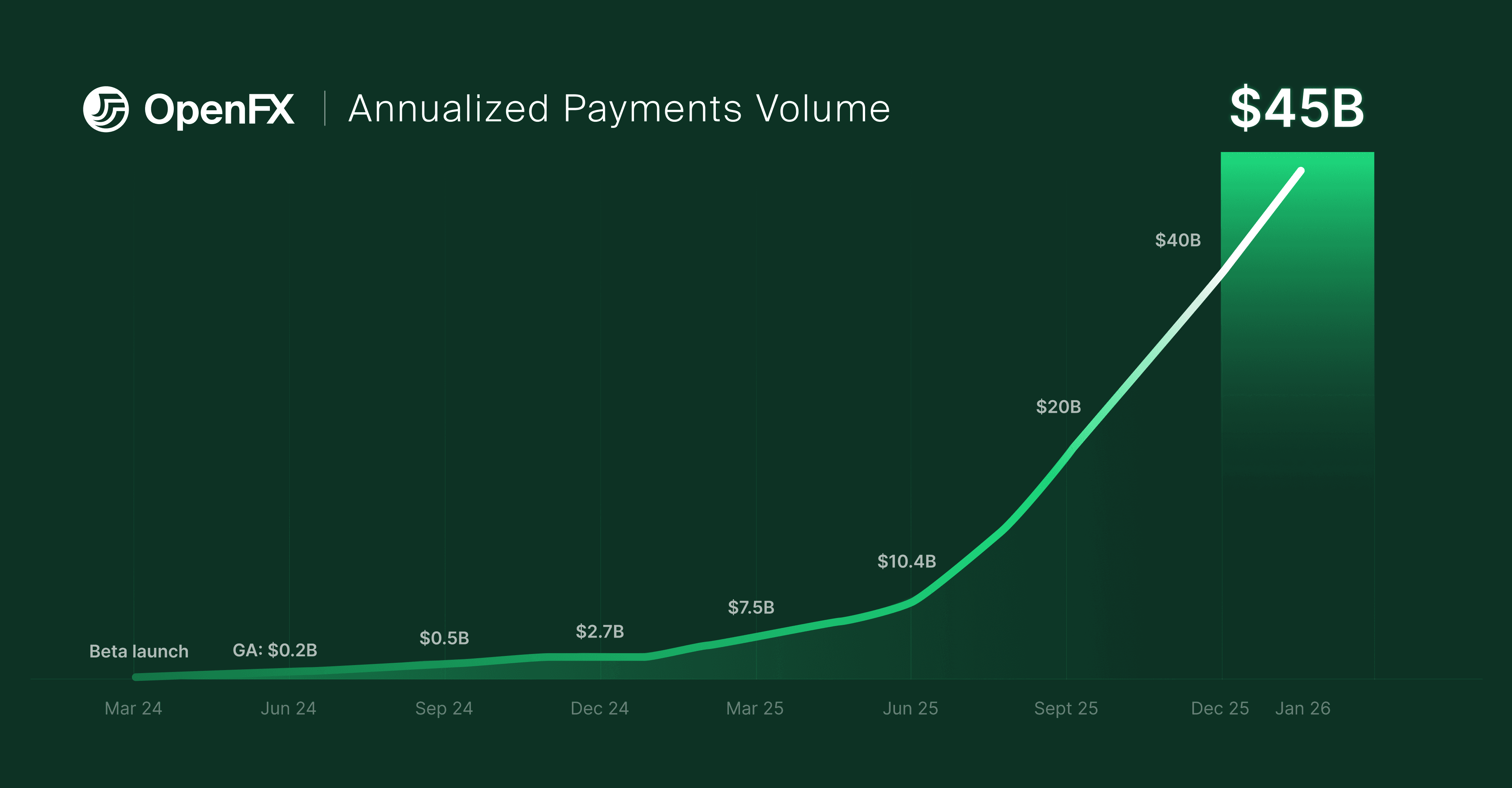
Chart showing OpenFX's total payment volume growth from $4 billion to $45 billion in January of 2026.

We grew from $4B to $45B in annualized TPV in 2025. Revenue grew 10x.

That growth happened because we solved a different problem than everyone else. While the industry spent 2025 celebrating infrastructure milestones, we built for liquidity depth. Not faster rails, deeper liquidity across more corridors.

The difference matters now.

Rails Are Only The Foundation

  • The GENIUS Act passed July 2025. 

  • The stablecoin market cap is above $250B. 

  • FedNow and RTP are processing $0.48 trillion quarterly, up 774% year-over-year. 

  • ISO 20022 is mandatory across Fedwire and Swift. 

  • Real-time infrastructure is live in 70+ countries. 

  • Nearly half of financial institutions are using blockchain-based settlement.

By the end of 2025, every provider had access to the same rails that they are desperately trying to build infrastructure on top of. In 2026, there is only one question that will separate winners from losers: who can provide the deepest, most reliable liquidity across the most corridors?

Because every problem remaining in cross-border payments is downstream of liquidity.

Weak Liquidity Leads to Weak Profitability

Smaller banks are exiting real-time payments. Not because the technology is too complex, but because they can't maintain profitable liquidity across enough corridors to justify the platform costs. When you only have liquidity in 5-10 currency pairs, the infrastructure investment doesn't pay for itself. Real-time rails require them to pre-position capital everywhere, continuously. The banks with thin liquidity networks can't afford it.

Merchant pilots are stalling. Payment providers promised merchants instant settlement would unlock better economics. But merchants are discovering that integration costs and fraud management expenses exceed the value of faster settlement, because the underlying FX spreads are still wide. When liquidity is thin, speed doesn't matter. A 200-basis-point spread executed instantly still costs 200 basis points. 

Compliance costs are forcing nonbank exits. Real-time transactions require real-time sanctions screening, KYC verification, and audit trails for every counterparty relationship. When you have fragmented liquidity—trading with a dozen different providers across corridors—you're managing a dozen compliance relationships, each with its own cost structure. Compliance expenses scale faster than profits, and failure is all but inevitable. 

These three problems all trace to the same root cause: insufficient liquidity depth across global corridors.

We Built for Liquidity First

Our 10x revenue growth came from solving the liquidity problem while the market was solving the infrastructure problem.

That required three things:

Regulatory clarity to operate everywhere. In 2025 we brought Katherine Mooney Carroll on as General Counsel to head Licensing and Regulation. Katherine led Regulatory and Public Policy at Stripe, navigating a notoriously complex legal landscape.

Providing liquidity globally means holding licenses across dozens of different jurisdictions, serving so-called “exotic” corridors means building comprehensive compliance frameworks to ensure fast, reliable delivery of value. With her help, we are building the bench we’ll need to solve these problems at scale. 

Actual presence in exotic corridors where liquidity is scarcest. We completed our LATAM expansion in 2025: Mexico, Brazil, and Colombia. Within six weeks of launch, Mexico became one of our highest-volume corridors. Not because we were always “faster” than competitors, but because we were the only provider offering deep liquidity in MXN at institutional scale. Our customers can rely on our quotes, and our settlement promises.

Programmatic tools that make liquidity accessible. We are building world-class API and treasury management tools so our customers can access our liquidity within their existing operations. Deep liquidity is only valuable if customers can use it programmatically–automated FX execution, real-time treasury operations, programmable settlement workflows. 

We believe liquidity is more than just moving stablecoins around on ledgers, for us, “deep liquidity” is a stack that includes: technology, infrastructure, and operational expertise. We are building towards all three.

2026 Is The Year of The Operator

Infrastructure convergence in 2025 set the stage. In 2026, the industry will split permanently into two groups: operators and everyone else. 

The first group will face the challenges we outlined above head on, and find novel solutions for them. They will move past worrying about crypto and towards focusing on the full lifecycle of the transactions. Even as the rails commoditize, their operational agility will allow them to produce outsized profits. They will survive. 

The second group will continue to flounder, hopping from pilot program to pilot program, unable to find a way to turn this revolutionary new technology into actual profits. 

OpenFX is in the first group. Our 10x revenue growth in 2025 happened because we built for the constraint that matters in 2026: liquidity depth across global corridors.

If you're processing billions in cross-border volume and want infrastructure built for liquidity depth, reach out: hello@openfx.com.

We grew from $4B to $45B in annualized TPV in 2025. Revenue grew 10x.

That growth happened because we solved a different problem than everyone else. While the industry spent 2025 celebrating infrastructure milestones, we built for liquidity depth. Not faster rails, deeper liquidity across more corridors.

The difference matters now.

Rails Are Only The Foundation

  • The GENIUS Act passed July 2025. 

  • The stablecoin market cap is above $250B. 

  • FedNow and RTP are processing $0.48 trillion quarterly, up 774% year-over-year. 

  • ISO 20022 is mandatory across Fedwire and Swift. 

  • Real-time infrastructure is live in 70+ countries. 

  • Nearly half of financial institutions are using blockchain-based settlement.

By the end of 2025, every provider had access to the same rails that they are desperately trying to build infrastructure on top of. In 2026, there is only one question that will separate winners from losers: who can provide the deepest, most reliable liquidity across the most corridors?

Because every problem remaining in cross-border payments is downstream of liquidity.

Weak Liquidity Leads to Weak Profitability

Smaller banks are exiting real-time payments. Not because the technology is too complex, but because they can't maintain profitable liquidity across enough corridors to justify the platform costs. When you only have liquidity in 5-10 currency pairs, the infrastructure investment doesn't pay for itself. Real-time rails require them to pre-position capital everywhere, continuously. The banks with thin liquidity networks can't afford it.

Merchant pilots are stalling. Payment providers promised merchants instant settlement would unlock better economics. But merchants are discovering that integration costs and fraud management expenses exceed the value of faster settlement, because the underlying FX spreads are still wide. When liquidity is thin, speed doesn't matter. A 200-basis-point spread executed instantly still costs 200 basis points. 

Compliance costs are forcing nonbank exits. Real-time transactions require real-time sanctions screening, KYC verification, and audit trails for every counterparty relationship. When you have fragmented liquidity—trading with a dozen different providers across corridors—you're managing a dozen compliance relationships, each with its own cost structure. Compliance expenses scale faster than profits, and failure is all but inevitable. 

These three problems all trace to the same root cause: insufficient liquidity depth across global corridors.

We Built for Liquidity First

Our 10x revenue growth came from solving the liquidity problem while the market was solving the infrastructure problem.

That required three things:

Regulatory clarity to operate everywhere. In 2025 we brought Katherine Mooney Carroll on as General Counsel to head Licensing and Regulation. Katherine led Regulatory and Public Policy at Stripe, navigating a notoriously complex legal landscape.

Providing liquidity globally means holding licenses across dozens of different jurisdictions, serving so-called “exotic” corridors means building comprehensive compliance frameworks to ensure fast, reliable delivery of value. With her help, we are building the bench we’ll need to solve these problems at scale. 

Actual presence in exotic corridors where liquidity is scarcest. We completed our LATAM expansion in 2025: Mexico, Brazil, and Colombia. Within six weeks of launch, Mexico became one of our highest-volume corridors. Not because we were always “faster” than competitors, but because we were the only provider offering deep liquidity in MXN at institutional scale. Our customers can rely on our quotes, and our settlement promises.

Programmatic tools that make liquidity accessible. We are building world-class API and treasury management tools so our customers can access our liquidity within their existing operations. Deep liquidity is only valuable if customers can use it programmatically–automated FX execution, real-time treasury operations, programmable settlement workflows. 

We believe liquidity is more than just moving stablecoins around on ledgers, for us, “deep liquidity” is a stack that includes: technology, infrastructure, and operational expertise. We are building towards all three.

2026 Is The Year of The Operator

Infrastructure convergence in 2025 set the stage. In 2026, the industry will split permanently into two groups: operators and everyone else. 

The first group will face the challenges we outlined above head on, and find novel solutions for them. They will move past worrying about crypto and towards focusing on the full lifecycle of the transactions. Even as the rails commoditize, their operational agility will allow them to produce outsized profits. They will survive. 

The second group will continue to flounder, hopping from pilot program to pilot program, unable to find a way to turn this revolutionary new technology into actual profits. 

OpenFX is in the first group. Our 10x revenue growth in 2025 happened because we built for the constraint that matters in 2026: liquidity depth across global corridors.

If you're processing billions in cross-border volume and want infrastructure built for liquidity depth, reach out: hello@openfx.com.

We grew from $4B to $45B in annualized TPV in 2025. Revenue grew 10x.

That growth happened because we solved a different problem than everyone else. While the industry spent 2025 celebrating infrastructure milestones, we built for liquidity depth. Not faster rails, deeper liquidity across more corridors.

The difference matters now.

Rails Are Only The Foundation

  • The GENIUS Act passed July 2025. 

  • The stablecoin market cap is above $250B. 

  • FedNow and RTP are processing $0.48 trillion quarterly, up 774% year-over-year. 

  • ISO 20022 is mandatory across Fedwire and Swift. 

  • Real-time infrastructure is live in 70+ countries. 

  • Nearly half of financial institutions are using blockchain-based settlement.

By the end of 2025, every provider had access to the same rails that they are desperately trying to build infrastructure on top of. In 2026, there is only one question that will separate winners from losers: who can provide the deepest, most reliable liquidity across the most corridors?

Because every problem remaining in cross-border payments is downstream of liquidity.

Weak Liquidity Leads to Weak Profitability

Smaller banks are exiting real-time payments. Not because the technology is too complex, but because they can't maintain profitable liquidity across enough corridors to justify the platform costs. When you only have liquidity in 5-10 currency pairs, the infrastructure investment doesn't pay for itself. Real-time rails require them to pre-position capital everywhere, continuously. The banks with thin liquidity networks can't afford it.

Merchant pilots are stalling. Payment providers promised merchants instant settlement would unlock better economics. But merchants are discovering that integration costs and fraud management expenses exceed the value of faster settlement, because the underlying FX spreads are still wide. When liquidity is thin, speed doesn't matter. A 200-basis-point spread executed instantly still costs 200 basis points. 

Compliance costs are forcing nonbank exits. Real-time transactions require real-time sanctions screening, KYC verification, and audit trails for every counterparty relationship. When you have fragmented liquidity—trading with a dozen different providers across corridors—you're managing a dozen compliance relationships, each with its own cost structure. Compliance expenses scale faster than profits, and failure is all but inevitable. 

These three problems all trace to the same root cause: insufficient liquidity depth across global corridors.

We Built for Liquidity First

Our 10x revenue growth came from solving the liquidity problem while the market was solving the infrastructure problem.

That required three things:

Regulatory clarity to operate everywhere. In 2025 we brought Katherine Mooney Carroll on as General Counsel to head Licensing and Regulation. Katherine led Regulatory and Public Policy at Stripe, navigating a notoriously complex legal landscape.

Providing liquidity globally means holding licenses across dozens of different jurisdictions, serving so-called “exotic” corridors means building comprehensive compliance frameworks to ensure fast, reliable delivery of value. With her help, we are building the bench we’ll need to solve these problems at scale. 

Actual presence in exotic corridors where liquidity is scarcest. We completed our LATAM expansion in 2025: Mexico, Brazil, and Colombia. Within six weeks of launch, Mexico became one of our highest-volume corridors. Not because we were always “faster” than competitors, but because we were the only provider offering deep liquidity in MXN at institutional scale. Our customers can rely on our quotes, and our settlement promises.

Programmatic tools that make liquidity accessible. We are building world-class API and treasury management tools so our customers can access our liquidity within their existing operations. Deep liquidity is only valuable if customers can use it programmatically–automated FX execution, real-time treasury operations, programmable settlement workflows. 

We believe liquidity is more than just moving stablecoins around on ledgers, for us, “deep liquidity” is a stack that includes: technology, infrastructure, and operational expertise. We are building towards all three.

2026 Is The Year of The Operator

Infrastructure convergence in 2025 set the stage. In 2026, the industry will split permanently into two groups: operators and everyone else. 

The first group will face the challenges we outlined above head on, and find novel solutions for them. They will move past worrying about crypto and towards focusing on the full lifecycle of the transactions. Even as the rails commoditize, their operational agility will allow them to produce outsized profits. They will survive. 

The second group will continue to flounder, hopping from pilot program to pilot program, unable to find a way to turn this revolutionary new technology into actual profits. 

OpenFX is in the first group. Our 10x revenue growth in 2025 happened because we built for the constraint that matters in 2026: liquidity depth across global corridors.

If you're processing billions in cross-border volume and want infrastructure built for liquidity depth, reach out: hello@openfx.com.

Share article

FX liquidity available 24/7

Settle multiple times a day. Withdraw in under 60 mins.

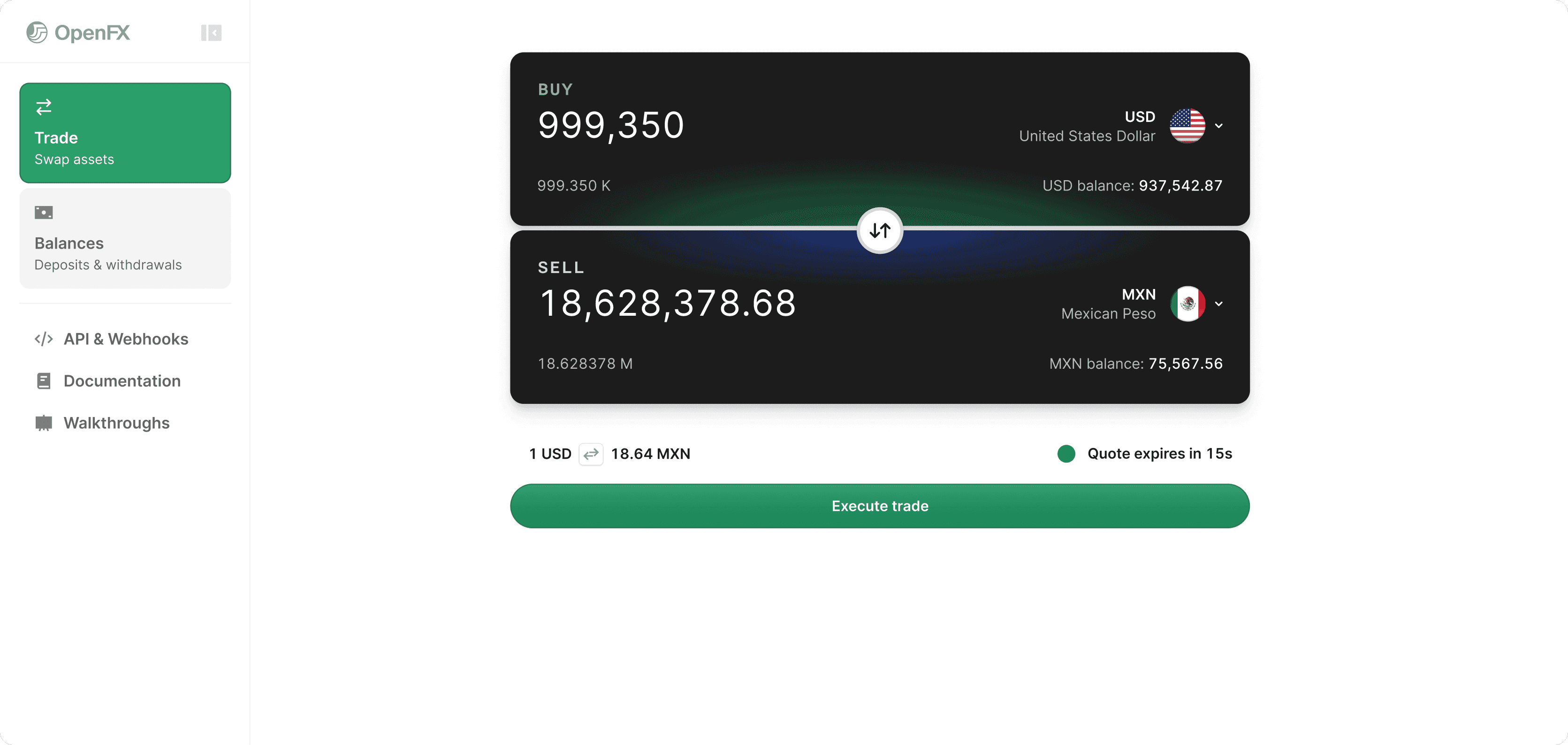
OpenFX trading interface.

FX liquidity available 24/7

Settle multiple times a day. Withdraw in under 60 mins.

FX liquidity available 24/7

Settle multiple times a day. Withdraw in under 60 mins.

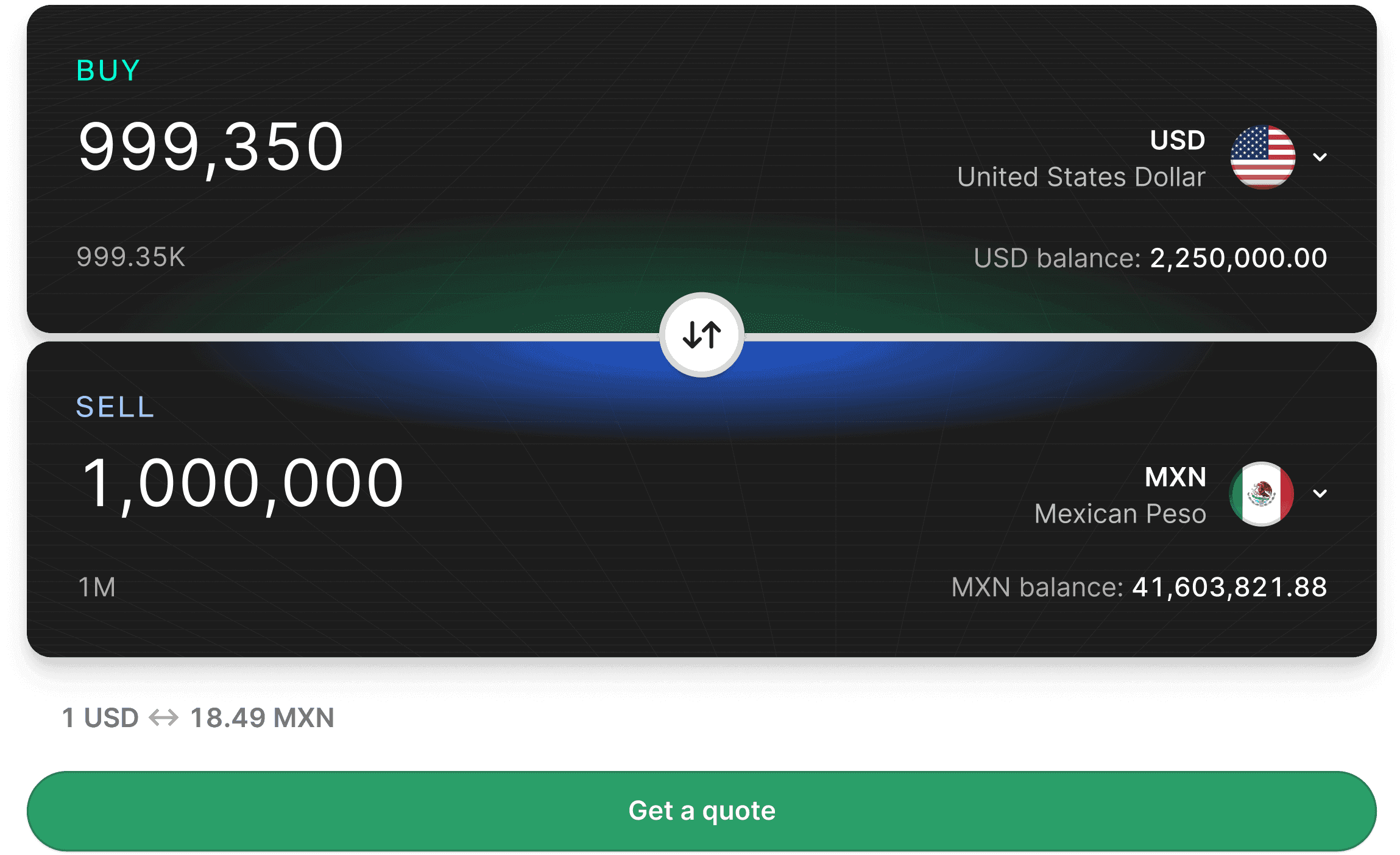
OpenFX trading interface.

Ask AI about OpenFX

Global network

Teams operating across North America, Europe, Middle East, and Asia

Operating Hours

We never close. Our platform and
support teams are available 24/7/365

Write to us

Red Envelope Delta, Inc, NMLS ID No. 2680829
All rights reserved, © OpenFX 2026.

Ask AI about OpenFX

Global network

Teams operating across North America, Europe, Middle East, and Asia

Operating Hours

We never close. Our platform and support teams are available 24/7/365

Write to us

Red Envelope Delta, Inc, NMLS ID No. 2680829
All rights reserved, © OpenFX 2026.

Ask AI about OpenFX

Global network

Teams operating across North America, Europe, Middle East, and Asia

Operating Hours

We never close. Our platform
and support teams are available 24/7/365

Write to us

Red Envelope Delta, Inc, NMLS ID No. 2680829
All rights reserved, © OpenFX 2026.