Summary
Liquidity is often reduced to a single question: is there enough money available? In cross-border payments, that is only the beginning. A currency can be available but difficult to trade at the size you need. A competitive quote can disappear before execution. A fast transfer can still leave the recipient waiting.
Stablecoins change how value moves, but they do not remove the need for FX conversion, compliance, local banking access, and reliable delivery. A wallet-to-wallet transfer is one step in a payment—not proof that usable money has reached its destination.
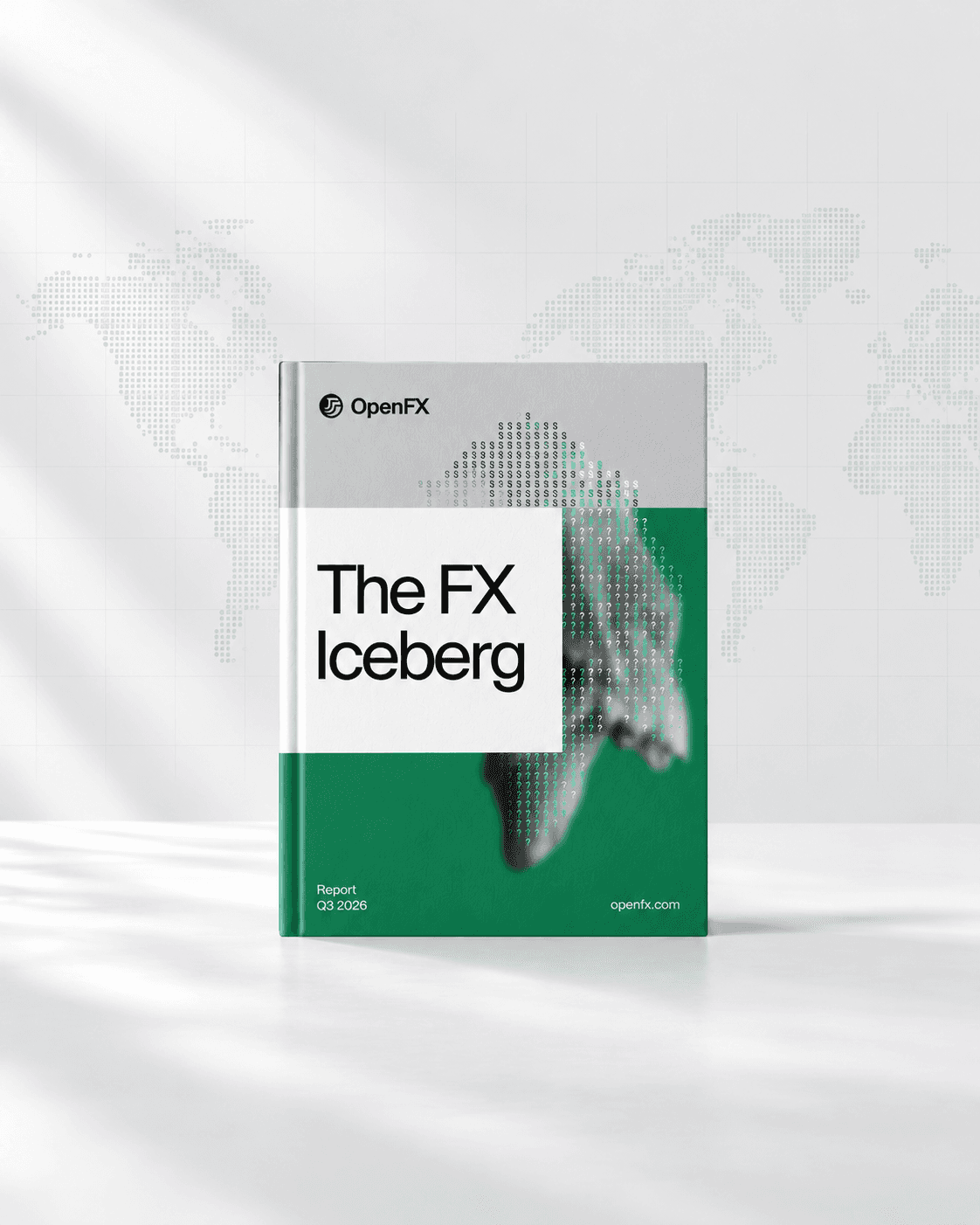
The FX Iceberg looks beneath the visible transaction to examine the operations and infrastructure that make money movement possible. Across three acts, we explore why liquidity varies across markets, introduce a six-part Liquidity Scorecard for evaluating provider claims, and examine what institutions must build to deliver reliable outcomes.
The test is straightforward: can the system move the amount required, at the expected price, and deliver usable money reliably?

What You'll Find Inside
Three acts trace liquidity from market structure to measurable performance to the infrastructure underneath. These six highlights show what that means in practice.
Act I
The Current State of FX
Why deep global FX markets coexist with constrained local corridors—and how transaction size, market access, and settlement infrastructure change what liquidity can actually do.
Act I
Two Architectures, One Transaction
Follow an illustrative $50 million payment from the United States to Colombia through correspondent banking and stablecoin rails. See what changes, what moves elsewhere, and what still has to work.
Act II
The Liquidity Scorecard
Evaluate liquidity through six measures, from spread consistency and execution quality to settlement under load. See whether performance holds as transaction size and market conditions change.
Act II
What You Have to Ask Your Liquidity Provider
Turn claims about tight spreads, deep liquidity, and fast settlement into specific requests for evidence—at your transaction sizes, in your corridors, and under the conditions you actually face.
Act III
Liquidity Is a System
See how funding, compliance, transfer, FX conversion, and destination delivery depend on one another—and why high-quality liquidity has to be built corridor by corridor.
Act III
What High-Quality Liquidity Requires
Go beneath the payment to the banking relationships, market access, liquidity pools, compliance systems, and technical infrastructure that support each stage of a reliable transaction.
A fast transfer is not the same as a completed payment.
Our Point of View
Liquidity is a system, not a balance. Available money is only useful when it can be converted, transferred, and delivered. High-quality liquidity depends on the operations and infrastructure that make all three possible.
Transaction size changes the answer. A market that looks deep for a small payment can become expensive or unreliable at institutional scale. Performance has to be tested at the sizes customers actually trade.
Stablecoins change the architecture, not the destination. Moving tokens faster is valuable, but the payment still needs usable funding, executable FX, compliance, and delivery into the recipient’s local bank account.
Provider claims need transaction-level evidence. Tight spreads and fast settlement are starting points for questions, not proof of performance. Ask how prices, execution, and completion behave across size, time, and stress.
Reliable liquidity is built corridor by corridor. Banking relationships, permissions, local currency capacity, and payout systems cannot be assumed. They have to exist before the payment arrives.
Better software cannot replace missing capacity. Automation can coordinate routes, manage inventory, and help resolve exceptions. It cannot create local liquidity or a viable payout route where none exists.