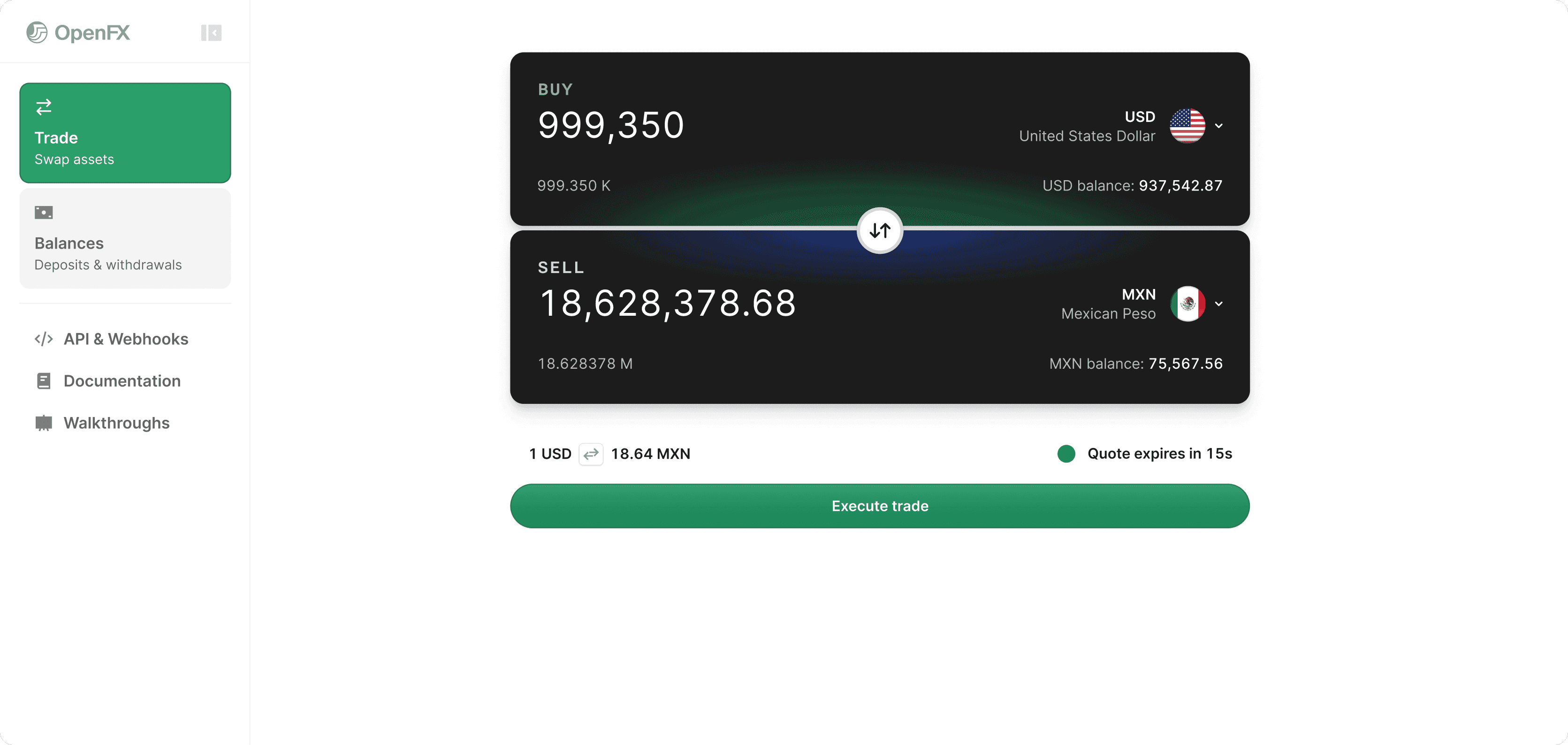
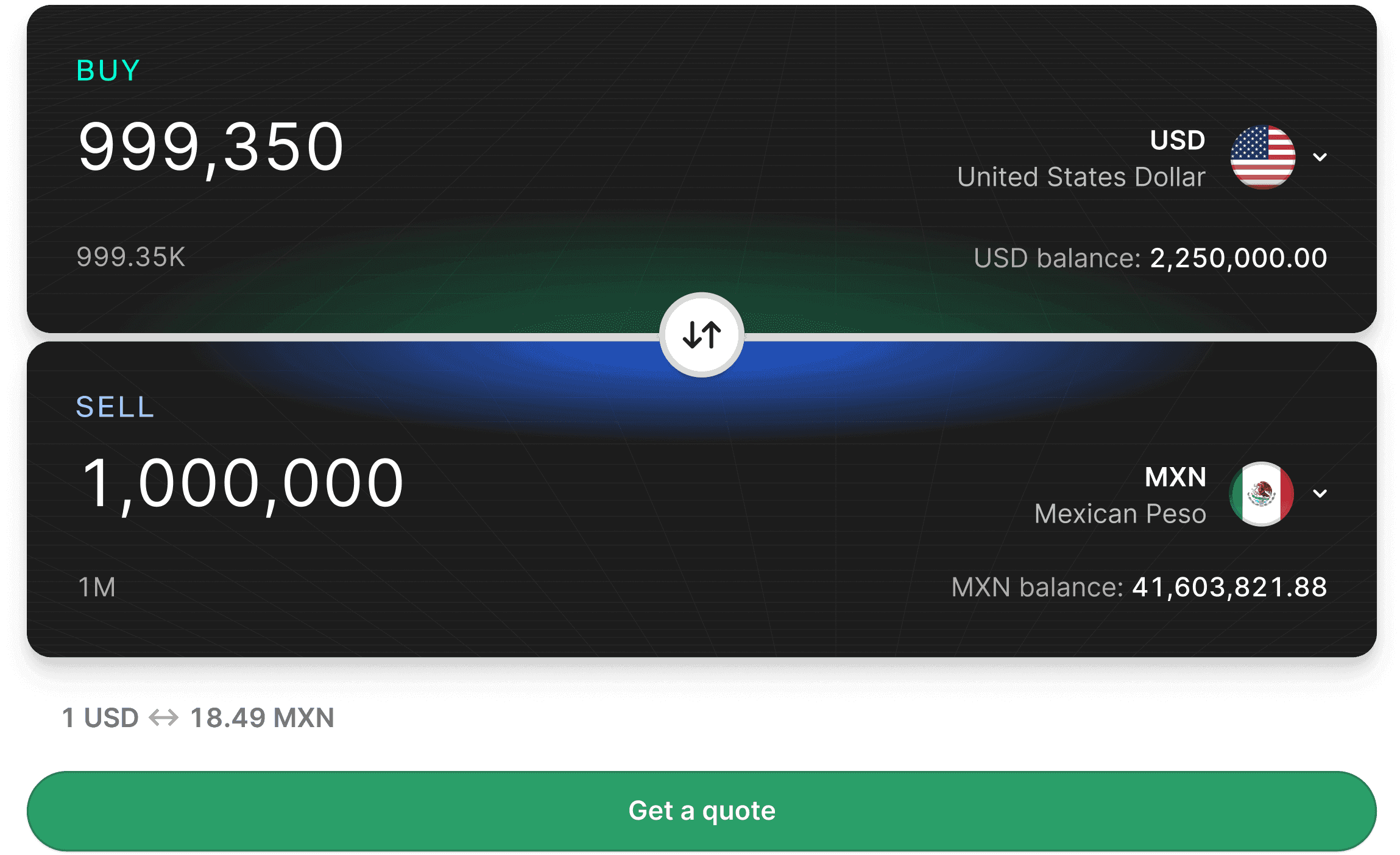
Understanding The USD to MXN FX Corridor

Catherine Kaupert
,
Head of Latin America

The United States and Mexico share the largest bilateral trade relationship in Latin America. Roughly $872.8bn in goods crossed the border in 2025. The peso handles this volume through a deep, continuously priced FX market with about $153bn in daily turnover, roughly 80% of that offshore.
USD->MXN is the only corridor in the region where both sides of the FX trade settle through CLS, eliminating Herstatt risk. The country levies no FX tax and has no substantial capital controls affecting cross-border FX. The domestic instant-payment system (SPEI) operates 24 hours a day and settles in seconds, meaning that the operational constraints in this corridor generally sit on the dollar side.
This document walks a $10M USD->MXN payment through the seven stages of a cross-border transaction, explains how Mexico's payment rails work, and covers intra-regional pairs that route through the dollar.
Corridor at a glance
Currency | Mexican Peso (MXN) |
Regime | Free float, no capital controls, no FX tax |
CLS | Yes (the only Latin American CLS currency) |
Market depth | ~$153bn/day, 14th globally, 3rd among emerging markets; ~82% offshore |
Spot | ~17.2 per USD (mid-June 2026) |
12-month range | ~17.1–19.3; peso +9% |
Domestic instant rail | SPEI (24/7, seconds) |
Dollar system | SPID (8:00–14:15 Mexico time; no central-bank dollar liquidity) |
Regulators | CNBV, Banxico |
Corridor scale | ~$872.8bn in bilateral goods trade (2025, BTS) |
How the rails work
SPEI (Sistema de Pagos Electrónicos Interbancarios) is Mexico's domestic instant-payment system. It clears interbank transfers in seconds, around the clock, every day. The peso leg of any cross-border payment lands here.
SPID (Sistema de Pagos Interbancarios en Dólares) handles dollar-denominated transfers within Mexico. It operates in a short, daily window, 8:00 to 14:15 Mexico time, timed for AML processing on the dollar leg. Banxico provides no dollar liquidity through SPID, banks must fund their dollar obligations through US correspondents.
CLS (Continuous Linked Settlement) settles both sides of a USD/MXN trade simultaneously, payment-versus-payment, eliminating the risk that one side of the trade pays while the other fails. Eighteen currencies worldwide are CLS-settled, the peso is the only one in Latin America.
Who regulates this corridor
Banxico (Banco de México), the central bank, sets monetary and FX policy and oversees the country's payment systems, including SPEI and SPID.
CNBV (Comisión Nacional Bancaria y de Valores), an arm of the Finance Ministry, licenses and supervises banks and brokerages directly. It's the compliance layer a cross-border payment actually answers to on the Mexican side.
Anatomy of a USD -> MXN payment

1. Fund the source leg
The US company's bank debits its dollar account.
2. Carry the instruction
The bank dispatches a pacs.008 message (the ISO 20022 standard that replaced the MT103 in November 2025) over SWIFT to its correspondent. The message identifies the beneficiary, the amount, and the fee-bearing code (typically SHAR: asserting that the sender covers its own bank's charge, and subsequent fees are deducted from the payment).
3. Convert the currency
The correspondent executes the FX conversion at a spread over the mid-market rate. USD/MXN is a deep, liquid pair with continuous pricing, these spreads on an institutional trade typically run a few basis points. The correspondent carries the rate risk between trade agreement and settlement.
4. Source the destination liquidity
Because the peso is deep and CLS-settled, the correspondent's MXN liquidity position is straightforward. CLS nets multilaterally: each participant's obligations across all CLS currencies are netted down to a single funding requirement per currency, reducing the capital that must be pre-positioned by over 96%.
5. Clear compliance
The originating bank screens the payment against its sanctions and AML obligations.
The correspondent screens it again, including an OFAC check on the USD leg.
CNBV requirements apply on the Mexican side.
6. Reach settlement finality
The USD/MXN trade reaches finality through CLS.
7. Pay out on the local rail
The peso leg lands in SPEI, which credits the beneficiary's account in seconds. The payment is complete.
Net. The cost of the transaction is approximately the FX spread plus correspondent fees.
When the pair is not USD
Almost no direct FX market exists between Latin American currencies. 98% of Mexican peso trading is against the dollar. A EUR->MXN, GBP->MXN, or any other intra-regional pair (BRL->MXN, COP->MXN) will route through the dollar in almost every case. This doubles the required conversion and the compliance screening.
For intra-Latin American trades the scenario is the same. A BRL->MXN trade, for example, must first pass through USD, every step in the process is repeated for both legs.
The BRL leg (or any other regional currency) also carries full correspondent settlement risk because it does not belong to CLS.
The one partial exception are countries that belong to the SML, the Mercosur local-currency settlement system, which settles directly in local fiat. Mexico is not part of the SML.
FAQ
Why T+2 and not same-day?
T+2 is the standard FX spot settlement convention for USD/MXN. CLS settles on the value date, not the trade date. It eliminates settlement risk on that date, but does not shorten the settlement cycle itself. Banks can advance commercial payments to T+1 when both sides' compliance and funding are in order.
What is the CLS settlement window in Mexico City time?
00:00 to 05:00 CST (07:00–12:00 CET). Funding pay-ins from CLS members must be completed within this window. The peso leg settles in SPEI once the CLS cycle completes.
What happens if my payment misses SPID's 14:15 cut-off?
The dollar leg waits until the next business day. There is no after-hours window and no central-bank dollar liquidity through SPID.
My counterparty banks through CIBanco, Intercam, or Vector: what do I do?
The FinCEN designations took effect 20 October 2025. US financial institutions are barred from fund transmittals, including virtual currency, with these three banks. If your Mexican correspondent or beneficiary routes through any of them, the payment chain needs to be restructured.
Does the 1% US remittance tax affect institutional flows?
No. The excise tax applies to cash, money orders, and cashier's checks. Bank- and card-funded transfers are exempt. Institutional flows are bank-routed and fall under the exemption.
How much of the MXN market trades onshore?
About $28bn a day, against a global total near $153bn. Roughly 80% of MXN trading is offshore. Onshore trading is almost entirely (98%) against the dollar and about 89% electronic.
Share article
Read other articles
Stay informed with our latest articles on currency launches, institutional FX trends, and global liquidity.