Understanding The USD to COP FX Corridor

Catherine Kaupert
,
Head of Latin America

The United States and Colombia share roughly $37.2bn in bilateral goods trade. The peso trades about $7.3bn a day onshore, almost entirely against the dollar, through a "channeled" (canalizado) FX market in which all foreign-exchange operations go through authorized intermediaries and are reported to the central bank. There are no substantive capital controls that affect FX transactions.
The defining cost in this corridor is the GMF (Gravamen a los Movimientos Financieros), a 0.4% tax on financial movements. Unlike Brazil's IOF, the GMF is fixed and does not vary by transaction classification, but it can apply more than once depending on how funds move through a payment chain. Forwards cluster at the short end: about half settle within a month and over 80% within three, so hedging beyond a quarter draws on a thinner market.
This document walks a $10M USD->COP payment through the seven stages of a cross-border transaction, explains how Colombia's payment rails work, and covers intra-regional pairs that route through the dollar.
Corridor at a glance
Currency | Colombian Peso (COP) |
Regime | Free float, no capital controls |
CLS | No |
Market depth | ~$7.3bn/day onshore; 30th globally |
Spot | ~3,440 per USD (mid-June 2026) |
12-month range | ~3,420-4,210 |
FX tax | |
Policy rate | 12% (late June 2026) |
Domestic instant rail | Bre-B (live Oct 2025, 24/7) |
Large-value RTGS | CUD |
Regulators | SFC, BanRep |
Corridor scale | ~$37.2bn in bilateral goods trade |
How the rails work
Bre-B is Colombia's instant-payment system, live since October 2025 with tens of millions of registered users. It operates around the clock. It is domestic-only.
CUD (Cuentas de Depósito) is the central bank's real-time gross settlement (RTGS) system for large-value interbank transfers. Cross-border settlements clear through CUD within Bogotá business hours.
No CLS. The peso is not a CLS currency. A USD/COP trade settles through correspondent banking, with each side settling independently. Bogotá and New York banking cut-offs do not fully overlap so some care should be taken to remediate counterparty risk.
Channeled market. All FX operations go through authorized intermediaries (banks and licensed FX houses) and are reported to BanRep and the SFC.
Who regulates this corridor
BanRep (Banco de la República), the central bank, sets monetary policy and is, by constitutional mandate, Colombia's main authority for foreign-exchange regulation.
SFC (Superintendencia Financiera de Colombia) is the integrated supervisor for banks, securities, and insurance, operating as a technical body under the Ministry of Finance. It's the compliance layer a cross-border payments Colombian correspondent actually answers to.
Anatomy of a USD -> COP payment
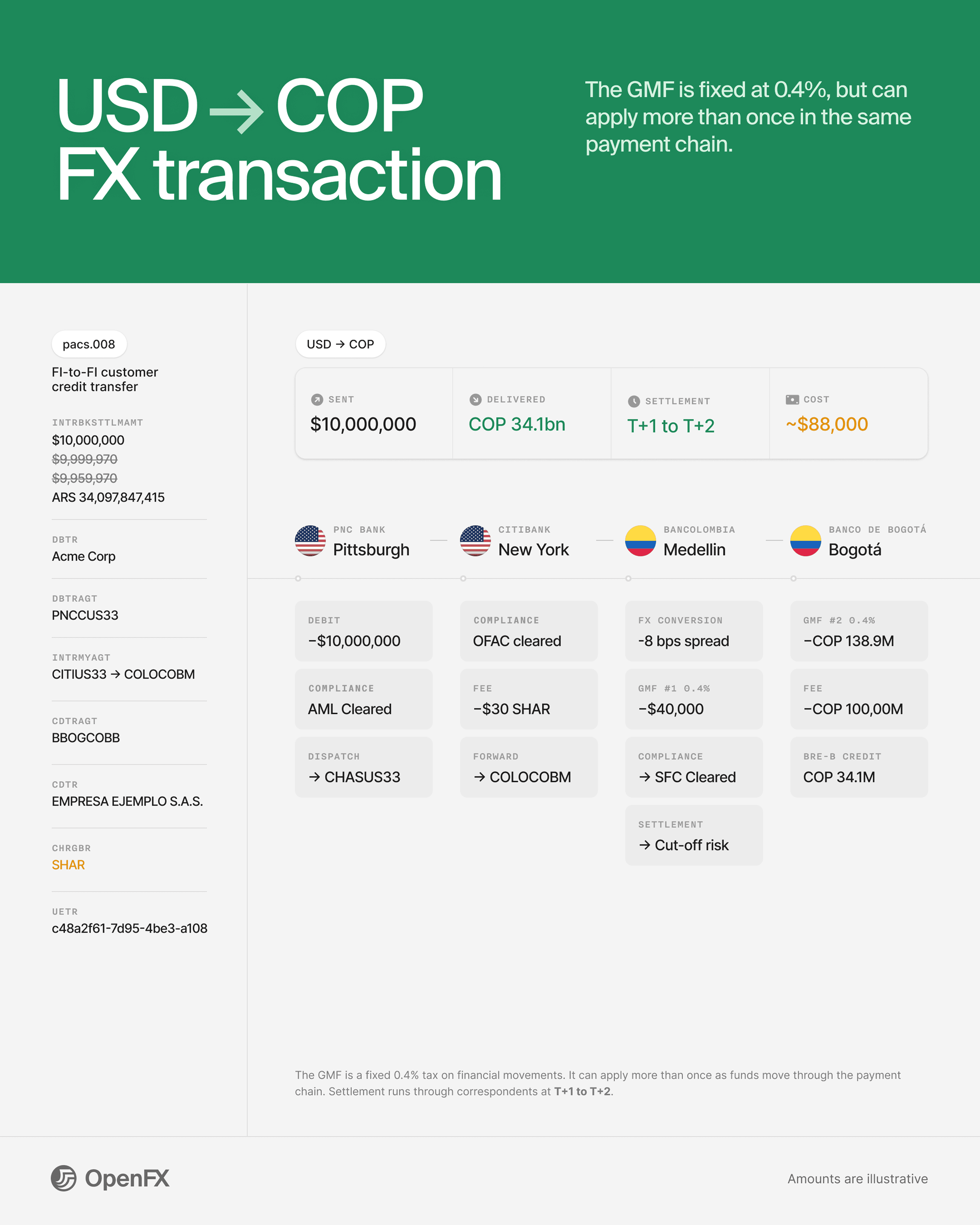
1. Fund the source leg
The US company's bank debits its dollar account.
2. Carry the instruction
The bank dispatches a pacs.008 message over SWIFT to its US correspondent, identifying the beneficiary, the amount, and the fee-bearing code (typically SHAR: asserting that the sender covers its own bank's charge, and subsequent fees are deducted from the payment).
3. Convert the currency
The FX conversion happens at or through the Colombian correspondent. The spread on a $10M institutional trade runs roughly 6–10 basis points. The 0.4% GMF is levied and can potentially apply on both the FX conversion and the subsequent domestic transfer. At 0.4% on a $10M operation, a single GMF charge is $40,000.
4. Source the destination liquidity
The Colombian correspondent pays out from its prefunded COP position. If the nostro balance is short, the payment waits or draws intraday credit.
5. Clear compliance
The originating bank screens the payment.
The US correspondent runs the OFAC check on the USD leg. Because USD/COP is a direct pair, the screen fires once.
The Colombian correspondent runs SFC compliance.
6. Reach settlement finality
Funds settle through correspondent banking. Weekends and holidays in either country will extend settlement from T+1 to T+2.
7. Pay out on the local rail
Bre-B can credit the beneficiary's account 24/7, CUD handles large-value settlements within standard business hours.
Net. Cost on this corridor is the GMF plus the spread plus correspondent fees. The GMF is typically the largest line item. Spot convention is T+2; commercial payments can settle T+1 within Bogotá cut-offs.
When the pair is not USD
Almost no direct FX market exists between Latin American currencies. COP trades almost entirely against USD. A EUR->COP, GBP->COP, or any intra-regional pair routes through the dollar, doubling the conversion and the compliance screening.
Because intra-regional liquidity is too thin for most Latin American currency pairs to trade directly, a payment between two regional currencies typically has to route through the dollar as well. Each additional hop adds its own delay, compliance screen, and potential tax application.
FAQ
How does the Colombian GMF work in practice?
The GMF is 0.4% on each covered financial movement. Colombian tax law provides a monthly exemption (350 UVT, roughly COP 18 million or about $5,300 in 2026) for a single qualifying account, but that is immaterial for institutional cross-border payment.
Did the 2026 fiscal turmoil change the tax picture in Colombia?
No. After Congress rejected the 2026 tax reform, the government declared a fiscal emergency and issued several tax decrees. The Constitutional Court struck those down 8–0 in April 2026 and ordered refunds.
Can I use Bre-B for cross-border settlement?
No. Bre-B is domestic-only, cross-border payments run through correspondent banking.
Share article
Read other articles
Stay informed with our latest articles on currency launches, institutional FX trends, and global liquidity.