OpenFX Launches Multi-Currency Accounts For Fintechs

Tyler McIntyre, Head of Banking
,
Head of Banking

Today we are taking another major step towards becoming the world's most comprehensive provider of Embedded FX through stablecoins by opening the waitlist for our multi-currency accounts, allowing clients to hold money closer to the trade, creating faster settlements and a more seamless experience.
It is also my first day. OpenFX has acquired Global Ledger, the company I founded to build accounts and payments for global businesses, and I have joined as Head of Banking to lead this work. Opening the waitlist is the first thing I get to do.
A multi-currency account lets your customers pay you locally in their own currency, and lets you hold what they send until converting suits your treasury needs. We are starting with named USD accounts and will add additional currencies from there.
With these accounts you can send and receive over ACH, Fedwire and SWIFT, paying into and out of more than a hundred countries. Issue a virtual account number to each counterparty and their wires will arrive tagged with who sent them, increasing transparency. The rails on either side do not need to match: hold dollars and send a UPI payment to a supplier in India, or give a counterparty a vIBAN and receive USDC in your wallet near instantly. All of this can be automated through our powerful API.
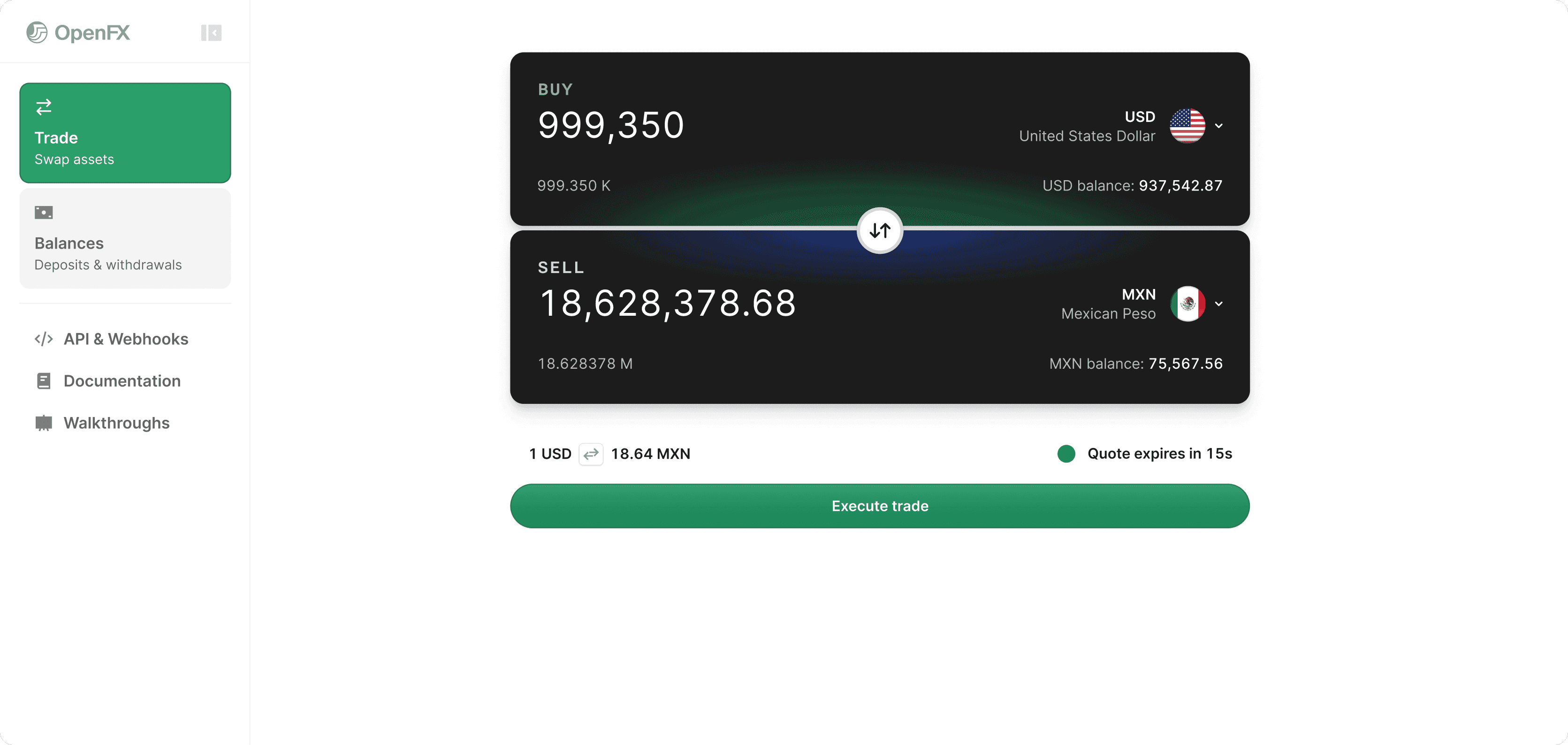
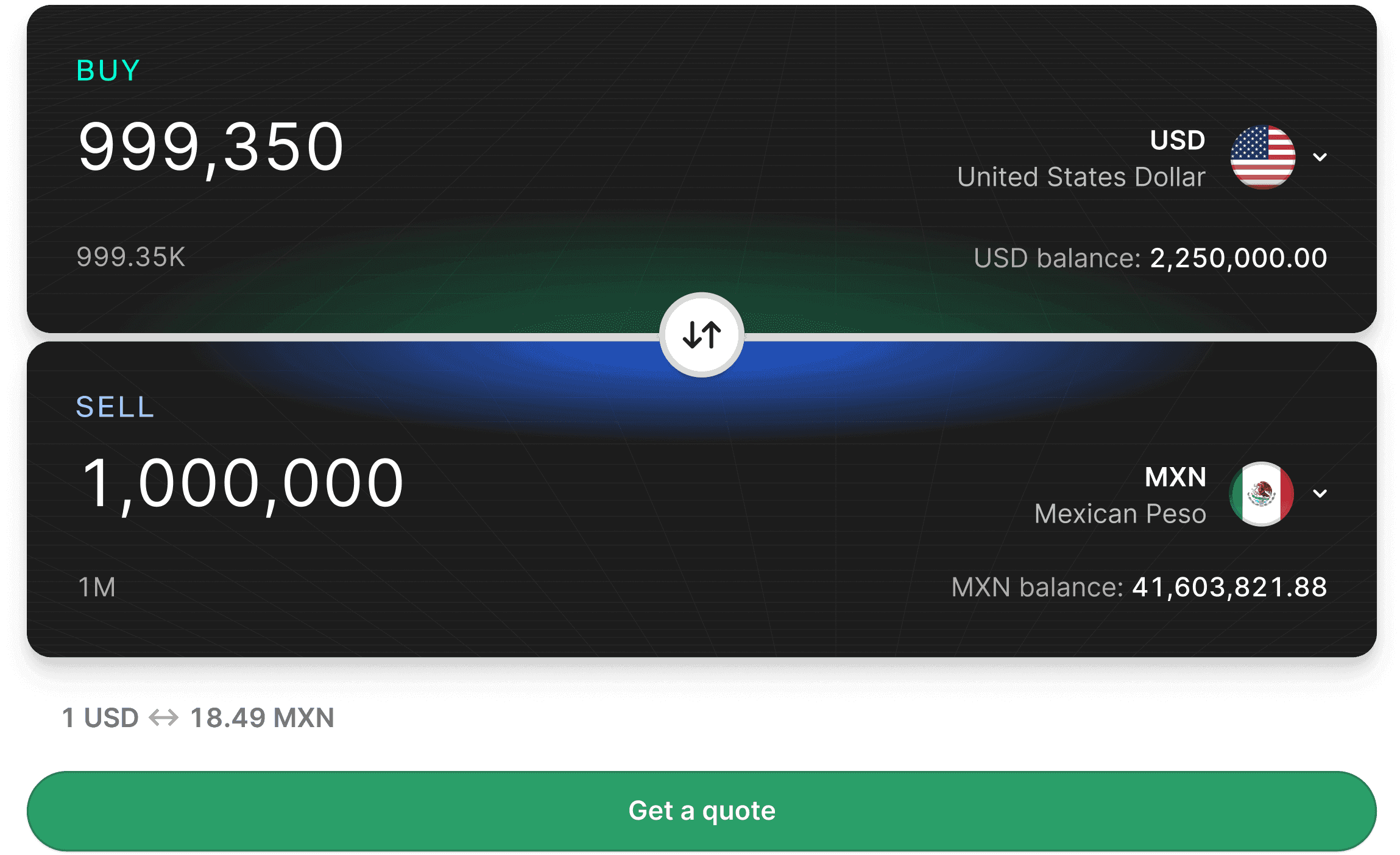
Starting soon, these accounts will sit alongside our liquidity product. Book a conversion and the purchased currency lands in the corresponding account as the trade fills, ready to use.
We built this because for most fintechs, the hardest part of handling money is finding somewhere to keep it.
The de-banking crisis
If you run a payments company that touches digital assets, there is a document you have either received or dread receiving.
It arrives from your bank and tells you that your account will close in thirty days, that a cashier's check will be mailed for the remaining balance, and that this decision is final. It does not explain why. You call, and the person on the other side of the line politely and repeatedly declines to say more.
What happened?
It's difficult to know, because if the closure follows a suspicious activity report, federal law bars the bank from disclosing that the report even exists, all they can say is that your account is closed and you'll need to find another.
Many of the nation's largest banks restricted digital-asset issuers, exchanges, and administrators from banking access between 2020 and 2023, citing financial-crime risk rather than any specific violation.
Whether there were actual reasons for these closures is impossible to know because that was not the criteria being used. A compliance officer looked at a model that did not map to an internal category and made a decision to de-risk.
This is the same problem we've seen in other parts of the FX iceberg, rather than trying to understand a new way of doing things, traditional finance simply excises it.
Irreducible risk
Billions of dollars of FX flow through businesses shaped by this risk.
To manage it, they keep spare banking relationships open, paying maintenance on accounts they hope to never need. They stage money through whichever account will have them, rather than the one that makes the most sense, so a company operating in Colombia might route to a bank in Peru because it is the only one willing to handle the flows.
Even when banks are willing, onboarding can take upwards of a year. This incredible length of time doesn't insulate you from the risks of being sent the letter.
This creates delays and costs that cannot easily be ameliorated ahead of time.
What it costs to live this way
The total cost of cross-border banking is difficult to understand because these institutions rarely lay them out clearly.
Depending on the route and currencies involved, a payment may include an originating bank charge, deductions by correspondents, and an FX cost when conversion is required. The payment charges cannot easily be predicted before funds are sent, and the FX costs are often hidden in an all-in exchange rate.
These rates usually matter far more than the fixed wire charge, a single basis point on a $50 million conversion is $5,000.
Even calculating the remaining costs can become a project. One institution may bill a service under cash management while another divides the same activity across several categories. Standards for electronic bank-fee reporting exist, but coverage and implementation remain inconsistent, leaving many treasury teams to normalize statements and reconcile charges against transaction volumes themselves.
Multi-currency accounts change where these costs arise. A customer can pay through a domestic rail into local account details, avoiding the correspondent-bank route on that collection leg. The funds can then remain in the currency received until the account holder chooses to convert or use them.
This avoids automatic conversion on receipt, allowing the conversion to occur when the treasury team chooses, at a rate disclosed before execution.
It also gives the purchased currency somewhere to settle.
The account I couldn't build alone
I've spent more than a decade thinking about this problem. It was why I founded Novo, a neobank whose mission was to give every American small business a bank account they could rely on, so they could focus their attention on growth. But Novo ended at the border, international flows still had to pass through the same broken system, one where they were expected to maintain multiple banking relationships in every country they operated. Expensive and inefficient.
Stablecoins started to change this, rails that are instant everywhere, always on, and indifferent to geography. I knew that an American-only bank could not solve the problem I really cared about, so I started Global Ledger to build the account those rails deserve: one account for a global business, where moving money between markets feels like moving it between your own pockets.
There was still one problem that needed to be solved, Global Ledger was the banking layer, but where would the required liquidity come from? As it turns out, OpenFX had already built the network I needed, and was moving billions in TPV across it.
It’s rarely efficient to rebuild the wheel, so I decided to join forces with OpenFX, to create a multi-currency accounting platform on top of their world-class rails. One piece of our broader mission to move money like data.
Moving money like data
If my career has taught me anything, it’s that traditional institutions aren’t going to fix the problems in finance. “Traditional” fintechs aren’t going to either, most are built on top of the same rails that have failed most of the world for the last half-century.
Our mission is to move beyond all of this, to create a system where a payment between two of the world's most difficult currencies is as fast as between dollars and euros. Liquidity was the first piece of the puzzle, and multi-currency accounts are the next.
We call it Embedded FX, a fast, reliable, comprehensive solution for end-to-end cross-border payments, aware of the nuances of each corridor, automated through powerful APIs, and as predictable as a text message. A single platform that makes the patchwork of banking relationships unnecessary, so that you can get on with the work of moving money to the places that need it.
The founding one hundred
Switching who manages your money can feel daunting and disruptive, comparing providers is hard to do because the costs are so opaque.
So we are going to pay you to move. The first hundred companies to join our program receive $30,000 in fee credits on us.
You can sign up to our waitlist here.
Tyler McIntyre is Head of Banking at OpenFX. He founded Global Ledger and co-founded Novo.
Share article
Read other articles
Stay informed with our latest articles on currency launches, institutional FX trends, and global liquidity.