Understanding The USD to CLP FX Corridor

Catherine Kaupert
,
Head of Latin America

The United States and Chile shared roughly $38.1bn in bilateral goods trade in 2025. This trade was conducted through a free trade agreement that has been in force since 2004. More recently, in April of 2025, the United States imposed a 10% tariff under IEEPA.
The Chilean peso trades in one of the most developed currency markets in Latin America when controlled for size. Turnover runs at 8.4 times GDP, composed primarily of derivatives. Roughly 90% of the forwards market sits offer and trade NDF.
Chile's FX system can be largely understood through its pension program administered through the AFP. The AFP (Administradora de Fondos de Pensiones) maintains a large, hedged portfolio of international equities. This is why the derivatives market in Chile is so large.
Outside of this, Chile has no specific FX tax. The Dólar Observado is Chile's official reference rate, a weighted average of the previous business day's transactions published daily by its central bank (Banco Central de Chile) This rate is used for taxes and private contracts.
This document walks a $10M USD->CLP payment through the seven stages of a cross-border transaction, explains how Chile's payment rails work, and covers intra-regional pairs that route through the dollar.
Corridor at a glance
Currency | Chilean Peso (CLP) |
Regime | Free float, no capital controls |
CLS | No |
Market depth | FX turnover 8.4x GDP (BIS 2025); NDF-heavy |
Spot | ~890 per USD (mid-June 2026) |
12-month range | ~851–983 |
Domestic instant rail | TEF (real-time since 2008, ~39% account-to-account) |
Large-value RTGS | LBTR |
FX tax | None |
Regulators | BCCh, CMF, Superintendencia de Pensiones |
Corridor scale | ~$38.1bn in bilateral goods trade (2025) |
How the rails work
TEF (Transferencia Electrónica de Fondos) is Chile's domestic instant-payment system. It has been live since 2008, and was one of the earliest to come online in Latin America. Payments clear through the Cámaras de Pago de Bajo Valor, which later nets and settles through LBTR. TEF is domestic-only.
LBTR (Liquidación Bruta en Tiempo Real) is the BCCh's real-time gross settlement system for higher ticket interbank transfers. The TEF uses LBTR as its settlement layer.
No CLS. The peso is not a CLS currency. A USD/CLP trade settles through correspondent banking.
The AFP system. Chile's AFPs manage pension assets.The BCCh caps their foreign asset exposure to 80% of the funds value. Since April 2026, regulators have imposed a 3% limit on derivative exposure. Market hedging in these pension accounts is one source of market liquidity.
Who regulates this corridor
BCCh (Banco Central de Chile), the central bank that sets monetary policy and runs LBTR. It is also responsible for publishing the Dólar Observado reference rate.
CMF (Comisión para el Mercado Financiero) Regulates banks, securities, and insurance. It was formed in 2019 by merging with the former bank superintendency. Chilean correspondents answer to it.
Superintendencia de Pensiones oversees the AFP pension funds.
Anatomy of a USD -> CLP payment
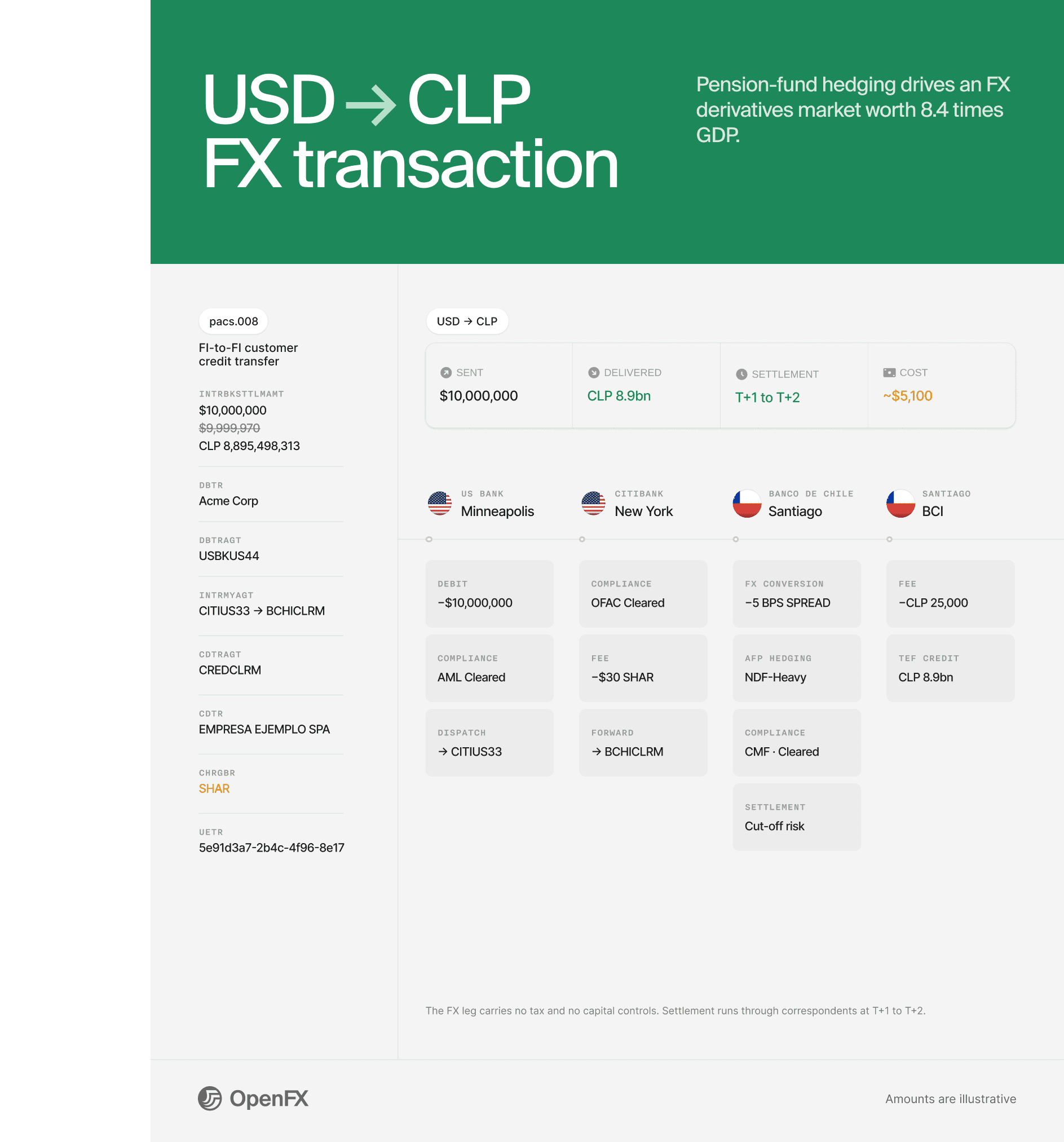
1. Fund the source leg
The US company's bank debits its dollar account.
2. Carry the instruction
The bank dispatches a pacs.008 message over SWIFT to its US correspondent, identifying the beneficiary, the amount, and the fee-bearing code (typically SHAR).
3. Convert the currency
The FX conversion happens at the Chilean correspondent. Chile has a relatively deep FX market relative to most of the rest of the region, so spreads tend to be tighter.
4. Source the destination liquidity
The Chilean correspondent pays out from its prefunded CLP position. If the nostro balance is short, the payment waits or draws intraday credit. Because both the onshore and offshore markets are deep, liquidity is comparatively easy to find relative to other Andean economies.
5. Clear compliance
The originating bank screens the payment.
The US correspondent runs the OFAC check on the USD leg.
The Chilean correspondent runs CMF compliance.
6. Reach settlement finality
Finality is reached through correspondent banking, typically T+1 to T+2.
7. Pay out on the local rail
TEF credits the beneficiary's account, LBTR handles the underlying settlement.
Net. Cost on this corridor is the spread plus correspondent fees. There is no FX tax and no relevant capital controls. Spot convention is T+2; commercial payments can settle T+1.
When the pair is not USD
Almost no direct FX market exists between Latin American currencies. A EUR->CLP, GBP->CLP, or any intra-regional pair (COP->CLP, PEN->CLP) routes through the dollar, doubling the conversion and the compliance screening. Settlement risk also increases.
Chile is not a member of the SML, the Mercosur local-currency settlement system: it's a Pacific Alliance economy, so its intra-regional trade routes through the dollar like the rest of the non-Mercosur region.
FAQ
What is the Dólar Observado in Chile, and does it apply to institutional FX payments?
Not directly. It's a reference rate used for import/export declarations, institutional FX trade uses the live rate instead.
Why is the derivatives market so much larger than the spot market in Chile?
AFP hedging demand, combined with widespread NDF use means most FX activity in CLP takes the form of a forward or derivative rather than spot trades.
Are there capital controls on repatriating funds from Chile?
No. Chile has no capital controls and no FX tax. The currency has been free floating since September 1999.
What changed with Chile’s AFP derivative limits in April 2026?
The BCCh introduced risk-based caps on AFP derivative exposure, along with a taper by fund type:
3% of fund value for the more growth-oriented fund types (A and B)
2.5% for fund C
2% for the more conservative D and E funds
Share article
Read other articles
Stay informed with our latest articles on currency launches, institutional FX trends, and global liquidity.